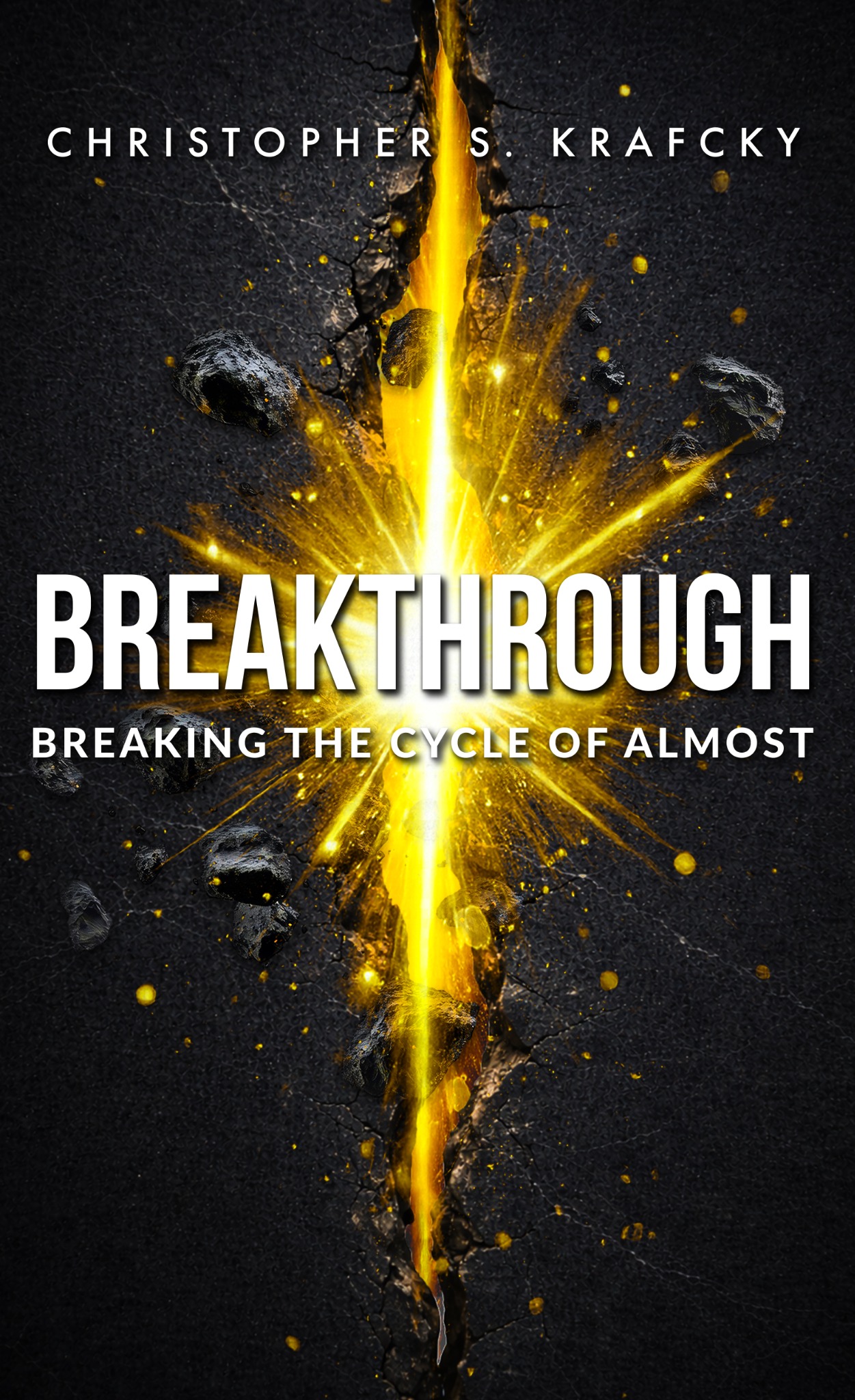
Public preview: Front Matter + Chapter 1 only
BREAKTHROUGH
Breaking The Cycle Of Almost
All Scripture quotations, unless otherwise noted, are taken from the Holy Bible, New International Version® (NIV®). Copyright © 1973, 1978, 1984, 2011 by Biblica, Inc.™ Used by permission. All rights reserved worldwide.
Scripture references are indicated with quotation marks and italics. Book names, chapters, and verses are rendered in bold for clarity and emphasis.
Library of Congress Control Number:
Trade Paperback ISBN:
Trade Hardcover ISBN:
Copyright © 2026 by Christopher S. Krafcky
Cover design by Christopher S. Krafcky
All rights reserved. No part of this publication may be reproduced, stored in a retrieval system, or transmitted in any form or by any means—electronic, mechanical, photocopying, recording, or otherwise—without the prior written permission of the publisher, except for brief quotations used in reviews or scholarly works.
Printed in the United States of America
First Edition, 2026
10 9 8 7 6 5 4 3 2 1
Dedication
For the ones who grew up almost.
For the ones who learned to brace, to scan, to stay near the exit.
For the ones who can function while quietly bleeding.
May you discover you were never destined to live on the edge of belonging.
Preface
This book starts where most breakthrough stories move too fast, in the long exhaustion of living under almost. You’re still standing, still breathing, still functioning, yet something foundational cracked years ago and never fully healed. That’s the danger. Almost doesn’t only disappoint you; it tries to convince you that disappointment is all your life will ever be.
I’m not writing from the kind of redemption arc that wraps everything up neatly and makes the pain look easy to explain. Instead, I’m writing from inside a pattern I had to name before I could begin to break it. That pattern looked like being almost loved, almost safe, almost free, and almost okay. From the outside, it can pass for wisdom, showing up as distance, control, self-reliance, or maturity. Underneath it, though, was a vow my body had learned by heart: I won’t get caught off guard again.
Some of my earliest memories don’t return as clean scenes with a clear beginning, middle, and end. They come back in pieces, as sensations, rooms, tones, and the feeling of something hitting my chest before it ever reaches language. If you grew up safe, a clean timeline may feel natural. That expectation makes less sense when memory arrives in fragments.
What I can offer is honesty, along with a road forward.
One of the hardest lessons of my life has been realizing that the coping skills that kept me alive can become the chains that keep me stuck. Those habits once protected me, then, they started limiting me until almost started offering relief without repair. Distance comes without deliverance. A better cage gets handed to you as though you should call it home.
I don’t believe God authored my captivity, but I do believe He refused to leave me in it. He came in without performance, without pretending the ache wasn’t real, and started prying open what fear had kept shut for years. At times that breakthrough feels like a bursting flood. In other seasons, it feels like a nervous system learning, one day at a time, that the world isn't on fire.
If you’ve lived under almost for a long time, hope may feel risky, and belonging may seem like it comes with an expiration date. You may look fine while still not feeling fully alive. If that sounds familiar, you’re not crazy, weak, or unspiritual. You’ve been trained that way.
This book is an invitation to be retrained by truth, by faith, and by the steady presence of a God who stays.
Acknowledgments
First, I thank God. More than anything, I thank Him not for a polished story, but for a faithful one. He stayed when my body expected abandonment and met me there in the residue, not only in the resolution. Through that faithfulness, He taught me that breakthrough isn’t always dramatic. Sometimes it looks like breath returning, fear losing its authority, and the ground inside a person finally holding weight.
To my wife, Anna, thank you for your steadiness, your patience, and your practical love. You’ve been a living contradiction to the old script that told me good things always leave. Because of your faithfulness, my nervous system has started believing what my mouth could say, but my chest still struggled to trust.
For the counselors, mentors, and friends who sat with me in healing, thank you. You didn’t rush me past the hard parts. By helping me name what I survived, you also helped me stop living there forever.
To you, the reader, thank you for your courage. If you’ve lived under almost, opening this book isn’t casual. It’s an act of defiance. My prayer is that these pages do more than describe pain. May they give you language for your own story and help you believe again that your life doesn’t have to stay on the edge of freedom.
Introduction
For years, I thought breakthrough would be a moment I could point to, a line crossed or a door kicked open, something dramatic enough to prove the old life was over.
My life didn’t change that way.
For a long time, my world was shaped by almost: almost safe, almost wanted, almost settled, almost free. It wasn’t always loud, and it wasn’t always obvious. Sometimes it looked like progress, other times like peace, and sometimes even like maturity. Underneath it, though, the pattern kept saying the same thing: don’t reach too far, don’t trust too deep, and don’t relax because it can all be taken.
That’s what almost does to a person. It teaches your body to stay on alert while your mind is trying to move forward. Then your heart learns to expect abandonment, so leaving first starts to feel wise. Over time, survival skills harden into habits you defend long after they’ve stopped protecting you.
This book isn’t a performance of healing. It’s an honest record of what it looks like when God begins touching the places you’ve organized your life around. That includes the memories, the reflexes, the story itself, and the inner system that learned how to brace.
There are parts of my past I can tell like scenes. Other pieces come back as fragments, a smell, a hallway, a tone of voice, or a feeling in my chest that arrives before words do. If you’ve lived through certain kinds of pain, you already know memory doesn’t always move in a straight line. Sometimes it's a locked room. At other times, it’s a flash. More than once, your body tells the truth before your mouth is ready to say it.
As you read, two things are happening at once. One is what happened to me; the other is what those experiences tried to build inside me. The events mattered, but the meanings they left behind mattered too. So did the vows, the coping, the internal rules, and the ways I learned to measure love, safety, and belonging as though they were always temporary.
I’m writing this for the person who’s done their best to keep going and still feels unfinished. It’s also for anyone who prays, works, serves, and pushes, yet never quite feels that inner unclenching, or who has stood near the edge of freedom so many times they’ve started believing the edge is all they’re allowed to have.
This book is an invitation to name what’s felt normal for too long. It also asks you to recognize the cycle, stop calling it personality when it’s really protection, and stop calling it wisdom when it’s fear dressed in good clothes.
Breakthrough, at least in my experience, is rarely one event. It’s a turning, a new refusal, and a slow, stubborn agreement with truth. God meets you in the places you built for survival and offers you something steadier than hype or denial.
If you’ve lived under almost, I want you to know this: learning to brace didn’t make you defective, adapting didn’t make you weak, and healing slowly doesn’t disqualify you.
You’re still here, and that means the story isn’t finished. Let’s begin.
ALMOST LOVED
WHEN BELONGING FEELS JUST OUT OF REACH
BORN INTO A STORY THAT WOULDN’T HOLD ME
Love felt permanent to some kids. They inhaled it like oxygen, present, invisible, assumed. The adults stayed, the rules stayed, the rooms stayed, and even when life got messy, the foundation held. They didn’t have to learn love’s weight because they never carried the fear of losing it. Childhood like that doesn’t erase pain, but it gives you a baseline: you belong here, and you can settle into it.
My baseline was movement. Before I understood language, my body understood instability. My nervous system learned the muscle memory of being lifted, carried, handed off, examined, evaluated, and shifted again. The earliest pieces of my history don’t read like a story; they read like paperwork, files, case numbers, short notes typed by adults trained to assess survival, not nurture a soul. On paper, the descriptions feel clinical, detached, almost polite, as if a few sentences can hold a whole child.
Real life doesn’t live on the page. It lives in the stomach that knots before you know why, the shoulders that stay braced when the room is quiet, the way a child learns to scan faces before he learns to trust words. I can’t give you a neat beginning with one scene that explains it all. Memory doesn’t cooperate when you start life small and scared, and it doesn’t hand you a clean reel of footage. It offers fragments: fluorescent lights that hum, disinfectant in a hallway, fabric scratching skin, or air too cold for how bright the room is.
People who grew up safe sometimes want details that early, names, dates, a plotline they can map. The instinct makes sense because it turns chaos into something manageable. But the first truths my body learned weren’t chronological. They were sensory: cold metal on a scale, adult hands lifting you without asking, keys and clipboards, or a door that closes and leaves you inside a room you didn’t choose. Even now, when I reach back that far, what comes forward isn’t a clear story. It’s the feeling of being moved like an object inside a process.
One house tried to anchor itself in my mind, not because it was perfect, but because it lasted longer than everything else. Faces didn’t stay the way movies portray memory, as if the brain stores close-ups forever, and full conversations didn’t hold either. My mind latched onto shapes, colors, temperature, the way a drowning person grabs whatever floats. Something red. Something blue. Time that didn’t collapse under my feet.
In that place, stability lasted long enough for my body to change posture. Hunger shifted from panic to expectation, and sleep went a fraction deeper. The air smelled more like food than chemicals, and silence didn’t feel like a warning. When you’re little, you don’t call that peace. You just notice your chest isn’t clenched every second, that your hands are less fisted, that you can play without waiting for the next adult to announce the next move.
Then it ended. Not because I broke, and not because I failed. It ended because the system moved, paperwork changed, and some adult, somewhere, signed something that redirected my life. The illusion of permanence vanished again, and no one held a ceremony for the loss. There was no funeral for “almost belonging,” no room where someone explained, gently, what was happening and why. Adults call it placement and transition, policy and procedure. A child experiences it as disappearance.
That kind of ending installs rules. It doesn’t announce them like commandments; it threads them into your bones. Don’t relax. Never trust too deeply. Don’t assume anything will last, and never lean all the way into good, because good has a history of leaving. Those rules don’t stay in childhood where they belong. They follow you, wearing the costume of personality, maturity, “I’m just careful.”
Adoption came later, and from the outside it sounds like salvation, the part of the story where people exhale and say, “Finally, everything is okay.” Adoption can be beautiful, even holy. It can rescue children from instability, and I believe that without hesitation. But adoption isn’t a magic trick. A signature can change your legal status in a day; it can’t rewrite the nervous system overnight.
I can still picture the kind of room where forever gets declared. Not my specific room, but the familiar ingredients: fluorescent lights, a desk with papers stacked neatly, adults shifting in chairs, the faint smell of coffee and old carpet. People smile because they’re supposed to. Words like “finalized” and “official” float in the air, and somewhere a child wonders what those words will cost if they don’t hold. If you’ve never lived through almost-belonging, you hear “forever” and feel comfort. But if you have, your body hears “forever” and quietly asks, How long is that supposed to mean?
Children who grew up almost loved don’t become secure because adults sign a document. They walk into permanence with suspicion under the ribcage. They might look calm on the outside, but their bodies keep watch, and their hearts keep record. Survival instincts don’t clock out because a judge bangs a gavel. They stay on duty, reading tone, reading silence, reading subtle shifts that signal danger before danger has a name.
Inside that home, love existed, and so did something else. Something stricter. Security came with conditions, and provision came with pressure. Approval felt measurable, like something you could earn and lose. As a child, you don’t have language for that atmosphere; you just learn to become fluent in it.
Footsteps can teach you more than lectures. A certain cadence in the hallway tells you whether you’re allowed to breathe, and the sound of a cupboard closing too hard becomes a warning, the same way a voice saying your name with a particular edge changes your whole-body temperature. So you adjust your face before you speak, shrink yourself when you sense the room tightening, and learn to be good in ways less about character and more about survival.
The old whisper returned, not as panic, but as a hum under everything: This might not last. Be careful. Don’t assume you’re safe just because you’re fed, and don’t assume you’re wanted just because you’re here. A child can live under a roof and still feel homeless, can be adopted and still feel like a guest who might overstay his welcome if he breathes wrong.
Wounds come in layers. Some cut skin while others bruise muscle, and the deepest ones rearrange identity without ever announcing themselves with blood. They rewrite the definition of family and turn “home” into a fragile idea instead of a place. When the words came later, when I was told, as a teenager, that the people who had promised forever no longer intended to keep it, that I was being returned, dismissed, unclaimed, those words didn’t just shatter trust. They rewrote the blueprint of what love meant.
People imagine one dramatic scene, a shouting match, a door slammed. Sometimes the ending is quieter than that, and that’s what makes it colder. Administrative sentences can carry the weight of a verdict. An adult can say something life-altering with the same tone they use to talk about groceries. The message still burns; you were almost family. Almost worth the effort. Almost worth the inconvenience. Almost.
That’s the moment “almost” becomes more than a theme and turns into an identity someone tries to hand you. “Almost loved” doesn’t always feel dramatic; it feels like living with emotional bags half-packed, like planning for the floor to tilt, like hoping carefully, loving cautiously, believing cautiously, existing cautiously, because the worst pain isn’t the first abandonment. It’s the repetition of it.
Most people never see that part. They meet the grown-up, the functioning adult who can speak clearly, work steadily, create, minister, dream, build, and encourage. Competence gets read as wholeness, and capability gets mistaken for peace. What nobody realizes is how easy it is to run your life like a well-oiled machine while carrying fractures inside that quietly dictate how close you’ll let people get.
Functionality can be a costume you tailor out of necessity, seams hidden on purpose. You learn to smile while your insides brace, to be grateful for the resilience you built because resilience kept you alive. Yet resilience has a birthplace, and it’s rarely comfort. Resilience grows when love becomes conditional, and belonging becomes temporary.
“Almost loved” shapes you over time. It doesn’t only leave you afraid of abandonment; it trains you to expect it, sets your relationships to default distance, and can even slip into your relationship with God as a quiet suspicion that He might eventually do what people have always done, leave. Not because you don’t believe, but because your body learned early that leaving is what love does.
That belief traveled with me long before I could name it. Part of me stayed attached to the idea that I was always one step away from being too much, too complicated, too disappointing to keep. I didn’t always say it out loud. It showed up as hesitation, as over-explaining, as needing to prove my worth before I relaxed into connection.
This book begins there, not in victory and not in polished redemption. It begins where most “breakthrough” conversations skip too quickly: the part where you’re exhausted from decades of almost. You’re still standing, still breathing, still functioning, but you know something foundational cracked years ago and never fully healed. The danger of almost is that it doesn’t only disappoint you once; it tries to convince you that disappointment is your destiny.
Almost isn’t only a childhood word. It can become a rhythm that repeats in relationships. You circle the edge of good things, almost committing, almost trusting, almost receiving, then pull back before it can hurt again. That cycle looks like wisdom, but underneath it’s a vow: I won’t be caught off guard. Breaking the cycle begins when you name that vow and question who taught you to live by it.
Even so, a quiet defiance refused to die under all of it, a stubborn insistence that more was possible. That whisper didn’t sound like fireworks; it sounded like a question I kept returning to, even when I didn’t recognize it as a prayer: What if love isn’t supposed to be this fragile? What if belonging isn’t supposed to be this conditional, and my story contains more than survival?
That’s where breakthrough starts. Not with a sky-splitting miracle and not with instant resolution. It starts when a conviction inside you, however faint, refuses to surrender the belief that “almost” isn’t all you were designed to receive. That refusal is small, but it’s not weak. It’s the first crack in a wall that has been acting like it owns you.
God enters this story the way He often does, without theatrics and without pretending the ache isn’t real. Scripture later reveals Him as the One who breaks open the way, the One who refuses to coexist with captivity forever. Before we rush toward victory, we sit here in the residue. For some of us, the first battle isn’t external. It’s the belief that almost is all we’ll ever get.
WHAT “ALMOST LOVED” DOES TO A SOUL
The hardest part of almost loved isn’t the moment it happens. It’s what it teaches your heart afterward. Instability doesn’t just hurt; it tries to disciple you. Childhood leaves beliefs and installs scripts you don’t remember agreeing to, and those scripts start narrating your life with the confidence of truth.
One script says, “Hold good things loosely.” Another says, “Expect people to leave.” A third whispers, “Don’t need anyone too much.” They don’t explain their reasoning. They just install it. These aren’t philosophies you choose; they’re survival strategies your body adopts. They can look like wisdom from the outside, but on the inside, they keep pain from repeating at full volume.
The tragedy is that these strategies work. They keep you from being crushed again, but they also prevent you from being fully held, shielding you against heartbreak while quietly blocking intimacy. You can build a whole adulthood on top of those strategies and call it independence. Nobody will challenge you because it looks strong. Meanwhile, the child inside you keeps living half-packed.
People raised in almost never walk confidently into love. We enter gently, cautiously, like someone testing the weight limit of a bridge, expecting cracks more than grounded life, no matter how much we don’t want to feel that way, how clearly we know it isn’t healthy, or how deeply we trust God. Trauma doesn’t always care what you understand theologically; it lives in the nervous system, not the intellect. You can’t reason it away. It lives in the bones.
That’s why this subject can be uncomfortable inside faith circles. Christianity is famous for rushing toward resolution. We love verses about victory, testimonies with clean arcs, skipping to the part where God restores everything, and the audience claps. Yet Scripture doesn’t skip like we do. The Bible sits inside ache longer than we’re comfortable with, refusing to clean pain up for presentation. Instead, it records pain, dignifies it, and shows that some seasons feel like endless waiting rooms and repeated disappointments.
Micah spoke to people who knew that hallway. They weren’t naïve or casual about God; they were exhausted. They’d been used, exploited, and manipulated by leaders who should've protected them, tasting hope only to watch it evaporate. They lived through cycles of almost, almost restored, almost safe, almost delivered, and every time the future seemed to open, another collapse followed. Trust stretched thin. Faith bruised. Hearts weary.
Micah looked into that kind of community and declared something startling: “The One who breaks open the way will go before them” (Micah 2:13). He didn’t offer them a motivational poster; he offered them a Person who moves first, a God who refuses to let the hallway of almost become their permanent address.
The title He gave God wasn’t gentle encouragement. It was The Breaker, and it feels aggressive, which is exactly why it matters. The picture is forceful in the best way: intervention, disruption, refusal to let captivity become normal.
This isn’t the God who sits politely in your pain while you adapt to chains. The Breaker pushes back what holds you, refusing to cooperate with the narrative that says your wounds get the final word. He doesn’t treat bondage as your personality or trauma as your destiny; He confronts what tried to name you and insists on rewriting what it means.
That matters for those of us raised in almost loved, because we learn to make peace with cages, decorating and normalizing them. “This is just how I am.” We stop calling it captivity and start calling it character. Then Scripture interrupts our coping and introduces a God who won’t sign the paperwork declaring our damage permanent.
Micah said the Breaker goes before His people, and that detail changes everything because the pressure to fix yourself doesn’t rest on you, and breakthrough isn’t self-engineered. The first collision with shame, abandonment, and the scripts governing your identity doesn’t come from you trying harder. It comes from Him moving first.
If you’ve ever tried to out-faith childhood pain, you already know how exhausting that is. You can quote verses over unresolved wounds like bandages over fractures, and then the ache refuses to disappear, and you assume you’re the problem. Micah’s vision interrupts that accusation. Breakthrough isn’t a reward for emotional perfection. It’s divine intervention meeting human fracture.
Hope sounds different when you believe that, not like pretending nothing hurt, but like the quiet conviction that, however long the damage has existed, however permanent it feels, God has no intention of leaving you there. He hasn’t made peace with what broke you or signed a treaty with your trauma.
Before God breaks chains, He does something quieter: He keeps your heart alive long enough to believe freedom is possible. Some people grow up under weight so heavy their hearts harden to survive, and others go numb. Yet in spite of everything, part of me refused to surrender completely to hopelessness. Even when life didn’t feel holy or purposeful, that inner pull still leaned forward.
That “something” wasn’t just personality strength. It was grace, God’s hidden work refusing to let despair finish its job. Breakthrough doesn’t introduce God into our story; it reveals the God who has been here the whole time, preserving what trauma tried to suffocate. Before He opens gates, He refuses to let your spirit die behind them. If He preserved you this long, it wasn’t so you could merely function. It was so that when the time is right, you’d recognize: He never intended almost to be your permanent identity.
Micah didn’t shame exhausted people for their fatigue. He acknowledged their reality and then placed a different reality above it: a God who refuses to coexist with captivity forever. A God who intervenes. That’s where hope begins to rise, not as hype and not as adrenaline, but as the dawning suspicion that your story might not end where it fractured.
LINCOLN AND THE LONG HALLWAY OF ALMOST
Failure doesn’t always push a man out. Sometimes it pulls him inward, into a quieter place where he starts asking himself questions he didn’t have to answer before. Not about effort, but about direction. Not about whether he can keep going, but whether he should. The longer the results don’t line up, the harder it is to ignore those questions. Abraham Lincoln lived in that space long enough for doubt to become familiar, and still didn’t let it decide what he would do next.
Pull back the curtain, and you don’t find inevitability; you find repeated near-successes that could've soured into cynicism. He lost elections, watched hopes collapse, and wrestled with darkness heavy enough that friends worried about him. Near the edge of obscurity, he listened to it whisper, You don’t belong here. Then he kept walking anyway. That’s the part history forgets: the long hallway where you keep moving without applause.
Lincoln knew what almost felt like, almost respected, almost chosen, and almost positioned. Persistence doesn’t feel poetic when you’re living it. It feels like waking up to another day carrying the weight of calling without evidence, like arguing with the voice that says, “Be realistic. Sit down. Stop embarrassing yourself.”
Most people eventually negotiate with almost. They shrink expectations so disappointment hurts less, stop reaching so dreams don’t bruise again, and call it maturity. Sometimes it is. Often, it’s surrender disguised as sophistication, the decision to live smaller because living bigger costs too much.
Every so often, someone refuses to make peace with unfinished redemption. Lincoln wasn’t heroic because success came; he was heroic because almost didn’t convince him to stop. He stretched his life toward something unseen when everything visible told him to accept a smaller truth. Through the eyes of faith, that looks like evidence of the Breaker’s quiet work long before public breakthrough arrives.
Those seasons no one claps for carry their own sacredness, no angelic interventions, no parting seas, just survival and forward breath. That’s why Lincoln belongs here. His story reminds us that almost seasons don’t automatically equal absence of purpose. Sometimes they’re the crucibles where purpose becomes weightier than convenience.
That image of God as The Breaker returns here. Without Him, endurance can become survival without promise. Through Micah’s God, endurance changes meaning and becomes alignment with a God who refuses to let the story end under oppression, shame, trauma, or failure. The Breaker doesn’t abandon the narrative; He moves within it, shaping people in places the world calls waste.
Lincoln endured because his purpose was rooted too deeply to be shaken loose. I endured because a stubborn refusal wouldn’t let almost write my identity. Even before I could explain it, an internal resistance kept pushing back against the script that said: This is all you are, all you get, and where you stay. It wasn’t always noble, and sometimes it was just breath in a body that decided to keep showing up.
A shift happens when you entertain the idea that survival might be evidence of God’s involvement, not proof of His absence. You start noticing moments when despair should've won and didn’t, remembering nights hope should've suffocated and somehow kept breathing.
That realization isn’t breakthrough yet, but it’s the tremor of it. It suggests something beneath your life is moving. The narrative you thought you were doomed to repeat might not have the authority you granted it. Once you see it, you can’t unsee it.
New language starts forming: Maybe I’m not cursed to repeat this. Not permanently broken. Maybe what I survived isn’t the end. Hope doesn’t stand tall yet, but it begins to stir, just enough to question inevitability.
Lincoln’s life proves a hard truth: many significant breakthroughs are born not in the spectacular, but in the stubborn. He wasn’t built in the Oval Office; he was built in obscurity, rejection, grief, and quiet endurance. The presidency wasn’t the creation; it was the unveiling. That pattern shows up in anyone who keeps moving while almost tries to seduce them into surrender.
God often forms in seasons the world labels failure, shaping in years we call wasted. The Breaker doesn’t always announce Himself with dramatic entrance music and sometimes works through unglamorous perseverance, the kind that looks ordinary from the outside and feels impossible from the inside. Pressure mounts, and cracks, even hairline cracks, mean one thing: the wall isn’t as solid as it wants you to believe.
WHEN THE BREAKER REFUSES TO LEAVE YOU THERE
A quiet moment comes, rarely dramatic, when you realize survival isn’t an accident. It isn’t just toughness. Grace held you, something beyond human resilience that kept your heart from hardening completely, your faith from collapsing entirely, your hope from going clinically extinct. Once that truth begins to register, the story shifts. If you were never meant to live, you wouldn’t still be alive. If love wasn’t part of the design, it wouldn’t still ache. And if freedom was never in the plan, something inside you wouldn’t be quietly pushing back against the walls.
Hope doesn’t begin as confidence. It begins as suspicion, suspicion that shame may not be honest, that rejection may not be the narrator, that trauma doesn’t get to be historian, judge, and prophet all at once. The shift sounds small, but it’s a rebellion against almost, the refusal to accept that your life is destined to remain defined by the first wounds that cut you.
This is where God as The Breaker stops being a comforting idea and becomes a dangerous reality. If God goes before His people, forward movement exists, hidden maybe, slow maybe, but real. When He breaks open the way, the walls surrounding your identity aren’t permanent just because they’ve been there a long time. If He leads, your job isn’t to manufacture breakthrough. Your job is to stop calling your chains normal.
At this stage, hope doesn’t have to roar. It just has to stop cooperating with despair, to question the narrative that says, “This is just who I am now,” to allow the possibility that God doesn’t merely comfort loneliness but intends to redefine your understanding of love. Not overnight and not with a single emotional moment. Gradually, deeply, with the kind of craftsmanship trauma rarely receives.
For years, I didn’t call endurance a miracle. Coping, management, functioning, those were the words I reached for. I’d learned to keep the lights on and meet expectations, stay busy enough that old memories couldn’t get traction, carry pain like you carry a heavy bag, adjust grip, keep walking, pretend you’re fine. Yet over time I noticed something subtle: coping shouldn’t preserve tenderness, but mine survived. Functioning doesn’t nurture compassion, but I cared about people more, not less.
Those aren’t the fingerprints of trauma. They’re the fingerprints of grace. Grace doesn’t preserve you merely to keep you breathing; it preserves you because your story doesn’t end where pain tried to fix it in place, and it keeps the tender parts alive so that when the Breaker starts moving, there’s still something in you capable of receiving what He breaks open.
This is the beginning of breakthrough. Not chains exploding and not walls collapsing in cinematic fashion, but the shift that begins internally when your heart stops treating captivity like a habitat and starts recognizing it as an intrusion. You stop asking, “How do I survive here forever?” and start whispering, “What if I don’t have to live here at all?” Endurance transforms from emergency response into evidence that God has been holding your narrative steady while He prepares to intervene.
The soul turns, subtly at first, from resignation toward expectation, from numbness toward sensitivity, from cynicism toward curiosity about healing. Meanwhile, the Breaker doesn’t demand that you sprint toward hope. He leads you toward it, slowly when necessary, gently when needed, firmly when required, always forward, and He doesn’t wait for you on the other side of freedom; He moves into confinement with authority and begins pressing outward from within.
That’s when something inside you stops merely surviving and begins preparing to live differently. You don’t always know how yet, but the soul recognizes oxygen. Hope stands a little taller, and faith breathes a little deeper. The word almost loses a fraction of its authority, not gone and not conquered, but weakening.
This is the turn: the point where the story stops spiraling downward and begins tilting forward. The God of Micah becomes more than theology in a verse; He becomes presence in your actual life. You realize He isn’t simply a sympathetic witness to pain but an active participant in rewriting how your life responds to it. Once a heart recognizes that the Breaker isn’t hypothetical, it stops preparing to live broken forever and starts preparing to follow.
FOR THOSE WHO GREW UP UNCHOSEN
If this were only my story, it might be moving. What gives it weight is that it happens to so many of us in different shapes and seasons. You may have never been carried from house to house, but you may know what it means to live one heartbeat away from disappointment, bracing always, holding relationships far enough away that losing them won’t completely destroy you.
Some wounds don’t need identical details to produce identical scars. Your almost might not involve foster care or adoption paperwork; it might live inside a home full of people where you still felt unseen. Maybe you performed your way into affection, learned early that love comes easier when you’re useful, impressive, obedient, or needed. Or maybe almost loved didn’t look like abandonment but like conditional acceptance, approval that never quite turned into affirmation, being tolerated when you were convenient and corrected when you were human.
If any of that resonates, you already understand this: you can live decades past childhood and still feel ten years old inside when someone doesn’t stay. A delayed reply can feel like rejection, a canceled plan like being chosen last, a small conflict like threat. The adult in you may know better; the child in you remembers patterns. That isn’t immaturity or weakness. It’s residue, early fractures echoing forward, looking for confirmation.
One of the cruelest lies we believe is that surviving means we must be fine, that healing happens automatically with age, that time is medicine. Time is only space. What fills that space determines whether we heal, harden, numb, or quietly collapse inside while our exterior life looks stable. You can build a respectable life on top of unaddressed pain and call it success, but if the foundation is still cracked, the building keeps rattling whenever the weather changes.
If your early life taught you not to trust love, God isn’t offended by your caution, isn’t impatient with your hesitation, and isn’t embarrassed by your triggers. He understands that wounds don’t disappear because we become adults who know better, and He understands that faith doesn’t erase biology, trauma, or nervous systems trained to brace before we ever learned how to pray.
At the same time, He refuses to leave you there. That refusal isn’t a threat but kindness so fierce it can feel unfamiliar. The Breaker doesn’t barge through your heart with violence. He moves with intention, works in layers, doesn’t start with “Get over it” but with “I saw it.” He doesn’t demand instant trust; He proves Himself trustworthy, sitting beside the child in you and refusing to let him or her believe abandonment is identity.
Maybe the most faithful thing you can do right now isn’t chasing a massive spiritual moment. The bravest thing might be telling the truth about where you are. That truth might sound like admitting you’re tired of living emotionally half-packed, recognizing that almost loved shaped how you show up in friendships, marriage, parenting, community, even faith, realizing what you labeled personality is actually protection, naming the cycle for what it is: you reach, you retreat, you hope, you brace, you tell yourself you’re fine, and you quietly wonder why you always feel one step from losing the thing you’re trying to keep.
None of that means you’re broken beyond repair. It means you’ve lived. Living in a world where love sometimes fails and people sometimes leave requires courage you may not even realize you’ve already shown. You didn’t go cold or shut down completely. The part of you that still wants connection, still yearns for belonging, still hopes love exists that won’t vanish when you exhale, that part isn’t weakness. It’s evidence, evidence that you were made for more than the cycle of almost, that your soul knows a deeper truth than your history taught you, that God has been guarding something tender in you that trauma didn’t get to finish.
If He preserved your ability to feel, He didn’t do it so you could keep bleeding quietly while calling it normal. He preserved you because there’s something ahead. This isn’t the part of the story where everything is magically restored. It’s the part where you stop assuming restoration is impossible, let yourself imagine the possibility that your life could become more whole than it has been, and begin, slowly, gently, cautiously if necessary, to lift your head and consider that God hasn’t been letting you drift through darkness for decoration. He’s preserved you because purpose still exists on the other side of your patterns.
If He truly goes before you, then forward isn’t reckless. It’s the first honest direction.
NOT THE CHILD OF ALMOST, THE CHILD OF THE BREAKER
If almost loved was the opening line of your story, it doesn’t have to be the closing one. Childhood may have written the beginning with trembling hands, but God isn’t bound to the tone someone else set for your life. The same God Micah described as The Breaker, the God who goes before His people, the God who refuses to coexist peacefully with captivity, has already proven He doesn’t abandon children in storms and then reappear only when the sky is blue. He steps into damage early, keeps hearts breathing when logic says they should shut down, and holds onto the thread of your humanity long enough to weave something new from it.
The quiet miracle underneath this chapter is simple and stubborn: you’re still here. “Here” may not feel glamorous or triumphant or anything close to victory yet. But here means the story is still moving, means despair didn’t finalize your identity, means something in you survived what should've named you permanently.
When you stand inside that realization long enough, you begin to sense a different future forming. Not a future curated by shame or abandonment or the fragile version of love you first encountered, but by a God who breaks what tries to break you, a God who meets you at ground level and refuses to leave you there.
Breakthrough doesn’t always begin with sound. Sometimes it begins with breath, with the moment you stop treating damage as destiny and recognize that your tenderness didn’t die for a reason, with allowing yourself to believe God’s faithfulness includes the parts of your story you’d rather not revisit.
It begins when the word almost loses its authority to define you. The old voice may still try to speak, but it no longer carries the weight it once did because another voice has entered the narrative, the voice of the One who goes before you, a voice that doesn’t negotiate with captivity, that calls you by something deeper than what happened to you.
Maybe this is the first declaration this book makes over your life: you weren’t almost loved; you were preserved for a love that doesn’t leave. That doesn’t minimize what happened or pretend the ache vanishes. It refuses to give abandonment the final vote. God has already begun breaking open what once confined your heart, steadily, without asking you to pretend it never hurt.
If He’s gone to that much trouble to maintain your ability to feel, He doesn’t intend for you to live permanently barricaded behind old defense systems. This is only the beginning. Other layers will surface: safety, freedom, stability, worth, calling, joy, breakthrough itself. History will need confronting. Healing will demand room to grow, and identity won’t reclaim itself without effort.
None of that happens without this first step: acknowledging that almost loved formed you, and believing God doesn’t intend to leave you shaped that way forever. The Breaker isn’t behind you, shaking His head at what you endured. He’s ahead of you, already making room for a different ending. If He goes before you, then forward isn’t only possible. It’s the direction your life was always meant to face.
THE NEXT RIGHT STEPS
If you grew up almost loved, your guardedness isn’t a character flaw, it’s a strategy your body built when affection felt conditional and closeness came with a catch. You don’t need to be pushed into openness like it’s a virtue test, and you don’t need spiritual language that talks over what you lived through. What you need is to identify the exact places you still brace, expose the rule that trained you to survive love instead of receive it, and bring that bracing into God’s hands without pretending you’re already okay.
Here are three steps you can take to soften guardedness with truth; no performance, no polishing, just honest ground.
- Name the moment you go guarded around closeness.
Track what happens when love gets near: compliments, attention, tenderness, someone asking a real question, someone staying. Notice the reflex—deflecting, joking, changing the subject, minimizing, withdrawing, “I’m good.” Don’t judge it. Just name it: “This is where I learned love has fine print.” Almost loved didn’t just hurt your feelings. It trained your nervous system to treat closeness like risk.
- Identify your “love-proof” strategy—and what it blocks.
Finish this without polishing: “When someone gets close, I try to stay safe by ________.” Maybe it’s staying useful. Staying funny. Staying in control. Staying needed. Staying distant. Then name the cost: “It protects me from ________, but it also keeps me from ________.” Almost loved made you earn what should’ve been given. This step is you refusing to keep paying.
- Offer God the part of you that expects love to leave.
Then pray it simply and honestly:
“God, I keep acting like love disappears the second I relax. Meet the part of me that expects abandonment. Break open the way where I brace. Teach me how to receive what stays.”
You don’t have to force yourself into a new identity overnight. You don’t have to pretend the old reflexes vanish in a moment. The first sign of change is often smaller than you expect: breath returning, shoulders lowering, the word almost losing its grip. And if The Breaker goes before you, then even this beginning, honest and unpolished, is already movement.
ALMOST SAFE
WHEN STABILITY EXISTS BUT SECURITY DOESN’T
A ROOF WITHOUT REFUGE
A roof can keep rain off your head and still leave you holding your breath. Walls can shut out the cold and still fail to protect you from the next emotional gust. Real safety isn’t measured in square footage or a mailing address but in whether you can exhale without calculating what that exhale might cost you, whether you can exist without bracing for consequence.
Some homes become havens because love lives in them, while others become “functional” because order does. Both have beds, food, and routines, but rest doesn’t always follow. A room can hold a body and still refuse to hold peace. That distinction took me a long time to name, because I’d already learned to survive without naming what I needed.
Survival taught me to settle for “almost safe” and call it gratitude. If nothing was exploding, it was fine. An empty refrigerator would’ve been worth complaining about, but a full one meant I should keep quiet. Clear rules meant I should be able to live inside them. I trained my expectations down because hoping for warmth felt riskier than living without it.
From the outside, this stage of my life could be summarized with one word: stability. Food showed up, schedules existed, chores got assigned, and boundaries had names. People could point to structure and say, “That’s a good home.” Some of that helped. Order isn’t the enemy, discipline isn’t abuse, and boundaries aren’t betrayal. A house can keep you from certain kinds of danger, and that matters.
But safety is more than the absence of crisis, and security is more than provision. The moment protection loses warmth, correction loses tenderness, and provision outweighs affection, something fractures under the surface, even if everything looks fine on the calendar. A child can be “taken care of” and still feel at risk, while a teenager can be fed and clothed and still live with a low hum under the ribs that never shuts off.
Fear doesn’t always announce itself as panic. Sometimes it arrives as monitoring: listening for footsteps, measuring tone before words, scanning faces for micro-shifts that mean a storm is coming. When love becomes conditional oxygen, something you receive only if you perform correctly, behave correctly, agree correctly, fit correctly, security turns brittle. Home stops feeling like refuge and starts feeling like an exam you can never finish, because the grading changes depending on the mood of the person holding the pen. Even when you pass, you don’t feel relief. You just survived the round.
The part people miss when they hear “stability” is what it actually felt like. They imagine calm, predictability, a system that shields a child from chaos. My lived experience taught me that systems can keep you stable while leaving you unsafe. A person can comply perfectly and still feel hunted inside their own home, and a child can do everything “right” and still not know if they’ll be loved tomorrow.
In that kind of environment, the days don’t always look dramatic. They look ordinary, which is what makes them hard to explain. Ordinary can still be built on eggshells. Meals can happen while the room feels like a courtroom, and chores can be completed while your stomach stays tight. You learn to move quietly, not because you’re respectful, but because being noticed feels dangerous.
I remember how tension changes the sound in a house. Dishes clink too loudly, a door closing can feel like a warning, and footsteps in a hallway become a forecast. Even laughter thins out, like it’s trying not to take up space. You start doing survival math all day long: when to speak, when to stay quiet, how to disappear without looking defiant.
The strangest part is that you can become “good” in an almost safe home. You become the kid who follows the rules, does what’s expected, stays out of trouble, earns praise for obedience. People look at you and say you’re doing fine. Meanwhile, inside, your heart is still learning that love is earned and belonging is conditional. You don’t say those words out loud, because a child rarely has permission to name what they feel. Instead, your body translates it, tightening, bracing, waiting.
Over time, the emotional weather shifted. The tone hardened in ways I couldn’t explain but couldn’t ignore. Warmth didn’t vanish in a single moment; it diminished, like sunlight behind slow clouds. Authority and pressure increased while expectations grew heavier. Love still existed, but it often felt buried under control and criticism, and conditional love never reassures a child who already suspects everything can disappear.
My body learned tension before my mind learned language. Shoulders stayed slightly raised even when the room was quiet, and breathing stayed shallow without me noticing. I learned to stand in doorways half inside the room, half ready to move. Silence didn’t feel peaceful; it felt like the inhale right before a shout.
That kind of vigilance might keep a child compliant, but it doesn’t make a child secure. It trains you to live guarded, your sense of belonging always slightly out of reach, your identity shaped by what the environment demands rather than what God intended. The longer you live like that, the more you start calling it normal, confusing hypervigilance with wisdom, bracing with strength, “not being in trouble” with being safe.
That’s why “almost safe” is dangerous. It sits close to stability, close enough that people praise it, and close to love, close enough that you get called ungrateful for naming fear. But almost isn’t enough to hold a soul, and it can’t teach a nervous system to rest.
The breaking point didn’t arrive as a metaphor. It arrived as a sentence.
Belongings got packed. A future got decided without my input, and my identity got reduced to what could fit in bags and boxes. Words were spoken that didn’t just sting; they rewrote history in real time: “We're no longer your parents.” That sentence wasn’t simply rejection. It was erasure, telling my nervous system, my memory, my understanding of love, that family could be revoked like a license.
I can’t explain what that moment does to a person without telling you what it doesn’t do. It doesn’t land and then move on or become a sad story you reference occasionally. That moment carves and brands, changing the way you interpret care afterward, because once “home” chooses to leave, you never fully trust the concept again without a fight.
The wound no one prepares you for isn’t only that love didn’t stay. It’s that “home” decided you were expendable. A child can survive a lot and still keep a secret hope that the people who hurt them will eventually protect them. That hope might be naïve, but it’s human. When that hope gets crushed by a declaration, when the people with the legal and emotional authority to call you “son” revoke the word, something collapses. The idea of family doesn’t merely crack; it shatters. Safety doesn’t merely disappear; it retreats.
In my mind, that sentence didn’t just describe my situation; it described my worth. The sound of it was: you don’t qualify, don’t belong, can be removed, replaced, sent away while the world keeps turning. That’s what rejection does when it comes from the people who were supposed to be your anchor. The hurt doesn’t just wound. It teaches.
Being placed into a group home wasn’t juvenile detention, and it didn’t look like a facility. It looked like a house, bedrooms shared with other kids, normal bathrooms, a kitchen, a living room, a dining table. Chores on a list. A school bus you took like any other kid, except you weren’t going home to your own family at the end of the day. The house parent had a separate area, space apart from ours, like a boundary line you could feel even when no one mentioned it.
That’s what made it confusing. From the curb, it could pass as ordinary, as a second chance, as a place designed to help. But the core of that home wasn’t the building. It was the system.
Control lived in the disciplinary structure, the point system that turned childhood into a scoreboard. Your behavior wasn’t just noticed; it was recorded. Good choices earned points while negative behavior meant deductions. Everything got marked on a card that followed you through the day, and the card wasn’t a private conversation between you and an adult. That card was evidence, leverage, tomorrow’s access being decided by today’s performance.
Privileges were the currency: TV time, snacks, phone calls, and outings. The small things that make a day feel human got held behind a gate called “earned.” You didn’t just want to do right. You wanted to keep what made life survivable.
Then came the review. At the end of the day, you didn’t quietly find out how you did. The point cards were reviewed in front of everyone else who was up for privileges too, kids sitting there, waiting, listening, watching. That kind of setup does something to you. Correction feels like exposure, and mistakes feel costly. You learn to manage not only your behavior but your image, to keep your face neutral, your voice controlled, your reactions small, because the whole room is a witness. That wasn’t only accountability. It was public measurement.
Even in the midst of that, life kept moving because it had to. Waking up, eating, going to school, doing chores, trying to stay inside the lines. But your nervous system stayed busy doing the real work: remembering what counts, what costs, what triggers deduction, what tone might be interpreted as attitude, what question might be labeled disrespect. The house looked normal, but the air didn’t feel normal. It felt supervised.
Layered over all of it was the thing that never left me: what I witnessed.
The physical abuse wasn’t aimed at me, but it was close enough to live in my eyes, close enough to teach my body what power can do when it gets activated. I can’t always tell you whether it was “part of the system” or separate from it, because sometimes it felt like the system was just the stage and the real danger was the house parent’s reaction. A kid would say something, do something, push back, trigger something in the adult. Suddenly, the lesson wasn’t about points. It was about control, dominance, and how quickly an environment that looked like help could become fear.
That uncertainty does its own damage. When you don’t know whether discipline will stay inside the rules, you stop trusting the rules and start trying to predict the person. Facial shifts and tone changes get read the way you read weather, and “good behavior” doesn’t always protect you, because the outcome can depend on what mood is holding the authority that day.
So no, it wasn’t a prison. But it trained something prison-like in the mind: constant calculation, constant self-editing, constant readiness to lose what little comfort you were allowed to touch.
That season didn’t just mark a chapter in my history. It sealed a message my earlier life had already been teaching me: stability is temporary, and belonging can be revoked.
That’s when almost safe stops being memory and becomes strategy. Staying near the edge feels safer than stepping fully into trust, so you keep an escape plan even when nothing is wrong. Without realizing it, you repeat the pattern: you get close to rest, close to belonging, and then you pull back before it can be taken. Near-success becomes a lifestyle, and “almost” becomes your ceiling.
This is the “Almost” moment in this chapter, the one that defines the theme, whether we want it to or not. Stability existed, the system functioned, and the roof held. Then a single sentence exposed the truth that had been forming underneath: provision isn’t refuge, and structure isn’t shelter. I was almost safe, right up until the day I learned how quickly almost can be revoked.
This chapter lives in that space between roof and refuge, between structure and sanctuary, between being “taken care of” and being protected. It lives in the reality that some of us have never known what it feels like to be deeply, unquestionably secure, and in the ache of children who grew up bracing and adults who are still bracing decades later, even when circumstances have changed.
A question rises out of that ache, and many of us are terrified to ask it. What happens to a soul that never gets to rest, and what becomes of a person when stability stands in for safety while an entire life gets built on a foundation that keeps you functioning but never lets you breathe?
LIFE IN THE PIT: WHEN SAFETY NEVER ARRIVES
“Almost safe” doesn’t just unsettle a childhood. It rewires the internal operating system. Rest becomes work, calm becomes suspicious, and breathing starts feeling like a privilege instead of a right. The nervous system gets trained to believe vigilance is wisdom and relaxation is irresponsible. People who’ve lived through unsafe love don’t relax automatically when circumstances change. They live with a built-in alarm that keeps humming even in quiet rooms.
In some homes, silence meant danger because something was about to happen. Other homes taught that affection could turn into punishment with almost no warning, and in still others, rules existed less to protect and more to control. Different details, same result: the heart learns to scan, the body braces, and the mind starts predicting, because prediction feels safer than surprise. Years later, even as an adult, some part of you can still be reading the room, still measuring tone before content, still waiting for the floor to give way.
That’s how “almost safe” becomes a kind of invisible imprisonment. Not bars or chains, just tension that starts to feel normal because you’ve lived inside it so long. You can function while imprisoned like that, can smile and work and succeed and serve and even lead. Yet your inner world stays crowded with alarms, and the alarms keep telling you rest is risky.
Scripture doesn’t treat that whisper like an inconvenience. It treats it like evidence, evidence that the soul still knows what you were made for, and that God isn’t offended by your need for refuge.
Psalm 40 begins with a voice that understands exhaustion without theatrics: “I waited patiently for the Lord; He turned to me and heard my cry” (Psalm 40:1). This isn’t the cry of someone facing a single crisis but someone who’s lived in tension long enough to grow quiet about it. It’s weariness, not panic. “Patiently” doesn’t mean passively. It means time has passed, the ache has lingered, and endurance has already been happening for a long time.
Then something both theological and deeply human happens: “He turned to me.” Those four words carry weight. God isn’t indifferent to prolonged ache, doesn’t require catastrophe to care, doesn’t shrug at pain that takes years to define, the kind of pain you can’t even describe because it became the atmosphere you breathe. He turns, pays attention, and leans toward the one who’s been waiting.
The Psalmist names what many of us resist admitting: “He lifted me out of the slimy pit, out of the mud and mire…” (Psalm 40:2). Pits aren’t only disasters. They’re conditions, emotional climates you get stuck in. Mud and mire don’t always come from sudden violence; they can come from slow suffocation, describing lives that don’t crash but sink.
That’s what “almost safe” does. It sinks you slowly, convincing you that survival is the best you should expect, telling you the pit is your portion and if you manage it well, you’re doing great, training you to build emotional furniture in your mud, coping mechanisms, strategies, and routines, so you can stay functional even as you keep sinking.
God doesn’t bless the pit as your permanent address. He acknowledges it, names it, and then moves toward you with rescue rather than commentary.
The Psalm doesn’t show a God who stands on the edge giving instructions, but a God who reaches in, who doesn’t compare your suffering to someone else’s and call you ungrateful for wanting relief. He lifts, changes conditions, and refuses to leave you wedged into a system that chokes the life out of you slowly.
Where He places you matters: “He set my feet on a rock and gave me a firm place to stand” (Psalm 40:2). A firm place to stand. That’s what safety was always meant to feel like, not guessing, not earning, not bracing, but standing.
When Scripture says He sets your feet on rock, it isn’t romantic poetry. It’s God describing His intent for your inner world, not spiritualizing danger and asking you to reinterpret it more positively. What He’s describing is rescue, groundedness, the kind of stability your nervous system can finally trust.
Only after that rescue comes the next line: “He put a new song in my mouth…” (Psalm 40:3). Not a performance or a chore, but a song. Safety works backwards from how many of us were trained. First God stabilizes, then He restores voice. Once He secures your footing, then He gives you back the freedom to sing without fear that singing will invite punishment.
If you’ve lived “almost safe,” even joy can feel dangerous. You don’t sing freely when you expect abandonment, don’t worship expansively when you’re scanning for consequences, don’t open wide when the world taught you that openness gets exploited. Psalm 40 honors the order: rescue, stability, then song.
He doesn’t call you holy while leaving you drowning. Instead, He calls you His, and then He comes for you. If He rescues, it’s because you were never meant to spend your entire life adjusting to pits. Almost safe is still captivity, and the God of Psalm 40 has never been content to leave His children there.
MANDELA AND THE LONG IMPRISONED HEART
Long stretches of time have a way of reshaping a person without asking permission. The repetition alone can wear down conviction if nothing interrupts it. When the environment doesn’t change, the pressure shifts inward, and what once felt temporary starts presenting itself as permanent. Nelson Mandela lived inside that kind of stretch, where the greater threat wasn’t a single moment, but the slow pull toward accepting limits that were never meant to define him.
Mandela didn’t simply endure injustice; he endured time. Time is its own kind of prison, because it doesn’t just hurt you once. It asks you to keep living with what hurt you.
He refused to become what his conditions suggested. He wasn’t physically or relationally safe, and release wasn’t guaranteed. He woke each day under the authority of people who benefited from his silence. Yet something profound held: his dignity didn’t collapse, his convictions didn’t dissolve, and his compassion didn’t corrode into bitterness. He remained who he was while the environment tried to make him smaller.
His captors controlled his surroundings, but they didn’t control his becoming.
I’m not describing Mandela’s story to blur the facts of mine, because my group home wasn’t a prison, it was a house, but the inner experience of control can still trap a person the way confinement traps a body.
That preservation echoes Psalm 40 in a quieter register. Before the Psalmist ever talks about song, he talks about rock, and before circumstances look different, God stabilizes the inner world.
This is why Mandela belongs in a chapter about “almost safe.” For many of us, the confinement isn’t visible. It’s emotional restriction, the inability to settle, to trust, to rest, to open fully. Because the confinement isn’t obvious, we rarely honor it as a battle, calling it personality, being cautious, independence, “just how I am.”
But it's a battle, and surviving it counts. If you’ve been fighting it silently, God has seen every round, even the ones no one else recognized as warfare.
The mornings you kept getting up while fear rode shotgun in your chest, the times you refused to let pain dictate who you’d become, every moment you chose compassion when bitterness would've felt justified, every decision to keep your heart human in a world that rewarded hardness, all of it counts as resistance, holy defiance, God preserving the parts of you trauma tried to erase.
Recognizing that preservation changes the question. It shifts you from “Why am I still like this?” to “What has God kept alive in me on purpose?” If God has preserved you this long, He didn’t do it so you could remain functional inside captivity. Preservation isn’t the finish line. It’s evidence that release is possible.
Mandela didn’t survive prison to become a more compliant prisoner. He survived because release was coming, because history wasn’t done, because the pit was never meant to be the final environment. Neither is yours.
Once that truth starts pressing on the edges of “almost safe,” the internal ground begins to tilt, not yet into triumph but into possibility, not yet into singing but into breathing differently, into the willingness to imagine that God is capable of more than helping you cope.
Endurance isn’t emptiness. It’s preparation, God refusing to let the deepest parts of you bow to the environment around you, divine defiance living quietly inside fragile flesh. Where endurance has been preserved, breakthrough has already started gathering strength, even if you still feel the walls and still wake up slightly braced.
The walls aren’t as final as they feel. Part of you already knows it, because you’re still here, and you’re still capable of wanting more than “almost.”
FEET ON ROCK BEFORE THE WORLD SEES IT
A moment arrives when you realize that if God has kept you this human through everything that should've hardened you, more than survival has been happening. Coping may have been necessary, but it was never meant to be your permanent identity. “Almost safe” might've shaped your reflexes, but it didn’t erase your capacity to long for real rest. A stubborn longing lives inside the soul, and you can quiet it for a while, but you can’t kill it, because God put it there.
That’s when Psalm 40 stops reading like poetic comfort and starts sounding like a promise with teeth: “He lifted me out of the pit…” Not comforted me in it, not taught me to reinterpret it, not congratulate me for adapting to it. Lifted. That word confronts the way we manage our lives, how we become experts at survival, professionalize endurance, build a whole system around staying functional in mud, and stop praying for freedom. Instead, we pray to manage better.
Part of the reason we pray that way is fear of disappointment. Asking for rock and staying in mud makes the ache sharper, and hoping for safety while the danger doesn’t change leaves you exposed. So we settle into smaller prayers, asking God to help us endure what we secretly believe will never change, learning to live with an “almost” God in our expectations, even while Scripture reveals a God who lifts.
At some point, taking God seriously forces a choice. Either Psalm 40 is true, or my history gets to be my theology. God can change conditions, or I’m destined to spend my life negotiating fear. He intends stability for my inner world, or I’ll keep building furniture in pits and calling it maturity.
Hope begins quieter than people expect, not roaring or flipping a switch but standing up slowly inside you with a steady refusal to keep bowing to fear as if fear were the most trustworthy voice in the room. It doesn’t deny reality, but it refuses to let reality become a ceiling, starting with the courageous admission that God might be more committed to your safety than you’ve ever allowed yourself to believe.
The Psalm says, “He set my feet on a rock.” Something in that phrase feels like an exhale. Mud requires constant adjustment, shifts under you, punishes you for resting. Rock is the opposite, the kind of ground that doesn’t disappear when you lean, doesn’t collapse when you finally let your shoulders drop, doesn’t demand that you earn stability by being perfect, and it tells your nervous system a truth your history might not: you’re allowed to be stable here, and you don’t have to audition for peace or stay on edge to prove you’re paying attention.
At this stage, hope looks less like celebration and more like permission, permission to stop living like danger is always seconds away, to consider that God isn’t only healing your past but building a future where safety doesn’t have to be negotiated daily, to picture a life where rest is normal and bracing isn't, to imagine relationships that don’t require constant performance to be sustained.
That picture changes how you move. The soul begins shifting from pure survival to subtle readiness, a willingness to trust again in measured ways, breathe deeper, stop shrinking around triggers, and to start building a life not defined by them. This isn’t emotional recklessness. It’s the internal straightening of a spine that has stooped under years of weight and is slowly deciding it doesn’t have to hunch forever.
If the Breaker goes before you in love, He can go before you in safety too. If He preserves dignity in captivity, He’s capable of establishing security in freedom. And if He steadied the Psalmist in the pit and preserved Mandela’s humanity in confinement, finishing what He started in you isn’t beyond Him. That belief isn’t naïve. It’s biblical.
Hope doesn’t grab the steering wheel yet. It just climbs into the car.
FOR THOSE WHO FEEL SECURE BUT NEVER SAFE
Anyone who’s lived “almost safe” doesn’t need an argument. The body already knows, in tense shoulders on calm days, in a mind that rehearses worst-case scenarios, in the struggle to rest even when nothing is wrong. When you don’t have language for it, your nervous system keeps speaking anyway.
Your story might look like mine, with unsafe years that were loud, conflict, rejection, and abandonment. Or your unsafe years might've looked quiet from the outside. Maybe you lived in a home people admired while affection was scarce and affirmation was rare, in a house full of rules and empty of warmth, or had every practical need met and still never felt emotionally protected. Sometimes the most confusing pain is the pain people tell you you’re lucky to have.
Different stories can produce the same internal reflexes. Watching rooms, measuring tone, calculating behavior, reading people for danger, feeling responsible for stability that was never yours to carry, forecasting emotional weather like a storm predictor who never gets a day off. After a while, you stop calling that hypervigilance trauma and start calling it maturity, being careful, being strong.
Meanwhile, the soul keeps whispering, I don’t feel safe yet. That whisper isn’t rebellion; it’s your inner life refusing to lie about what it learned.
God isn't standing over your caution with impatience. He's not embarrassed by your triggers or exhausted by your hesitation. He knows every room where you learned to brace.
What He also knows is this: you weren’t created to live in survival mode forever.
So the most faithful thing you can do might not be pretending you’re fine. The bravest act of worship might be acknowledging you still brace for impact when you shouldn’t have to anymore, and perhaps the most sacred honesty is confessing you don’t know how to relax, not because you lack faith, but because you never learned safety. Sometimes the deepest spiritual posture isn’t strength; it’s truth.
From that truth, hope can begin doing something slow and sacred, telling you the pit isn’t permanent, suggesting God isn’t done, loosening fear’s grip on how you interpret every environment and relationship. No one is promising this happens instantly. Healing has a pace, and God is patient.
Each time you let yourself consider that God intends better than tension, you cooperate with healing in a way your trauma never expected. When you stop apologizing for needing stability, you honor the worth God placed in you, and every time you whisper, “Lord, I want to feel safe someday,” you stand in alignment with a God who’s never settled for “almost” in any part of your story.
If He turned toward the Psalmist, He turns toward you. When He lifted then, He lifts now. If He built rock under fragile legs before, He still builds rock under fragile legs today, and if He’s preserved you this long, it isn’t so you can stay scared forever. Rest is coming, stability matters to Him, and you were never meant to spend your entire life bracing for the next impact.
When God goes before you, the safest place you’re ever going to stand isn’t behind you. It’s ahead.
THE STORY IS WRITTEN BY THE ONE WHO PULLS YOU OUT
When God lifted the Psalmist from the pit and set him on a rock, He wasn’t performing a cute spiritual metaphor. He was restoring something essential, returning a person to the footing life was always meant to have: firm, steady, unthreatened, real. Not theoretical peace or the kind you have to earn, but the kind that lets your shoulders drop because nothing is about to explode.
If your story includes seasons where home wasn’t refuge, where voices raised instead of reassured, where love carried more conditions than comfort, or where the people who should've protected you became the reason you learned to brace, it makes sense that your soul learned to live half-guarded, that your body waited to relax before trusting, that even now, part of you wonders whether safety belongs to other people, not you.
This chapter exists to contradict that conclusion. Not by denying what happened, but by refusing to let what happened become the final authority over what’s possible. Pain may have had a voice in your story, but it doesn’t get to be the narrator.
If almost loved tried to name your beginning, almost safe tried to reinforce it, convincing you that security is something you should never expect, something too fragile to rest in, something that’ll never fully be yours without costs too high to sustain. That training taught you to live alert, to watch for tone shifts, to read rooms fast, to keep part of yourself packed and ready.
Yet God didn’t preserve you through instability just so you could spend the rest of your life negotiating fear. He’s been doing what Psalm 40 describes: turning toward you, hearing you even when your prayers were quiet, keeping something alive in you that tension didn’t manage to suffocate, and moving you, slowly, maybe painfully, but intentionally, toward ground strong enough to hold you.
You aren’t destined to live internally exiled from peace. If God has gone before you in love, He’ll go before you in safety. When He’s carried you through what tried to break you, He can establish you beyond what tried to define you. You may not feel the rock beneath your feet yet, but the pit doesn’t get the final say, not in Scripture, not in Mandela’s life, and not in mine or yours.
God doesn’t rescue halfway or stabilize partially. He doesn’t leave His children suspended between danger and refuge forever, because He’s a finisher, a builder, the kind of Father who refuses to call almost good enough when His children are drowning quietly.
Healing isn’t finished here. This is still early, and chapters remain. Ground, breath, trust, all of it's still being placed, restored, rebuilt. Some days you’ll feel progress. Other days you’ll feel the bracing return, and you’ll wonder if anything is changing.
But the moment you believe, even faintly, that God doesn’t intend for you to feel unsafe forever, something has already begun. The story shifts from endurance toward expectation, and your inner world stops assuming danger as the default and starts imagining rest as a possibility. Once that begins, fear no longer gets to sit on the throne of your interpretation of the world.
The God who turned, who heard, who lifted, who set, who steadied hasn’t finished with you. Every bit of it was real: the pit, the tension, the years. But rock is real too, and so is stability, and so is safety that doesn’t require bracing.
Forward isn't a gamble. It's the first direction that leads somewhere He's already been.
THE NEXT RIGHT STEPS
If you grew up almost safe, hypervigilance isn’t “extra”, it’s your nervous system doing the job it had to do when peace was unpredictable. You don’t need to be corrected for scanning the room or flinching at quiet, and you don’t need to treat your body like an enemy you must conquer. What you need is to locate where your safety alarms still live, name the rule that keeps you on alert, and invite God into the place that still expects impact—so steadiness becomes something you can actually stand on.
Here are three steps you can take to lower the alarms little by little without forcing calm or calling vigilance sin.
- Map your safety alarms.
Write down your top three “danger cues”—even if they’re not dangerous now: silence, raised voices, closed doors, someone’s mood shift, being behind a schedule, being questioned. Then notice your response: scanning, people-pleasing, rehearsing, overexplaining, tightening. This isn’t drama. It’s conditioning. Almost safe taught you to live like impact is always next.
- Create one “micro-safety” practice you can repeat.
Pick one regulation anchor and do it on purpose (not only in crisis): longer exhale than inhale (4 in / 6 out), feet pressed into the floor, unclench jaw + drop shoulders, orient your eyes slowly around the room. Tell your body the truth while you do it: “This room is not that room.” Safety becomes real through repetition, not lectures.
- Ask God for rock, not adrenaline.
Then pray it simply and honestly:
“God, I’ve lived on alert for a long time. Break open the way to real safety in me. Teach my body what steady feels like. Give me rock under my feet, not just survival skills.”
You don’t have to force yourself into calm. You don’t have to pretend trust is easy. What matters is that you stop calling fear your home address and start letting God lead you toward rock, one honest breath at a time.
ALMOST FREE
WHEN DISTANCE PRETENDS TO BE DELIVERANCE
ESCAPE ISN’T THE SAME AS FREEDOM
Escape can look like freedom from the outside. It smells like air, feels like space, and convinces you that distance is deliverance and that movement counts as healing. Then the adrenaline fades and you learn what nobody bothers to tell a runaway: leaving a place isn’t the same thing as being free from it.
Your body can cross state lines while the nervous system stays locked in the same old room. A calendar can flip while the inner alarms keep ringing. You can change cities and still carry a prison in your chest, outrun people and still live tethered to what they trained your soul to believe. Geography shifts faster than trauma does, and the heart unpacks slower than the suitcase.
When I finally broke away, when I left the systems, the authority, and the emotional weight that had pressed on me for so long, I believed the story had turned. I told myself pain stayed at the address I left behind and assumed escape would pump oxygen into parts of me that had been suffocating. Distance tastes intoxicating when you’ve lived captive, because movement feels like becoming and space feels like healing. “Not there anymore” can sound like a benediction, even when it’s only a change of scenery.
But survival follows. It follows like a shadow, silent and attached. Freedom without grounding simply means your pain has more places to wander. The ache becomes mobile, and the fractures inside you learn new routes and ride with you wherever you go. On the outside, everything changes, different streets, different air, different beds, different faces, different noise, and the world assumes that’s the whole story.
Inside, the story moves slower. Control can disappear while fear stays, danger can lessen while the body still braces, and the crushing can stop while the damage still speaks. I was out, yes, but not anchored. The watching had changed, but my mind still scanned for the next hit. Old doors were behind me, but my thoughts still walked the same hallways. Escape gave me distance; it didn’t give me wholeness.
That’s when the phrase landed: almost free. It sounds close enough to celebrate, and that’s what makes it dangerous, looking like progress and feels like relief, yet it quietly trains you to stop reaching for the deeper thing God intends. “Almost free” teaches you to settle for a life that’s merely less painful instead of fully transformed, inviting you to build your identity around leaving, because leaving once saved you, and the body wants to repeat whatever kept it alive.
The cycle of “almost” doesn’t always announce itself. Sometimes it whispers and disguises itself as maturity, showing up as relief that never becomes rest, as improvement that never becomes wholeness, as a life that looks better on paper while your inner world still runs by old rules. “Almost free” can be a cleaner version of captivity, and it’s still captivity.
The wilderness season of my life didn’t look like a spiritual metaphor. It looked like work and doing what I had to do, decisions formed by survival instead of wisdom, trying to outrun memories that kept showing up in new places, like my mind had packed them in the same bag as my clothes. Rebuilding identity from fragments instead of foundations. I wasn’t trapped anymore, but I wasn’t steady either, no longer in the pit but not yet standing on rock.
People celebrate that you’re “out.” They tell you things are better now, point at any improvement and call it victory. From the outside, distance looks like resolution, so everyone speaks like your story arc has already landed. Only you know what it costs to keep your face calm when your insides are still sprinting, how thin your peace is, how often strength is just adrenaline wearing a decent smile, when the bed is safe but sleep still isn’t.
This chapter lives in that gap between escape and liberty, in the desert between what you fled and where you’re meant to become. Some of us didn’t just run once; we built identities out of running. Some of us never learned how to stand still long enough to heal because standing still once meant danger. We got so used to motion that silence feels threatening and stability feels foreign. Yet somewhere deeper than reflex and coping, the soul still knows this isn’t what freedom is supposed to feel like.
Something in us senses there must be more than distance, more than survival in a new location or wandering with better scenery. Otherwise, why would the heart still ache for more even when the most obvious pain is behind you?
So this is the ground we’re going to stand on, the uncomfortable truth that sometimes the life we celebrate as freedom is actually a modified cage. The bars are thinner, the light is better, the air is fresher, and the door might even be open. Yet the body still flinches like it’s locked, the mind still rehearses escape routes as if danger is waiting at the corner, and the spirit still carries the tightness because captivity trained it to.
Even there, especially there, God is already doing something. The barren, in-between places aren’t wasted space in His hands. “Almost free” isn’t where He plans to leave you.
BUSY DESERTS AND BORROWED BREATH
“Almost free” rarely crushes you the way obvious captivity does. It works subtler than that, exhausting you with illusion. You look at your life and see movement where walls once stood, distance where suffocation once lived, options where no choice once existed. By every visible measure, it’s better, so you tell yourself it should be enough.
The body doesn’t measure freedom by scenery, though, and the heart doesn’t measure it by how many miles separate you from the people or places that hurt you. Freedom isn’t about mileage. It’s about transformation—and changing ZIP codes isn’t transformation.
That tension creates a strange life: gratitude tangled with ache. You’re grateful you’re not where you were, and you ache because you’re still not where you need to be. One voice says, “Be thankful. This is better than before. Don’t be dramatic.” Another voice, quieter and easier to mistrust, says, “Yes, but something inside is still not free.”
I learned how easy it is to bully that quieter voice into silence, how quickly I could accuse my own longing of being ungrateful, how to say, “I’m fine,” and mean, “I’m functioning.” In that season, “fine” was a shield, a way to avoid the truth that my life had improved on the outside while my insides still lived on alert.
Longing isn’t always rebellion. Sometimes it’s an echo, the soul remembering what wholeness is supposed to feel like. When you’ve grown up unsafe, unseen, unheard, or unloved, longing becomes terrifying because it implies hope, and hoping feels like inviting disappointment. The nervous system doesn’t forget old lessons because the scenery changed. It keeps rehearsing the old script until someone writes a new one.
Wilderness seasons aren’t always defined by sand and silence. Sometimes they’re defined by noise and motion. After I broke free from the boys’ home in Chicago, the air itself carried urgency, the cold that bit through your clothes, the sirens that stitched the night together, the city moving like it didn’t care whether you had a place to land. People kept walking, trains kept running, work kept happening somewhere, and I kept moving too, because stillness felt like exposure.
Silence didn’t sound peaceful back then. It sounded like something approaching. When childhood trained your body to associate stillness with getting hurt, adulthood doesn’t simply untrain that reflex. The adult mind can say, “You’re safe now,” and the body answers, “Prove it.” That disconnect is one of the most exhausting parts of being almost free: your circumstances improve, but your body refuses to believe the improvement.
So the wilderness becomes busy instead of barren. The mantra becomes, “I’ll be okay if I just keep moving.” Another lie follows: “Healing will happen naturally as life goes on.” Then the boldest lie of all: “As long as I stay ahead of yesterday, I won’t have to feel today.” The problem is that wilderness catches up because the wilderness isn’t only outside you. It moves inside you when fear becomes your compass.
You can build routines in a desert, friendships, habits, jobs, even ministry, while still living in survival mode, impressive lives in deserts, and people might admire what you’ve built, because outward productivity looks like stability. But you know when your strength is constructed over unresolved rubble, when what appears stable is held together by coping, guilt, or shame, when exhaustion masquerades as faithfulness, and you call it devotion because that sounds holier than admitting you’re afraid to stop.
In my “almost free” season, the days could be full and my heart could still be empty. I could be surrounded by people and still feel alone, doing all the responsible things and still feeling like a child inside, bracing for the next thing to go wrong. That’s what borrowed breath looks like: you’re alive and moving and making it, but you’re not exhaling, not inhabiting your own life. You’re renting it.
That’s the honesty Isaiah 43 walks into, not denial, not dramatic panic, but weary existence. God is speaking to a people who already knew captivity. They aren’t hearing these words from a place of perfect triumph or after years of visible victory. God speaks into disappointment, confusion, and disrupted identity, because that’s where people begin to believe wandering is all they’ll ever be.
He doesn’t give them soothing language but action language. Isaiah 43:19 says, “See, I am doing a new thing! Now it springs up; do you not perceive it? I am making a way in the wilderness and streams in the wasteland.”
Those aren’t metaphors for coping or spiritual sedation. They’re metaphors of interruption. A new thing isn’t improved captivity, a way in the wilderness isn’t learning to tolerate wandering better, and streams in the wasteland aren’t strategies for living dehydrated with a smile. They’re divine refusal, God refusing to let wilderness become identity or wandering become permanent or “almost free” masquerade as destiny.
Pay attention to what God doesn’t say. He doesn’t say He’ll teach you to cherish your desert, help you understand why it hurts, or show you how to spiritually decorate your wasteland. Wilderness doesn’t get romanticized; it gets an engineered exit. He makes roads.
Direction, purpose, movement with intention instead of drifting with fear. Roads imply leadership, timing, sovereignty, and they say, “You’re going somewhere. This isn't your final address.” Then God adds streams, and that image carries its own mercy.
Water is life, but it’s also softness, nourishment in places you expected to starve forever, the return of tenderness after environments taught you to numb, tears you’re finally allowed to cry without being punished for them. The imagery isn’t accidental. God isn’t only saying, “I’ll lead you through this.” He’s saying, “I’ll revive you in it.”
Even when you don’t consciously realize it, the soul leans toward that kind of God. Deep down, beneath coping strategies and the lowered expectations trauma trains into you, something in you has always suspected wandering isn’t your inheritance. You may have been almost free, but the deeper part of your spirit never agreed to stop wanting actual freedom.
That stubborn longing is grace. Longing didn’t die when it could've, and you could still feel ache when collapse would've been easier. Hope stayed alive even when logic argued that moving on required burying desire. Isaiah’s promise isn’t motivational poetry. It’s the announcement of divine intention.
God doesn’t do “almost.” He doesn’t redeem halfway or deliver you to the doorstep of healing and then leave you politely outside. He goes all the way, and sometimes “all the way” looks like slow progress that still counts as progress.
When I look back at that season now, I don’t see shame first or failure first. I see wilderness, not as punishment, but as in-between. Between no longer captive and not yet grounded, between what broke me and what would eventually shape me deeper instead of shattering me more.
More importantly, I see a God already carving roads I didn’t yet notice. I didn’t feel it then, couldn’t articulate it, didn’t have theological clarity or emotional maturity. God didn’t ask me to be mature enough to interpret Him. He asked me not to die inside before He finished His work, to survive long enough for streams to come.
They came slowly at first, then steadily, then with enough strength to change how I lived. Things that once required adrenaline began to require less effort, and hope that once felt embarrassing began to feel possible again. The version of me who only knew how to run started learning something I never thought I’d experience: how to stay in my own skin without panicking.
That didn’t mean being stuck, trapped, or obligated. Staying meant being grounded, present, and honest enough to heal instead of just surviving another day.
Isaiah 43 isn’t sentimental to me. It’s structural, framework, the theology of a God who doesn’t merely walk beside wanderers but architects the exit from wandering. The story you’re reading isn’t about a man who ran and then magically became free. It’s about a God who sees the desert, refuses to romanticize it, and starts drafting roads before you ever recognize you’re standing on the blueprint.
THE COST OF MOTION
Motion costs less than healing in the beginning. It’s immediate, gives you something to do with your hands and somewhere to put your eyes, and lets you say, “I’m moving forward,” even when your heart is stuck in the past. Healing asks for stillness, and stillness can feel like standing in a doorway with no lock.
The body doesn’t distinguish between past danger and present discomfort the way we wish it did. A quiet room can feel like a threat simply because quiet once came before something bad, while a kind voice turns suspicious because kindness once had strings, and a safe relationship starts to suffocate because closeness once meant pain. That’s why “almost free” is so exhausting: you’re safe enough to stop running, but not healed enough to stop bracing.
In that season, I could tell myself the truth and still feel the lie. I could say, “Nobody is chasing me,” while my chest still tightened as if footsteps were behind me, could tell myself, “I’m allowed to rest,” while my mind argued, “Rest is how you get hurt.” That internal argument becomes its own captivity. It’s quieter than the old one, but it’s still a cage.
One of the hardest moments is realizing your coping skills have become your chains. You built them to survive, and they worked, keeping you alive. Then one day they start limiting you, and you don’t know how to be grateful for what saved you without staying loyal to what’s now keeping you stuck. That tension can make you feel disloyal to your own progress, like admitting the truth is a betrayal of how far you’ve come.
That’s exactly why the “almost” theme matters in this book. Almost isn’t only a description; it’s a seduction. It offers relief without repair, distance without deliverance, a better cage and asks you to call it home. Breaking the cycle requires courage, because familiar pain can feel safer than unfamiliar healing.
This is where your story becomes more than a story about escape, becoming instead a story about refusing to stop at the nearest form of relief, about wanting freedom that doesn’t vanish the moment life gets loud again, about letting God heal not only the memories but the reflexes, those quick inner reactions trained in captivity and repeating even after the door opens.
Sometimes “almost free” shows up in small moments nobody applauds because they look ordinary. I might be standing under bright grocery-store lights, staring at a shelf as if I’ve forgotten how to choose, because choice itself can feel like danger when your life was once controlled. Someone might raise their voice a little, not even at me, and my stomach tightens before my mind can explain why. My hands can stay steady on the outside while my insides run a full emergency drill I learned in years when I had to predict moods to survive.
In those moments, the internal dialogue gets loud. “Relax,” I’d tell myself. “Nobody is coming.” Then another voice, older, faster, harder, would answer, “That’s what you think. Stay ready.” Living like that is exhausting, not because life is dramatic, but because your body keeps treating ordinary days like battlefields. That’s why distance alone never equals deliverance. A new city can’t convince a nervous system that learned fear in its bones.
What makes this cycle so stubborn is that it can look like maturity. Hypervigilance can masquerade as responsibility, emotional numbness as strength, avoiding closeness as wisdom. You can build a life where nothing is “wrong” and still feel like something is missing, because what’s missing is the ability to feel safe inside yourself. “Almost” lets you function, then asks you to call functioning the finish line.
Breaking the cycle starts with naming it without shame. The moment you can say, “This is a survival reflex, not my identity,” you create room for the road to appear, and once you admit, “I’m out, but I’m not whole,” you stop pretending and start healing. That kind of candor isn’t weakness. It’s courage, the first step of perceiving what God is already doing, because perception usually begins where denial ends.
This is also where community matters, even when you don’t know how to trust it yet. Captivity teaches you to rely only on yourself, because relying on others once cost you. Freedom teaches you that being held isn’t the same thing as being controlled. You learn the difference slowly: the difference between someone who grips you and someone who supports you, between a voice that manipulates and one that steadies. That learning is part of the stream in the wasteland, God re-teaching you what safe feels like through people, through truth, and through time.
It’s the quiet re-training of a heart that learned to brace, permission to exhale without apology, discovering that rest can be safe, that joy can be real, that peace can hold steady even when memories knock. Little by little, the wilderness loses its vote. That’s how freedom grows, slowly.
STALLONE AND THE REFUSAL TO SELL YOURSELF SHORT
There are moments where a line gets crossed quietly, without ceremony. Not a decision announced out loud, but one that shows up in what you start letting go of just to make it through. It doesn’t feel like surrender at the time. It feels like survival. Later on, it becomes clear that something important was on the table in that moment.
Sylvester Stallone hit that point before anything in his life suggested it would circle back into something worth holding onto. Today, the world sees a Hollywood icon, Rocky as cultural legacy, applause, wealth, impact. That cinematic roar from the Philadelphia staircase didn’t come from privilege. It came from wilderness.
Before Rocky, Stallone lived in an economic and emotional desert. Acting opportunities were scarce, doors stayed closed, and auditions turned into rejection after rejection while bills stacked. The story is often told this way, and even fact-checked this way, that he was so broke he sold his dog, Butkus, for a small amount of cash because he couldn’t afford to feed him. Accounts vary (often quoted around $25–$40), but the point doesn’t change: he was hungry enough to trade away companionship just to make it another day.
Then something cracks open. After watching the Muhammad Ali vs. Chuck Wepner fight in March 1975, Stallone wrote the first draft of Rocky in just a few days. When studios showed interest, the offer wasn’t as pure as it sounds. They wanted the script without him, his voice without his presence, to benefit from his creative soul while erasing him from the center of the story he’d birthed.
That’s an “almost” moment if there ever was one, the temptation to accept the version of success that keeps you alive but shrinks you, the offer that pays the bills but costs you identity. He could've taken the money, escaped the poverty, and told himself it was enough, could've called that freedom because it would've changed his circumstances. Yet a quieter imprisonment would've remained: the knowledge that he traded his place in his own breakthrough.
Instead, he said no. He refused to sell the script unless he starred in it. That refusal doesn’t come from comfort. It comes from a soul that’s lived in the desert long enough to say, “I’m tired of being almost. I’m not signing away the one thing God put in me just to get a quick exit from hunger.”
His story matters here because “almost free” is the same bargain in a spiritual costume. It says, “Take the relief and stop asking for restoration,” “Accept the improved version of your pain and call it peace,” “Settle for better and don’t risk hoping for more.” That bargain can look responsible and humble while it quietly amputates your calling.
A person who’s lived through captivity can get so used to compromise that wholeness feels like arrogance. The desert trains you to lower your expectations until your prayers sound like apologizing. You start shrinking what you ask for so disappointment won’t hurt as much, saying, “God, just get me through,” instead of, “God, make me whole,” because “get me through” feels safer.
But something in you can still refuse to live with diluted calling, refuses to believe you were preserved just to live half-awake, resists signing away the final layer of what you’re meant to become. That refusal isn’t always ego. Sometimes it’s integrity, the echo of a promise heaven hasn’t finished speaking yet.
The same principle plays out spiritually. You don’t come this far with God just to keep wandering. He doesn’t carry you through pits, storms, rejection, abandonment, and almosts simply to hand you a slightly improved wilderness and call it destiny. If He’s sustained longing in you, if He hasn’t allowed your heart to go fully numb, He’s done that on purpose. Desire that refuses to die isn’t always stubbornness. Sometimes it’s evidence that grace is still working under the surface.
“Almost free” taught me endurance, how to fight, how to keep moving when everything in me wanted to collapse. Yet it also exposed something holy: I wasn’t built to wander forever. Neither are you.
A point comes when survival has done its job and something else must happen, something beyond coping, beyond “at least it’s better than before.” This is where the ground begins to tilt, the moment before breakthrough starts to breathe, where “almost” starts to feel insulting instead of safe, where Isaiah 43 stops sounding poetic and starts sounding like direction.
God isn’t asking you to romanticize your wilderness. He’s turning your face toward the road already being carved beneath your feet, even if you don’t recognize it yet as a road. When that realization begins to dawn, hope shifts from ache to expectation. Freedom stops being an abstract concept and starts approaching like something with footsteps.
A ROAD APPEARING UNDER MY FEET
Wandering can feel like relief in the beginning. Escape tastes like oxygen, like possibility, like control. Then time exposes what motion can’t heal, and the same movement that once felt like deliverance starts to feel like hunger.
One day you realize you’ve been walking for years, but you’re still carrying the same ghosts, still waking up tired, still fighting battles inside that no longer have an external source. The prison isn’t behind you anymore. It’s inside, and that realization doesn’t condemn you. It clarifies you.
Freedom isn’t escape; it’s transformation. Once you see that and admit it without shaming yourself, something shifts. The wandering that once felt like life starts looking like unfinished work, the adrenaline you called strength starts wearing thin, and the coping mechanisms that once felt heroic start resembling chains with better lighting.
Gratitude remains. You’re still thankful you’re not where you used to be. But gratitude stops being a ceiling and becomes a floor, and floors aren’t meant to trap you. They’re meant to hold you while you build.
That’s when Isaiah 43 reads like a door: “I am doing a new thing.” Not “I might” or “I hope” or “When you finally get it together, I’ll consider it.” “I am.” Present. Active. Assertive. Decided.
God doesn’t ask permission from deserts to rewrite your story, doesn’t poll your trauma to see whether it approves of hope, doesn’t negotiate with fear as though fear holds equal authority. When God announces a new thing, He isn’t gently inspiring you. He’s declaring jurisdiction, announcing that your life isn’t governed by what hurt you but by the One who refused to leave you there.
The haunting question in the verse isn’t whether God is doing something new. It’s the question He asks us: “Do you not perceive it?” New beginnings rarely arrive with trumpets. They arrive quiet, disguised as small shifts, as courage where only coping used to live, as the first breath that doesn’t taste like panic, as the moment you stop saying, “This is just who I am,” and begin saying, “Maybe it doesn’t have to be.”
Newness shows up as tenderness returning where numbness once camped, as the first time you notice your shoulders drop without forcing them, as tears that come without you apologizing for them, as a thought like, “I don’t want to live like this forever,” and for once you don’t crush that thought. It sneaks in like dawn, slow, stubborn, undeniable.
God says He makes roads in the wilderness, and roads aren’t escape hatches. Roads require walking, participation, and they mean direction, not teleportation. They imply, “We're heading somewhere.” That’s the turn, not from desert to paradise in one breath, but from wandering without purpose to moving with intention. Healing stops being a vague spiritual word and starts becoming a lived trajectory.
Then God speaks of streams in the wasteland. Not bottles of water or drips of survival hydration. Streams. Sustained nourishment, continual renewal, not enough to barely keep you alive but enough to restore you.
That’s what grace looks like in this stage of the story: sustained kindness and sustained intervention. Healing that doesn’t demand performance to maintain it. God doesn’t want you hydrated long enough to stagger forward. He wants to teach your nervous system what calm feels like again, reintroduce your heart to tenderness, teach your mind what hope sounds like when it’s no longer screaming for oxygen.
When that truth lands, something inside you begins to stand up straight. Hope is no longer a fragile whisper you apologize for but becomes posture, expectation. You stop negotiating with “almost,” stop calling survival destiny, stop believing that because escape took everything out of you, fullness must be too much to ask for.
Slowly at first, then with growing strength, you begin to suspect, with growing conviction, that God didn’t go to all this trouble rescuing you just to leave you wandering with better coping skills. He intends to anchor you, heal what captivity trained you to normalize, bring you into a kind of freedom that stays even when life shakes.
That shift doesn’t always happen in one dramatic moment. More often, it happens in small reversals: a decision to tell the truth instead of performing, a choice to rest rather than prove yourself, a willingness to be helped rather than acting like you don’t need anyone, a quiet confession like, “God, I don’t just want out. I want free,” spoken without theatrics and without bargaining.
That prayer exposes the lie behind the cycle of almost. Almost safe isn’t safety, almost loved isn’t love, and almost free isn’t freedom. They’re thresholds and invitations, proof that something has already changed and that God hasn’t finished.
WHEN DISTANCE ISN’T DELIVERANCE
If you’ve ever escaped something that once owned you, a relationship, a home, a belief system, an addiction, a culture, a silence, and still didn’t feel free, you’re not broken, not failing at healing, and not ungrateful. You’re human. Nobody walks out of years of emotional captivity and wakes up instantly whole, and nobody steps from instability into clarity without a wilderness in between. If the journey feels longer than you hoped, if growth feels slower than you wish, if part of you is frustrated that you still carry the weight of what you left behind, that doesn’t mean you’re behind schedule. It means you’re living a real human story instead of a highlight reel.
Maybe your “almost free” looks like patterns you can’t quite shake, instincts you never asked for but still live with. Your body might overreact to situations that remind your nervous system of old danger, or you run instead of rest, keep people at arm’s length because closeness once meant pain, don’t know how to receive good things without preparing for them to disappear. Or maybe your “almost free” isn’t emotional; it’s practical. You physically moved on, started over, rebuilt, survived, and by all accounts you’re functioning well, but something inside still hasn’t exhaled.
You're not behind on some healing schedule God set. He knows why your instincts haven't caught up to your present reality, and He has compassion for every version of you that learned to survive the only way you knew how.
His patience isn’t passive. It’s purposeful. Isaiah 43 doesn’t merely tell us that God acknowledges the wilderness; it tells us He creates roads in it, interrupts wandering, moves toward transformation even when all you’ve managed so far is escape. That means your “almost” season isn’t permanent. If God sustains longing in you, even quietly, even barely, that longing isn’t cruelty or a flaw. It may be holy, evidence that God’s Spirit inside you hasn’t given up on fullness even when exhaustion tried to.
So what do you do while the road is still forming? Tell the truth. Stop shaming yourself for not being finished yet, stop minimizing your ache, stop pretending freedom feels more complete than it does. Tell it to God, and tell it to someone safe. Allow your story to be as complex as it really is, and then dare to believe, carefully, steadily, that God intends more than functioning. He intends flourishing, wholeness, a life where your nervous system isn’t your master and your past isn’t your dictator.
Sometimes the holiest prayer in this stage of life is simple: “God, I don’t just want out. I want free.” God doesn’t despise that prayer. He meets it, honors it, leans in when you say it, because He’s not a God who rescues halfway or specializes in “almost.” Rivers aren’t created to tease you; they’re created because He intends for you to drink, soften, and live again instead of existing in survival mode.
You may not see the full road yet, and you may feel like your life is still more desert than garden. Some mornings you may wake up feeling like your story is more wandering than becoming. Yet if you have even a flicker of expectation left, an inner sense that maybe God isn’t done, that there’s more, that “almost free” isn’t the finish line, then you’re not stuck. You’re already moving forward, not by adrenaline and not by stubborn performance, but by a God who makes roads where none exist and brings water to places that swore they’d never come alive again.
WILDERNESS WAS NEVER THE ENDING
Freedom isn’t merely the absence of chains but the presence of wholeness. You can walk out of a prison and still breathe like a captive, leave environments of control while their echo lives in your body years later, escape, rebuild, survive, progress, yet wake up feeling like some part of you hasn’t made it out yet.
That doesn’t mean you failed at healing. Real freedom runs deeper than movement, and God’s work in your life isn’t measured by how far you’ve gotten from what hurt you, but by how deeply He’s restoring what it wounded. Distance can change your address and still leave your nervous system living in the old room.
If almost loved tried to shape your heart and almost safe tried to reshape your stability, then almost free goes after your future, convincing you that distance is the best you can hope for, whispering that surviving is the same thing as becoming, suggesting that as long as you’re not drowning anymore, breathing shallow should be enough.
Isaiah refuses to let that lie settle into your bones. God doesn’t build people for deserts and then rename that desert destiny. He doesn’t preserve your life through storms, abandonment, captivity, wandering, and exhaustion just so He can leave you pacing circles in the sand, calling it maturity because you can tolerate it now.
He’s the God who makes roads, who doesn’t merely acknowledge your longing but answers it with direction, who doesn’t just give you enough strength to keep going but brings water to the parts of you that forgot how to thirst for more.
This is the God who looks at wasteland moments in your story and refuses to rename them home. Even when you can’t see His hand clearly, even when progress feels invisible and movement feels internal, He’s never stopped working toward a freedom that isn’t partial, fragile, or conditional. Freedom that stays.
If you stood in front of your life right now and only looked backward, it’d be easy to stop here, to settle, to tell yourself that what you have now is good enough, better than before, safer than it was, more stable than it used to be. In many ways, it is.
But God has never only been interested in better than before. He’s committed to fullness, to restoration, to stories that don’t end with survival but continue into healing. He doesn’t call coping the finish line.
That means the wilderness isn’t your conclusion. It’s your threshold. Somewhere ahead, maybe closer than it feels, maybe slower than you wish, but absolutely certain, God is still doing what He promised. Newness rarely arrives all at once but grows, unfolds, and sneaks in through small mercies and stubborn hope.
It takes shape in courage, honesty, surrender, trust, and time. One day you look up and realize the road has been under you longer than you knew, that you’ve been walking forward even on the days you felt stuck, because God was moving in places you couldn’t measure.
You didn’t endure all that you endured just to remain almost. If God turned toward you in the pit, steadied you when you were almost safe, and preserved desire when almost free tried to numb you, then the story is still moving. The God who writes it isn’t interested in half-finished deliverance.
More waits ahead than wandering, more than coping, more than managing your life with admirable strength and calling it peace. Freedom is still on the table, real freedom, the kind that doesn’t need adrenaline to hold itself together.
What waits ahead isn't only distance from pain. It's a life where your heart finally learns how to live unbound.
THE NEXT RIGHT STEPS
If you grew up almost free, it makes sense that parts of you still move like you’re confined, because leaving the cage isn’t the same as feeling unbound inside your own skin. You don’t need to call survival “victory” just because you escaped the worst, and you don’t need to shame yourself for still tightening when life slows down. What you need is to name the echo of captivity that still runs through your body, expose the rule that keeps you pacing, and ask God for freedom that doesn’t depend on distance; freedom that stays.
Here are three steps you can take toward freedom that reaches your body, not just your circumstances.
- Name the “invisible restraints” you still live by.
Almost free often shows up as internal confinement: needing control, panicking when you can’t leave, discomfort with stillness, compulsive busyness, fear of being trapped in obligations. Name the restraint, not just the feeling: “I’m free on paper, but my body still acts like I need an exit plan.”
- Replace the escape pattern with a grounded choice.
Identify your go-to “escape move”: scrolling, working, leaving, numbing, arguing, fantasizing, shutting down. Then choose one grounded alternative for ten minutes: walk without your phone, sit outside, journal the exact fear, take a shower slowly, do one task start-to-finish. Freedom isn’t only leaving. It’s staying present without panicking.
- Invite God into the place that still feels cornered.
Then pray it simply and honestly:
“God, I learned to survive by staying ready to run. Break open the way into freedom that stays. Teach my body it doesn’t have to flee to be safe.”
Freedom doesn’t have to arrive like a dramatic exit. Sometimes it arrives like your breath finally going all the way down, like your shoulders lowering without permission, like a life that stops moving out of panic and starts moving with direction. The wilderness was never the ending. It was the threshold.
ALMOST STABLE
WHEN YOU KEEP REBUILDING A LIFE THAT STILL SHAKES
REACHING FOR NORMAL THAT NEVER STAYED
There comes a point when you stop craving the extraordinary and start wanting the ordinary so badly it almost hurts. Not applause, legacy, or some grand destiny, but a bed that still belongs to you next month, a job that holds, and a week that doesn’t feel ready to turn on you. After enough storms, ordinary life starts to feel holy.
Once chaos has been your normal for long enough, stability looks less like comfort and more like rescue. A paycheck every two weeks, rent paid on time, groceries without counting every dollar at the register, a morning with some shape to it, and a night that doesn’t end in dread, those things begin to look sacred.
Even then, some of us live as if the room is level while our bodies can still feel the hidden tilt under the floorboards. Everything may look fine from the outside, yet some small shift can throw the whole moment off. That feeling reminds me of the kitchen tables from too many houses growing up, always one leg short, always needing something folded underneath. You could eat there, talk there, even laugh there, but the wobble never really left.
During those early adult years, when becoming someone was supposed to be the goal, most of my energy went into not coming apart. I stepped toward the military, but it never grew into a long chapter. Jobs came and went, and I kept trying to build something steady while wondering whether I was too damaged to hold it. From a distance I looked functional enough. The uniform suggested order, and routine made me seem more grounded than I actually was, though under all of it something in me still shook.
For a lot of people, steadiness seems like the starting point, and life only tips when something dramatic happens. People who grew up inside emotional, relational, or psychological storms learn the opposite first. Chaos feels familiar because it's what your body learned earliest. You may hate it, but you know its timing, and even when something good finally arrives, your nervous system starts listening for thunder.
That tension showed up in ways nobody could see. I kept waiting for the announcement that the job was ending, the phone call that would change everything, or the conversation that would pull the ground out from under me. Disappointment had become so familiar that my body was ready for it before my mind even caught up.
More than once I thought I had reached the season that would finally hold. A job seemed promising, a new beginning looked solid, and a fresh chapter almost convinced me to breathe differently. For a while, normal life would begin taking shape, like scaffolding rising around the fragile frame of everything I was trying to build.
Soon enough something hit. Sometimes it came through circumstance, sometimes through another person's choices, and sometimes through my own unhealed cracks pushing through the surface. Whatever the cause, the scaffolding came down and I found myself standing in the dust again, asking why stability always seemed willing to visit but never willing to stay.
Living that way wears a person down. You laugh, you show up, and you do your best to look like everyone else, while somewhere deeper a voice keeps warning you not to relax too much because this might disappear. The strain settles into your body and stays there.
Those years developed their own rhythm. Apartment keys felt temporary the day I got them. Paychecks brought relief for a few days before dread came walking back in. Opportunities looked hopeful until pressure exposed how fragile everything still felt, and relationships offered glimpses of safety until fear or old wounds pushed them off balance. After a while it was easy to believe stability belonged to other people, the ones who learned peace before they learned survival.
That kind of near-stability creates its own fatigue. It’s not loud, dramatic, or easy to explain. Instead, it feels like carrying your story into every room, holding your breath during seasons that should feel peaceful, and gripping the wheel because too many sudden turns have taught you not to loosen your hands.
Those were my years of almost, years when I could see the outline of the life I wanted without being able to live inside it. Rest stayed close enough to imagine, but trust never stayed long enough for me to lean my full weight into it. So I kept moving, kept rebuilding, and kept getting back up.
Looking back now, that stretch doesn’t read like a neat success story. It looks more like scratched film, flashes of light and progress interrupted by abrupt cuts. Even so, a stubborn piece of me refused to believe instability would’ve had the final word. I didn’t know how to name that yet, but I kept reaching.
Stability hadn’t arrived, but I hadn’t stopped reaching for it.
WHEN STABILITY IS A BATTLEFIELD
Instability has a rhythm. It repeats in loops and echoes until the pattern starts to feel older than the moment in front of you. Every fresh start carries some promise, whether it’s a job, place, routine, or a season, and for a little while you may think the past has finally loosened its grip. If the fractures under the surface never healed, though, familiar storms still find their way into brand-new rooms.
That’s what those years felt like for me. I'd enter a season determined to do better, hold it together, and finally build a life that stayed solid. Responsibility gave shape to the days, routine warmed the room a little, and I'd start to think I could trust what was happening.
Then the ground would give way. Sometimes the trouble came from outside me, and sometimes it came from choices I made while carrying wounds I didn’t yet understand. Building a steady life is hard when your foundation has been shaking since childhood. Nobody steps into adulthood with a clean emotional slate. We carry unfinished stories, buried hurt, and survival habits that still go off under pressure.
Most people only see the outward collapse. They notice the lost job, strained relationship, move you never planned for, financial pressure, and the tiredness in your eyes. What often stays hidden is the war inside, the fight between the part of you that wants stability and the part of you that still expects instability to win.
That’s why the scripture in this chapter matters to me. It doesn’t sit here as decoration, and it’s not meant to wallpaper over pain. What it says is blunt: "The Lord has broken through my enemies like a bursting flood" (2 Samuel 5:20).
David said that after conflict, not from a safe distance. He said it on ground that had already seen sweat, fear, and resistance. The verse matters because breakthrough can sound soft when people repeat it too often, but there’s nothing soft about a flood.
Floodwater doesn’t negotiate with a barrier. It pushes, overwhelms, and breaks through what has been holding the line. Some of us don’t need a slight adjustment or a nicer coping strategy. We need something to crack open, because the walls around us have stood for too long.
Now, looking back, those years read differently. At the time they felt like proof I couldn't hold a life together the way other people seemed to. Old accusations came back fast, telling me something in me was off, that I fell short, and that chaos would always find me. From where I stand now, those were battleground years. Patterns were being exposed, and instability wasn’t just happening to me, it was being confronted.
People love the language of peace, purpose, and blessing. They're less eager to sit with the brutality of the process, with the pressure, rebuilding, collapse, and rebuilding again that sometimes comes before anything changes. There were days when I couldn’t see God in any of it. All I could see was exhaustion, repetition, and the same story dressed in different clothes.
Real faith doesn’t pretend instability doesn’t hurt. It simply refuses to let instability tell the whole story.
Every collapse exposed something deeper. Fault lines came to the surface, unnamed fears showed themselves, and survival mode revealed how much of me was still built for emergency rather than peace. Survival can keep you alive, but it can't teach you how to rest. Somewhere inside all of that, God was doing more than helping me endure. He was preparing me for something steadier than anything I'd known.
David didn’t describe breakthrough as a slow improvement plan. He described force, movement, and pressure strong enough to overwhelm what had opposed him. That changed the way I read my own history. Those years weren’t meaningless punishment, and they weren’t wasted. They were war years, the years when old structures were pushed to the surface and the illusion that I could secure stability by sheer effort started to crack.
Stability isn't always the absence of battle. Sometimes it's what rises on the other side of it, and even when I couldn't see it, the flood was already gathering.
5,127 TRIES DYSON AND THE GOSPEL OF NOT QUITTING
It helps me to remember that instability isn't always a private failure story. Sometimes it's the hallway you walk through on the way to something that matters. Faith anchors that truth for me, and history helps me recognize it in another person's life.
James Dyson noticed a problem most people had accepted. Vacuum cleaners lost suction as their bags filled up, and people treated that flaw like part of the deal because it was familiar. Broken systems survive that way. We get tired of fighting them, then start calling them normal. Dyson didn’t accept that answer, so he started trying to fix it.
He worked in quiet places, not in front of a crowd. Sheds and workrooms became the setting for a very long stretch of unfinished effort, the kind nobody romanticizes in real time. What followed wasn’t quick success. It was a long season of almost.
Prototype after prototype, attempt after attempt, he kept going until the number reached 5,127 failed prototypes before he found the one that worked. That number only hits with full weight when you imagine it as years, debt, doubt, and the strain of waking up to another try.
During that stretch Dyson was anything but stable. He was financially strained, professionally dismissed, and living mostly off his wife's income while he chased a vision other people didn’t believe in. From the outside it looked foolish. Critics could call it stubbornness dressed up as ambition, but what they couldn’t see was that the failures weren’t tombstones. They were scaffolding.
That’s the part we usually skip. We like the polished interviews and the triumphant ending that arrives after the risk has finally paid off. The long middle gets less attention, even though it’s where most real change is forged, in the place where breakthrough hasn’t arrived and the only thing keeping you moving is a stubborn refusal to quit.
Those years weren’t glamorous, but they were doing important work. Every failed attempt taught him something, and every lesson became part of the final success. He wasn’t only building a machine. Over time he was building the resolve to outlast ridicule, fatigue, and fear.
When I look back at my own almost stable years, the comparison lands in a different way. I wasn’t designing an invention. Instead, I was trying to build a life that wouldn’t collapse under the weight of its own history, a life I could belong to, one that didn’t feel like a permanent emotional emergency.
Each attempt mattered, even when it didn’t last. Every season I tried to stand a little steadier taught me something about where the fractures still lived, what fears kept pulling me backward, and which wounds were still bleeding into the present. Instability reveals things, whether we want it to or not, and each collapse forced me to face something deeper than the event itself.
Dyson wasn’t failing in the way people usually mean failure. He was learning, and that distinction matters. We’re quick to label unfinished seasons as proof that we’re incapable, when they may actually be the years building the foundation for what comes next.
Once he finally reached his breakthrough, success didn’t erase the long middle. It gave those years meaning. I think something similar is hidden inside seasons of almost stable. Maybe every near miss, every collapse, and every season that held together before slipping away wasn’t evidence that I was incapable, but evidence that I hadn’t stopped building.
Those years when life kept shaking weren’t wasted years. Endurance took shape there, wisdom was learned there, and character was tested there. When I look back now, I can see that my almost stable years weren’t just years of chaos. They were years of becoming, rough and uneven, but still doing their work in me.
Breakthrough was never going to drift in quietly. It was going to come through pressure, persistence, and a long stretch of not yet.
WHEN GOD FLOODS THE CHAOS
Sometimes you can feel something changing before you have language for it. The circumstances aren't perfect, and every loose end isn't tied up, but the ground begins to feel a little more solid under your feet. What changes first is often quieter than the event you expected.
That's how breakthrough began for me. It didn’t arrive with fireworks or a dramatic announcement. Survival slowly started turning into sustainability, and I began waking up without fear being the first thing sitting on my chest. Small signs kept appearing, enough to make me wonder whether life always had to collapse.
God doesn’t always push back chaos all at once. Sometimes the pressure builds the way rising water leans against a barrier until the wall finally gives way.
Jobs lasted longer. Responsibilities didn’t crush me the way they once had, some roles fit instead of exposing me, and stability lingered longer than I expected. Last-minute disasters came less often, emotional explosions lost some of their power, and for once I wasn’t bracing every minute.
Even that felt suspicious at first. When instability is what your body knows best, steadiness can feel dangerous, like a trap dressed as relief. Part of you wants to trust it. Another part keeps waiting for it to show its claws.
Still, life kept not collapsing. Bills got paid, not always easily, but regularly. Work held longer than I expected, the ground stayed under me, and people didn’t always leave. Provision showed up when it was needed. Doors opened that I didn’t force and couldn’t take credit for. Moments came and went that would’ve wrecked an earlier version of me, and I stayed standing.
Looking back, I can see those as the early waters gathering. The flood wasn’t crashing through yet, but the pressure was building, and God was moving under the surface before I knew how to call it breakthrough.
Then there were the moments that felt unmistakable, the ones where something in me knew the story itself was changing. Provision came when the numbers shouldn’t have worked and something still held. Clarity showed up when the voice that always expected collapse got quieter. It didn’t disappear forever, but it lost some of its authority.
Healing came too, though not in some dramatic scene. It showed up in the way I could breathe without assuming the breath would be stolen, forgive without feeling like I was giving myself away, and speak openly about wounds without handing them the whole narrative. My nervous system started learning that the world wasn’t on fire every day.
At the same time, God's presence stopped feeling theoretical. I could look back over years I'd once called abandoned and start seeing fingerprints. He hadn’t been waiting for me to get myself together before showing up. Through every collapse, every rebuild, and every almost, he’d already been there.
That's when 2 Samuel 5:20 stopped feeling like a distant image and started sounding like the truth about my own life. My enemies weren’t people. They were patterns, fears, old narratives, and storms I'd carried for years. Breakthrough was God pushing back what had been ruling me from the inside.
I felt the turn, not as one giant scene, but as a real before and after. Challenges didn’t disappear, because life is still life, but instability stopped being the center of gravity. The table that had always wobbled could finally hold weight.
Maybe that's the miracle, not perfection or a life with no hardship, but the end of inevitability. After years of breathing fear, I was learning how to breathe peace.
For the first time, I wasn’t just living almost stable. I was beginning to live stable for real.
FOR EVERYONE LIVING ONE PAYCHECK FROM COLLAPSE
If you've lived any part of your life in the ache of almost stable, then you know a kind of tiredness that is hard to explain. I don’t mean one rough month or even one brutal year. What I mean is the kind that builds slowly, the weight that settles into your bones while you do mental math with money or replay a conversation because it might decide whether something safe stays or disappears.
Maybe your instability has been financial, and you know what it's like to stare at bills and hope the numbers agree. Shame creeps in even when you're working harder than most people know, and practical things carry far more emotion than they should. An apartment can feel temporary, a car can feel unreliable, and a job can seem secure only on paper.
For someone else the instability may be emotional. Good things haven’t stayed, so your heart doesn’t trust them. Your body stays braced for withdrawal, betrayal, or the sudden shift in someone's tone because it learned long ago how quickly safety can disappear.
In other lives the instability stays mostly inside. Other people think you're fine because you smile, function, and keep moving, while under the surface your footing never feels firm. You live with that short table leg for so long that wobbling starts to feel normal.
If any of that sounds familiar, I want to say something plainly. Feeling tired doesn’t make you weak, and an unsettled life doesn’t mean you’ve failed. It means you’re human and have been carrying more than most people can see.
One of the loneliest parts of long-term instability is the sense that everyone else somehow received a map you missed. Other people seem to land. They move into routine, steady work, and solid ground, and it’s easy to wonder what’s wrong with you when your life has never followed that script.
There's always a history underneath instability. Trauma shifts a foundation, loss rewires trust, poverty teaches the body to stay on alert, and rejection works its way into identity. None of that evaporates just because time passes. Those things don’t loosen their grip because you try harder. They require something deeper than self-management.
That's why the verse matters to me. "The Lord has broken through my enemies like a bursting flood" (2 Samuel 5:20). It’s not a bandage slapped over pain. What it names is the kind of force some of us actually need.
If stability could be manufactured by willpower alone, many of us would’ve reached it years ago. We’ve made plans, rebuilt from scratch, worked harder, and tried every strategy we knew. Real stability, though, is more than financial relief or emotional calm. It’s the experience of being held, not only the strain of trying to hold yourself together.
Once you see it that way, instability is no longer only something to manage. Sometimes it's something that has to be broken through.
For one person that breakthrough may look like provision. In others it may show up as healing, the nervous system learning to breathe, relationships no longer driven by fear, or hope returning in a form sturdy enough to trust.
I’m not going to tell you everything changes tomorrow. That would be too easy, and it wouldn’t respect what real life feels like. Some people reading this are still in the grind, still building prototypes of their lives, still trying, failing, adjusting, and trying again.
Even so, those seasons aren’t wasted. They’re not proof that you’re cursed, broken beyond repair, or permanently disqualified from steadiness. Instead, they may be waiting rooms, training grounds, or hard places where strength and faith are being formed, even when it doesn’t feel noble at all.
James Dyson didn’t know which prototype would finally work. He only knew that quitting guaranteed nothing would change, so he kept building with stubborn purpose.
Maybe that's what this season is doing in you. What feels like repeated collapse may also be repeated construction, and what feels like instability may be pressure building under the surface, preparing ground that can finally hold weight.
If you're living paycheck to paycheck, emotionally, spiritually, mentally, or in the most literal sense, you're still allowed to hope. Steadiness isn't reserved for other people. Ask God to come like a flood and push back everything that has convinced you life will never settle.
Failed prototypes aren’t tombstones. The relationships that didn’t work, the jobs that didn’t last, and the seasons that looked promising until they fell apart don’t get to tell the whole truth about your life. Buried things aren’t always dead. Sometimes they’re becoming.
Being almost stable doesn’t mean you’re failing. It may mean stability is still forming under the surface, slowly, quietly, and with more strength than you can yet see.
One day, maybe sooner than you think, you may notice what I eventually did. The ground under you doesn’t tremble the way it used to. Your story has turned, and the flood has come.
THE FLOOD PUSHES BACK WHAT SAID “YOU’LL NEVER SETTLE”
At some point you look back and realize you crossed a line without seeing it when it happened. You’re no longer waking up inside the same emotional weather, and the thunder that once lived in your chest isn’t gone from memory, but it’s no longer your daily climate.
Trusting that takes time. The body remembers too many collapses to believe steady ground on the first try, so even when life looks calm some part of you still listens for the crack in the floor.
When stability arrives, it doesn’t always announce itself. Sometimes it comes like morning light through blinds you forgot how to open. At first you expect it to pull back, the way other good things did. Then it stays another day, then another, and eventually enough time passes that your nervous system starts learning what your heart has been afraid to believe.
You aren’t living in almost anymore.
Ground that once felt temporary starts to feel like home. The table that always wobbled has been rebuilt, not patched with quick fixes, but made sturdy enough to hold weight. That kind of steadiness feels miraculous after years of chaos.
Ordinary life becomes sacred when you've lived in survival mode. A paycheck arriving on time means more, a roof over your head carries more than shelter, and a refrigerator with food in it feels like grace you can touch. Silence starts to feel restful instead of threatening, and laughter no longer comes with dread hiding under it.
That's the shape breakthrough takes in everyday life. Floods do more than push back what stood against them. They reshape the ground, and when David said God had broken through like a bursting flood, he was naming a before and after.
So much of my story before this chapter was marked by instability, not because I wanted chaos, but because chaos had been written into my nervous system by years of storms. I didn’t know what life felt like without internal earthquakes. Steadiness seemed like something other people got.
For a long time stability looked close enough to want and too far away to trust. I felt like I was always reaching toward it and never meant to keep it.
Now I can look around and admit that I live in a life I once doubted I could inhabit. Though it's neither flawless nor free of hardship, it's anchored. I only know how extraordinary that is because I remember what it felt like to live with every muscle tight and every thought running contingency plans.
Something that used to define me no longer gets to. Constant collapse doesn’t name me, unfinished scaffolding doesn’t define me, and the storm that never settles no longer gets the last word. There's steadiness in my story now, grounding in me now, and a kind of grace that younger versions of me wouldn’t have known how to imagine.
Once survival loosens its grip, other aches start to surface. Steadiness answers one longing and uncovers another, because the heart begins stretching toward belonging, love, identity, and the relief of being fully known without fearing disappearance.
That belongs to the next chapter.
For this one, I want to honor the miracle of stable ground, the God who didn’t merely adjust my circumstances but broke through them, and the years that didn’t destroy me even when they wore me down. Failed attempts still matter to me, not as shameful ruins, but as hidden foundations, and so do the nights that built endurance, the mornings that taught me how to breathe, the people who stayed, the provision that showed up, and the quiet strength that formed in silence.
If you'd told the younger version of me that one day I'd live a life not defined by collapse, I don’t think he would’ve believed you. He knew too much about wobbling tables and unreliable ground. Years of near-stability that never held had trained him to doubt.
Still, here I am, and the ground holds. I didn’t engineer all of this. Perfect faith was never the reason, and stumbling didn’t disqualify me. The ground holds because God broke through like water.
More than anything, the flood gave me land to stand on, a place to belong, and a steadiness I now carry inside, not just around me.
This part of my life didn’t end with applause, and it didn’t need to. It ended quietly, the way a storm loses strength and the air changes before you fully notice it. Life grew stable without becoming simple, and after everything, that felt like grace.
THE NEXT RIGHT STEPS
If you grew up almost stable, your caution isn’t unbelief, it’s what happens when your history taught you that the ground can disappear without warning. You don’t need to be rushed into trust like your body should forget what it survived, and you don’t need to be shamed for testing the floor before you commit your weight. What you need is to identify the places you still anticipate collapse, name the rule that keeps you braced, and bring that bracing to God so stability becomes a home you can live in without living like it’s temporary.
Here are three steps you can take to let steadiness become home without rushing trust or shaming caution.
- Identify what stability triggers in you.
For some people, stability feels good. For others, it feels like a setup. Notice what you do when things are finally steady: over-saving, over-working, waiting for the call, preparing for loss, refusing to enjoy. Name it: “I don’t trust stable. I wait for the floor.”
- Build one “steadiness ritual” that doesn’t depend on your mood.
Pick a daily anchor that says, we are not collapsing today: same wake time, one meal eaten slowly, a 10-minute house reset, a short budget/plan check-in, a walk at the same hour. Stability becomes home when your body sees reliable patterns, not just good intentions.
- Ask God to teach your nervous system what “held” feels like.
Then pray it simply and honestly:
“God, my body still expects the roof to cave in. Break open the way where I can’t settle. Teach me to live here without counting down.”
Stability doesn’t have to be loud to be real. Sometimes the miracle is the quiet morning where nothing collapses, the day your shoulders loosen without thinking, the moment you realize you are standing and you’re not falling. The flood pushed back what said you would never settle, and the ground beneath you is still holding.
ALMOST ENOUGH
WHEN LOVE IS REAL BUT SHAME WON’T SHUT UP
LOVING WHILE WONDERING IF YOU’RE FAILING
Some pain doesn’t crash into your life. It settles in quietly and stays, humming under everything while you keep moving through ordinary days. You smile, work, pay bills, mow the lawn, sit through birthdays, and carry it the whole time. From the outside, life can look full and functioning while something heavy keeps riding just under the surface.
That’s what “almost enough” feels like to me. Not total failure, and not peace either. It’s that painful middle ground where love is real, effort is real, and the results still break your heart. Your hands are full of good intentions, and your life still leaks in places you can’t seem to seal.
I was never the man who didn’t care. Caring was never the problem. If anything, I cared so deeply that it turned into pressure. Marriage mattered to me. Family mattered to me. Fatherhood felt bigger than a role or a title. It felt like a chance to break something old, to end a pattern, to prove that a boy who once belonged to no one could grow into a man who held his home together.
Good intentions, though, can sink fast under the weight of old history.
When you’ve had words like “We're no longer your parents” spoken over your life, something stays lodged in you. You can build a life, love people, and show up every day, but fear still runs underneath the floorboards. It comes out in questions you barely want to hear yourself ask: Will I fail them the way people failed me? Is all the damage I tried to outrun still living in me? Could I become the very thing that wounded me?
People talk about marriage and fatherhood as if love automatically teaches you how to do both. That wasn’t my experience. Trauma doesn’t leave because you said vows, the past doesn’t pack up and move out because a baby is born, and fear rarely loosens its grip just because a small voice calls you Dad.
I remember the early days of marriage, the hope of it, the effort of it, the way we could move from “we’re okay” to “we’re not okay” faster than either of us wanted to admit. More than anything, I wanted steadiness and longed to become the safe place I never had. Marriage, though, has a way of showing you what still lives in you. It reflects the wounds you haven’t healed, the cracks you covered with performance, the places where love is present but maturity still lags behind it.
Then came fatherhood, beautiful and terrifying in equal measure. A child changes the air in a room, slowing time, making everything feel more sacred, and putting weight on every choice.
I can still picture my daughter when she was small, bundled up and fragile, eyes wide enough to take in a whole world she didn’t understand yet. My history meant nothing to her, not the abandonment, the shame, the survival, or the ways hurt had shaped me. In her world, I was simply supposed to be safe.
That scared me more than I knew how to say.
I knew the feeling of safety leaving, of family shutting the door, of love arriving with conditions you could never quite satisfy. So every fear I'd ever carried about not being enough stopped being abstract and became painfully personal. The fear had a face now, and it called me Daddy.
Good days came. So did laughing days, and days when fatherhood felt holy, marriage felt possible, and I could breathe without feeling my shortcomings crowd the room. More than once I thought maybe this was the turn, the season when life would finally stop shaking long enough for me to live inside it.
Other days told a different story. Some mornings the weight hit early, while on other nights exhaustion got into my tone before I could stop it. At times the gap between the man I wanted to be and the man I was felt unbearable. I could feel that old abandoned boy in me stepping forward, angry, tired, defensive, ready to protect himself before anyone else had the chance to hurt him. When that happened, my failures weren’t ideas. They landed in the real world and touched the people I loved.
There’s a heartbreak that comes from watching your best still fall short. It grows out of realizing that love, by itself, doesn’t always heal what history damaged. Healing can move slower than the moment requires, and two wounded people can love each other while still reopening things neither of them knows how to carry well.
That kind of life keeps you on edge. Love is real, but so is the bracing, and before long you're second-guessing your tone, your reactions, your choices, your silences. A quiet fear trails you through the day and into bed at night. At my lowest, I wondered whether I was ever going to get this right, whether I really was too damaged, whether almost was all I'd ever be.
Estrangement doesn’t usually arrive in one dramatic scene. Most of the time it comes in inches. It grows through misunderstanding, stress, exhaustion, words spoken from triggered places, and long stretches where nobody knows how to get back to each other. By the time distance becomes obvious, it has usually been forming for a while.
That kind of distance leaves rooms behind in your memory. Conversations do too. You replay them more times than you’d ever admit, imagining different words, a steadier posture, a softer answer, a wiser way of staying. In those moments, you become witness, prosecutor, and judge all at once, and the ruling nearly always sounds the same: almost better, almost healed, almost the man you wanted to be, almost enough.
This chapter isn’t written from cynicism, and it isn’t me defending myself either. I’m not trying to clean up history and make myself look noble. What I want is to tell the truth about loving your family while still carrying the shame of not becoming who you hoped you'd become soon enough.
That truth reaches beyond marriage or fatherhood. It reaches into manhood itself, the pressure to be provider, protector, anchor, and steady ground while your own soul still shakes. So does the quiet ache of looking at the people you love most and thinking they deserved a better version of you than the one they got in those years.
What keeps this chapter from collapsing into despair is what I’ve learned about God. My almost isn't how He measures me, unfinished places don't make Him walk away, and painful years aren't years He calls wasted.
Joel 2:25 says, “I will restore to you the years the locusts have eaten.” Years, not just moments. That matters to me because some losses don’t fit inside a single event. Grief can stretch across seasons, regret can settle over a timeline, and none of that frightens God. He isn’t put off by estrangement, distance, failure, or the long ache of wishing you'd loved better. What He does is meet people inside the truth, not outside it.
So this chapter isn't me claiming I nailed fatherhood, pretending marriage was simple, or erasing mistakes. It’s the story of loving deeply while feeling like I wasn’t enough, then holding that story up to a God who restores more than isolated memories. He restores years.
THE ACHE OF NOT MEASURING UP
There's a weight that settles into a man's chest when he realizes love alone doesn't always save what he hoped it would save. Being the wounded child in the story is one kind of pain. Becoming the adult who can wound others without wanting to is another kind altogether. Fatherhood feels holy when you never had a clear model for safe fathering, and it feels terrifying too, because you want to rewrite the script, build a different home, and give your child something steadier than what you were given. Yet even with all that desire, there are days when unhealed years lean so hard on your life that love shows up shaking.
Some fathers leave easily. Others never really try. There’s another kind of father, though, and that one doesn’t get named often enough. He wants desperately to be steady, keeps showing up even when he has no map for the role he’s trying to live, and loves through his own limp while watching something precious crack anyway. That kind of grief doesn’t usually cry in public. It lives on long drives, in late-night thoughts, in prayers that don’t come out clean. Call it sorrow wrapped around love.
Estrangement rarely feels cinematic when you’re inside it. It doesn’t usually blow the windows out in one afternoon. More often it works through smaller fractures, the argument that never really healed, the misunderstanding that kept growing, the reaction that came from fear when patience was needed. While all of that's happening, you’re still going to work, paying bills, trying to hold life together. Then one day you look back and realize distance has become normal.
That’s why Joel 2:25 lands so hard for me. “I will restore to you the years the locusts have eaten” isn't comfort for a rough week. It's language for devastation: in Joel, the fields had been stripped, what should've turned into harvest was gone, and the loss was bigger than a moment. The damage involved time, possibility, fruit, and the ache of what should've grown but didn’t.
That’s what estrangement can feel like, not only pain but the wounding of time itself. You grieve what happened and also what never got the chance to happen. Birthdays should've felt different. Conversations never came. Years that should've carried laughter ended up carrying distance. Under all of that, shame waits for its turn.
Guilt says I did something wrong, while shame says I'm the wrong thing. One looks at a failure; the other turns failure into identity. It takes one broken season and tries to make it the truest sentence over your whole life as a man, a husband, a father, and a human being.
If you already carry childhood rejection, shame has an easier time finding your voice. Estrangement in adult life can sound like confirmation of the worst thing you’ve fought your whole life to disprove. At my lowest, I wondered whether I'd ever been enough to stay, whether the old story was always going to win, and whether all I'd really done was carry the wound forward in a different shape.
That’s where the beauty of Joel comes in. God doesn't say, “I restore people who never failed,” and He doesn't limit restoration to what deserved to flourish. He speaks into ruin, consequence, drought, heartbreak, and the kind of damage nobody can fix by pretending it isn’t there. His promise reaches those who got things wrong, those who suffered, and those standing in wreckage wondering what could still be salvaged.
God isn't intimidated by complicated stories. He isn’t nervous around years that hurt. When He says He restores years, He's saying He sees the distance, the silence, the regret, the repeated attempts to do better, and He refuses to call those seasons beyond redemption.
Scripture shows a God who understands estrangement better than we do. His people keep pulling away from Him, yet He keeps pursuing. He loves children who run, waits with a patience we rarely understand, and holds out faithfulness even when relationship isn't what it should be. So when God speaks restoration, He's not speaking as a detached observer. He speaks as a Father acquainted with distance who still refuses to surrender the story.
That promise doesn’t guarantee every relationship resolves in the neat form we want. Human beings have free will, pain changes people, and time leaves its mark. Reconciliation can take longer than we hoped, and at times it may look different from what we imagined. Even so, Joel keeps saying something shame hates to hear: wounded years aren't wasted years.
Admitting the ache carries dignity. Saying, “I wish I'd been stronger, healthier, calmer, more healed in those moments,” takes courage. Adding, “God still has something to say about this story,” takes faith. The promise isn't that I was always enough. It's that He is, and that He's still able to work with years I'd have written off.
Joel 2:25 feels like God putting His hands into the soil of time and saying, “I still work here.” That doesn’t erase what hurt or make the past lighter than it was. What it does say is that even years marked by failure and distance aren't beyond grace. They may be the very ground where grace goes deepest.
ROWLING AND CARRYING SOMETHING UNSEEN BUT SACRED
Building something that no one else can see yet creates a tension that doesn’t resolve quickly. The work keeps asking for attention, while everything around it keeps demanding proof. You carry both at the same time, knowing one of them will eventually force the other to give. J.K. Rowling stayed with what she was writing through that pressure, even when there was nothing coming back to confirm it was worth the cost.
By the time the world knew Hogwarts, the story had already lived in Rowling’s mind and in notebooks for years. Before readers quoted her books, she was a single mother on public assistance, writing in cafés because they were warm enough to sit in, holding one cup of coffee long enough to keep a place while her daughter slept nearby. That isn’t the polished version people remember after success. What it shows instead is the hard middle nobody applauds while it’s happening.
She wrote through rejection. Publishers turned her down more than once. She wrote through depression too, a darkness she has described openly. There were years when she was trying to keep going at all, years that looked stalled and bruised from the outside. Those weren't glamorous years. They were years of almost.
What matters to me about that part of her story isn’t what came later first. The part that stays with me is the way she kept carrying what mattered before anyone else could see its worth. That kind of strength rarely looks dramatic in real time. It looks like faithfulness in hidden places and the refusal to let poverty, shame, depression, or rejection decide what you're still allowed to hold.
That feels close to the way father-love can survive distance. When a child isn't near you, the love doesn’t vanish. Estrangement doesn't erase affection. Silence doesn't pull a child out of a father’s heart. The relationship may not be functioning the way you prayed it would. You may not be in the room for the milestones, the laughter, the ordinary moments. Even then, love remains. It lives quietly, like pages carried in a worn bag, protected because they still matter.
Writing in secret and loving in silence have more in common than people might think. They ask you to believe in something you can't force into visibility, require endurance when rejection is close by, and refuse to let pain have the final word. There's something sacred about still loving when the relationship is strained. It's a quiet refusal to surrender to hopelessness.
I imagine Rowling in those cafés, writing while the day moved around her and most people had no idea what she was carrying. She wasn’t celebrated or secure, and a lot of days she was simply surviving. Yet the story stayed with her. For fathers like me, distance can feel like that. You move through normal life carrying a love nobody else can see, still hearing old laughter in your head and remembering the weight of a small hand in yours. Time doesn't erase it. Distance doesn't bury it.
That’s part of why her story points me back to God. He honors what we carry even when nobody else recognizes it yet, doesn't measure the reality of love by whether it's easy to express, and sees the prayers whispered in private, the longing that hasn’t gone quiet, and the hope a person is trying to protect from despair. Scripture is full of people carrying something holy long before anyone around them understood it. Abraham carried promise before he saw it. David carried calling long before he wore a crown. Joseph carried dreams through betrayal and prison. Mary carried Christ in obscurity before the world knew who was among them. God has always worked through hidden seasons.
Most people admire Rowling now because success made the earlier struggle easier to package. The strength was already there in the cold seasons, the public assistance, the writing that went on when quitting would've made sense. In the same way, the dignity of a father who still loves through distance can't be measured only by reconciliation. You see it when bitterness doesn't become his native language, when compassion stays alive, and when he refuses to treat a strained relationship like something disposable.
Holding on isn't weakness. Loving without guarantees isn't desperation. Keeping room in your heart for what could still be takes courage, and that courage is a form of faith.
There's another reason Rowling belongs in this chapter. She was carrying a story and the responsibility of raising a daughter she loved while her own life felt unsteady. That responsibility came with the fear of not being enough, and love kept pressing her forward even while failure and pressure stood close behind. Any parent who has lived through estrangement knows some version of that tension, the attempts you remember, the nights you wish had gone differently, and the ache of wanting your child to receive something steadier than what you'd received.
Her story reminds me that despair doesn't get to be the final author. Meaning can rise from years marked by rejection, depression, poverty, and almost. That doesn’t make those years easy. It does mean they weren't empty. Maybe that's what gives a father like me room to believe love isn't over just because it's quiet right now.
Sometimes God asks us to hold hope long before we have evidence for it. At times He asks us to keep carrying love into silence without turning the silence into proof that the story is dead. The years that look chewed up still belong to Him, the pages we think will never be written remain within His reach, and relationships that feel impossible aren't too hard for Him either.
That's why this chapter doesn’t end in despair. Loss hurts, distance hurts, and regret hurts too. Even so, something sacred can survive inside years of almost. Love can remain alive there, faith can remain alive there too, and beauty can still come slowly, painfully, but it can come.
Before the world recognized Rowling’s story, heaven already knew it mattered. I believe God looks at love that same way.
A GOD WHO RESTORES NOT JUST MOMENTS, BUT YEARS
Eventually, a quiet evolution begins to reshape the tone of your inner life. Not because everything has been fixed, and not because the past suddenly stops hurting, but because something in you quits agreeing with the lie that this is all your story can ever be. The shift is usually quieter than people expect, more like a deep breath than a trumpet, more like steadiness entering the room than drama.
Somewhere along the way, after enough years under the weight of almost, I noticed something I'd missed while living in survival mode. I was still here, and I'd survived things I was sure would bury me. Love was still alive in me too, even after disappointment, shame, and distance. That alone told me something important. Shame hadn't turned me into the monster it promised. My heart hadn't gone fully hard. Softness remained, longing remained, and some tenderness had made it through.
That matters because shame does more than accuse. It tries to hollow you out and convince you that failure is your final identity, that you're beyond use, beyond growth, beyond love, beyond redemption. So when you realize there's still compassion in you, still grief, still hope, still a desire to love well, that realization isn't weakness. It's evidence of grace.
This is where Joel’s promise stops sounding poetic and starts sounding solid. “I will restore to you the years the locusts have eaten.” Those words don’t float over life. They land in it, refuse to make light of pain, and name devastation without calling it final. The promise looks at stripped fields, empty years, silence, regret, and distance, and still dares to say, “This isn't beyond God.”
Shame tells a man that his worst season is his truest name. It whispers that this is who you really are, that your failures are your legacy, and that what broke under your care will always define you. Scripture keeps interrupting that lie. Peter doesn't remain trapped in his denial, David can't be reduced to his worst decisions, and Jacob never stays under the old name that described his dysfunction. Again and again, God refuses to let broken moments become permanent verdicts.
That refusal changes identity slowly. I stop seeing myself only as the father who failed, the husband who fell short, or the man who broke something precious, and I begin to see myself as a man God isn't finished with. That shift doesn’t excuse the past or erase responsibility. It does place my story back into the hands of Someone who isn't afraid of it.
Then another kind of hope begins to grow. It's usually small at first. Restoration starts to feel like more than a doctrine. I begin to imagine relationships healing in ways I can't script, and I begin to imagine God softening hearts I can't reach and planting life under ground I was sure had gone dead. Some turning points begin there, not in control, but in surrender.
Hope at this stage still aches. It doesn’t erase longing, but it does give movement where there used to be only permanence. I start to understand that God restores more than outcomes. He brings life back inside, gives dignity to the ashamed, returns perspective when confusion has taken over, lends courage to weary people, and teaches a person how to love without needing to control what happens next.
For years the sentence “I'm not enough” sat in my chest like a stone. I heard it in memory, in regret, in comparison, in silence. Yet once God stands in front of that sentence, a new one starts to form. I wasn’t enough on my own, but God has never stopped working. That changes everything because if God is still at work, then time hasn't been thrown away, seasons haven't been thrown away, and even grief can be gathered into redemption.
Some of the most important moments in a man’s life aren't the ones people celebrate. They're the ones where he refuses to give despair the last word, choosing humility over self-hatred, confession over denial, and softness over bitterness. Nobody applauds those decisions. Heaven sees them.
As that becomes real, the posture of the soul changes. Rather than staring backward until I bleed, I begin to lift my head. Standing in ruins and apologizing forever gives way to standing before God and asking what He can still grow here. Instead of saying, “This is the end,” I start learning how to say, “This is a chapter, and I'm not the author.”
That turn isn't the finish line. It's a doorway leading into the truth that complicated stories are still capable of resurrection. If God names Himself a Restorer of years, then He still intends to do something with mine.
FOR THOSE WHO BELIEVE THEY BROKE WHAT MATTERS MOST
A lot of people live in the narrow space between who they wanted to be for the people they loved and who they actually were in the moments that mattered. You don’t have to be a father to know that ache. It belongs to parents, spouses, sons, daughters, friends, and anyone who can look back on a season and feel regret moving through it.
Maybe you left too soon, stayed while still wounded, showed up in body while missing in spirit, or broke trust after being broken yourself. The details vary, but the fear underneath them sounds familiar. What if my almost moments are the final truth about me?
People usually go one of two ways after relational failure. Some drown in shame, replaying the same scenes until their whole identity shrinks to the worst chapter, even while they keep going to work, holding conversations, and sitting in church with an exile inside them. Others harden up, act as if none of it really mattered, revise the story to avoid humility, and let numbness pass for strength. Neither path heals, because shame traps you and denial isolates you.
There is a third path, and it begins with honesty. Tell the truth without letting the truth become a weapon against yourself. You're allowed to name what you wish had been different, grieve years that didn't go the way you hoped, and admit that some things can't be fixed by wanting them fixed. Honesty isn't the enemy of grace. A lot of the time it's where grace first gets welcomed in.
That honesty, though, has to stay in the same room as God’s promise or it'll suffocate you. Joel 2:25 is for people who can point to years, not just moments, and say, “Something important was damaged here.” If you can look back on part of your life and call it devoured, God’s promise is speaking into your life.
Don’t assume God has stopped moving because you've run out of ideas. A relationship can feel closed because we got too tired to hope, a conversation can seem impossible because we stopped praying about it, and even our own hearts can feel unreachable. If God restores years, though, there is no such thing as a permanently wasted season.
That doesn’t always mean every relationship will return in the form you imagine. Life is harder and more human than that. It does mean God can bring dignity, healing, wisdom, tenderness, and meaning out of what looked like a graveyard. He may restore relationship, peace, identity, or the ability to love again without fear ruling the whole room. More importantly, He won't walk away from the field just because locusts have been there.
But there’s a deeper layer still. Let God restore you, not only your circumstances. Most of us want changed outcomes with untouched interiors. We want the relationship reopened, the pain eased, the story repaired, while leaving our pride, our fear, our defensiveness, and our old patterns mostly alone. God often works the other way around. He heals shame, softens the places that hardened, and grows maturity before outward change appears.
That can feel slow. It can also be mercy. Inner change makes fragile reconciliation stronger and gives healed hearts a real chance to endure.
If you're a parent aching over distance, your grief doesn't make you weak. Your tears don't embarrass God. Longing isn't failure. It's evidence that your heart hasn't died. Don't let shame tell you that love no longer belongs to you because you couldn't protect everything you wanted to protect. Still caring carries dignity, praying without forcing takes strength, and hoping without demanding holds a kind of tenderness God sees.
If you're the child carrying wounds from a parent, this chapter is for you too. Joel isn't speaking only to the one who regrets. He's also speaking to the one who was hurt. If your life includes neglect, abandonment, emotional absence, or damage that still aches, those years matter to God as much as anyone else’s. Healing doesn't require pretending your parent did everything right. It means your future doesn't have to stay chained to what broke you.
If you're simply someone looking at life and seeing more regret than triumph, remember this. Your story isn't ruined because it contains sorrow. God doesn't write people off because their lives got complicated. He works in living stories, changing stories, stories that still breathe even when they hurt.
So what do you do in the meantime? Stay tender, stay honest, and stay teachable. Refuse to build your whole identity out of what went wrong. Pray, even if all you have are tired words. Apologize where apology is needed, not to control an outcome but because humility matters. Forgive where God gives you strength, not because the wound was small but because freedom matters too. Hold hope with open hands.
Then let this settle where shame used to live: “almost enough” isn't the same thing as “never enough” in the hands of God. You aren't frozen in the identity your regret tried to give you. Years may have been marked by loss, silence, and heartbreak. Even so, God calls Himself the Restorer of years for a reason.
RESTORATION IS STILL ON THE TABLE
After grief has spoken and honesty has done its work, the soul stops shaking the same way. You realize that while you can't rewrite the past, you're not sentenced to drag it behind you forever. The shift is subtle. Breath starts coming easier in places that forgot what ease felt like.
Restoration rarely enters like a movie scene. It isn't always reunion, clean closure, and instant peace. At times it begins inside, with peace arriving before outcomes do and tenderness returning before trust is rebuilt. You find yourself able to speak about what once destroyed you without being swallowed by it. That, too, is restoration.
Some of God’s deepest miracles happen where nobody sees them. Learning to sit upright again after years of shame shows restoration. Continuing to love from a distance without turning bitter reveals restoration. When a heart no longer braces every time hope gets near, that also bears the mark of restoration.
Joel’s promise keeps sounding less sentimental and more stubbornly true. God can restore years, not by pretending the locusts never came, and not by erasing every consequence, but by refusing to let loss become the final authority over what's still possible. He stands in the aftermath and says, “I can still work here.”
Part of healing is realizing that redemption was never yours to perform. Loosening your grip on the story becomes possible, and then you do your part: grow where you were immature, soften where you grew hard, stay available where doors aren't open yet. After that, you let God be God over what you can't carry any farther.
That surrender doesn’t remove longing, but it changes its sound. The future no longer sits entirely under the shadow of failure. Brokenness may have humbled you, but grace can steady you.
Once God begins to steady what “almost enough” fractured, another truth starts to come into view. He may call again, not away from your past but through it, not into performance but into honesty, not into pretending you're healed but into carrying what you survived with weight, humility, and compassion.
Restoration isn't the last chapter. It's the ground where calling can stand without collapsing.
THE NEXT RIGHT STEPS
If you grew up almost enough, the ache you carry isn’t entitlement, it’s the residue of needs that were postponed, minimized, or punished. You don’t need to be hurried into gratitude as a way to silence grief, and you don’t need to prove you’re “fine” just because you’ve learned to function. What you need is a way to tell the truth about where you still brace when good comes close, name the rule you learned in the unfinished places, and let God hold what you were never meant to fix through effort alone.
Here are three steps you can take to name what still aches and let God carry what effort can’t.
- Name the “not enough” voice by its exact line.
Write the sentence it repeats: “I’m behind.” “I’m too much.” “I’ll never catch up.” “I don’t deserve.” “I ruin things.” Don’t argue with it yet. Just name it and where it lives in your body. Almost enough isn’t a feeling—it’s a verdict you’ve been living under.
- Grieve the specific thing you had to go without.
Not vague grief—specific: safety, affection, protection, guidance, childhood, dignity, consistency. Put it in a sentence: “I needed ________, and I didn’t get it.” That honesty is not bitterness. It’s truth. And truth is where God meets you.
- Bring your “not enough” to God without bargaining.
Then pray it simply and honestly:
“God, I’ve been trying to fix this with effort. Break open the way where shame has been naming me. Hold what I can’t repair. Call me what You call me.”
Restoration does not require you to erase what happened or pretend it didn’t mark you. It requires you to stop letting “almost” keep the naming rights. The years were real. The losses were real. But so is the God who restores, and so is the slow, steady turning where your life begins to face forward again.
ALMOST CALLED
WHEN PURPOSE FEELS REAL BUT CONFIDENCE DOESN'T
FEELING MADE FOR MORE AFRAID TO STEP FORWARD
Some aches announce themselves. This one didn't. It lived lower than heartbreak and quieter than grief, more like a steady pull in my chest that never fully went away. I could feel that something in me was meant to come alive, yet year after year it stayed just out of reach. It was like standing in front of a door I'd always believed belonged to me, only it never opened, and after a while I started asking whether it had ever really been mine. That's what "almost called" felt like.
I lived with that tension for a long time. Rejection, abandonment, shame, survival, and restoration had already shaped too much of my life. When that's your history, calling doesn't always feel like a gift. Sometimes it feels risky, like hope is being held out just long enough to wound you again when it disappears. People who grow up with a sense of belonging often hear calling as invitation; those of us who were pushed aside, mishandled, or written off can hear it as possible disappointment. I believed God called people, just wasn't sure I was one of them.
At times, a part of me would wake up without warning. I'd share a piece of my story and watch a room go still, not because people pitied me, but because something in them recognized something in me. Other times I'd sit in the back of a church, in a meeting, or in a moment of worship and feel a quiet stirring rise inside me. The thought didn't sound like ego, and it didn't feel like pride begging for attention. It felt more like a whisper: you were meant to speak, to build something that mattered, and to carry more than survival. What I'd lived through wasn't only there to be endured. It was there to be used.
Then the other voice would show up and smother it.
Who do you think you are? You've made too many mistakes. People like you don't get chosen for things like that. I told myself that real ministry belonged to lives that looked cleaner, safer, and far less scarred than mine, to people formed by structure instead of trauma, to people who seemed born into calling instead of dragged toward it through fire.
Every insecurity I carried had its own file of evidence. My past felt too complicated, my story too messy, and my life too exposed. Rather than step toward purpose, I learned how to stay close to it without ever entering it.
That's what "almost called" looked like in real life. I stayed helpful and faithful, served where I could, and encouraged people who were doing the very things I quietly ached to do myself. After a while I convinced myself that proximity was enough, that being near the work of God was almost the same as taking part in it. From the outside, that could look like humility. It wasn't humility driving me. Fear was, dressed up as wisdom, maturity, and surrender.
The background felt safer than the foreground. Staying "almost" meant I didn't have to risk public rejection, test whether I actually carried anything worth giving, or face the painful possibility that maybe the only person still doubting me was me.
That tension got even harder because I really did love God. I wasn't running from faith. Purpose didn't bore me, and rebellion wasn't the issue. I just didn't trust that I belonged inside anything holy. When you've been treated like a problem to manage instead of a person to nurture, it gets hard to believe God would place something precious in your hands and ask you to steward it. My heart wasn't doubting Him. Instead, it kept doubting me.
Looking back, Joshua 6 was already living under my skin long before I had language for it. Israel walked around Jericho day after day without seeing any visible movement. They obeyed without immediate payoff, marching near walls they couldn't enter and couldn't move. That was my life. I circled purpose for years, close enough to sense it, taste it, and feel it, yet never fully stepping through. God was already moving, calling was real, and I was the part that still needed healing.
What I couldn't see then was that God sometimes lets you walk near calling before you step into it because He's healing the parts of you that don't yet believe you can carry it. The wall isn't always outside you. Sometimes it's built inside, stacked brick by brick with shame, insecurity, trauma, doubt, and all the stories you've believed about who you are and who you're not. Mine was built from years of being told, directly and indirectly, that my voice didn't matter, my presence was inconvenient, and my existence was negotiable. God can call your name, but those old messages don't disappear overnight. Calling doesn't erase the need for healing. A lot of the time it exposes exactly where healing is still needed.
So I lived in that in-between place with a slow ache. This wasn't hunger for attention and it wasn't a desire to impress anybody. I just couldn't shake the sense that God had preserved my life for more than survival, and I still wasn't healed enough, or brave enough, to fully accept it. Desire and hesitation kept sharing the same space in me. I wanted to move forward while bracing for disappointment.
Even in that hesitation, God never shamed me. He didn't rush me or walk away because I was slow. Instead, He stayed with me in the circling. While I was growing tired of the same laps, He was quietly dismantling a lifetime of fear.
That's where this chapter begins, not with confidence or certainty, but with ache, reluctance, doubt, and longing. It begins with the slow realization that maybe I wasn't only surviving life. I may have been getting readied to speak into it, and "almost called" may not have signaled failure at all. It may have shown that God was still forming me, patiently and deliberately, with more faith in my life than I had in myself.
THE WAR BETWEEN CALLING AND CONFIDENCE
Eventually the loudest battle in my life wasn't outside me. It was inside, in the private courtroom of my own mind, where identity, fear, calling, insecurity, and faith kept arguing their case. On the outside I kept working, living, providing, and doing what needed to be done. Inside, the debate never really stopped. It showed up on long car rides, in late nights staring at the ceiling, and in those moments when someone would say, "You have something to say," and I'd laugh it off even though part of me knew they were right. The battles no one hears often end up shaping you the most.
My thoughts about calling never sounded bold or heroic. They sounded like questions that didn't trust themselves: Who am I to speak? What credibility do I really have? Why would anyone want to hear from someone with my history? If I step out and fail in public, what then? What if I become proof that everyone who doubted me was right about me all along?
Each insecurity came with evidence. I had my past, my wounds, my mistakes, and the shame I had gathered over the years. There were seasons when my life felt like a list of disqualifications. Once you believe you're disqualified, opportunities stop looking like blessings and start looking like traps. You don't lean toward them. Instead, you brace against them.
Under the fear of failure was something even deeper: exposure. Calling asks you to be seen. It asks for vulnerability, for the willingness to step forward without much armor and speak from places that still feel tender. Surviving trauma is one thing. Talking about it in front of other people is something else. Some people will misunderstand you, others will reduce you to your pain, and still others will question why you're speaking at all or simply stop caring. Doing something for God wasn't what scared me most. Opening myself up and getting dismissed again, that was what I feared. I was afraid of stepping into sacred work while still feeling like the same boy who had been dropped, abandoned, and taught by a thousand spoken and unspoken messages that he was temporary.
That's why Joshua 6 has never felt like a neat children's story to me. It feels emotional, psychological, and painfully human. Israel wasn't given a strategy that made sense, and they weren't handed tools that matched the task. Rather than rush the wall or attack it head-on, they walked around it day after day, in silence, with no visible proof that anything was changing, no cracking stone, no shifting ground, no evidence that their obedience was doing a thing. Just circles.
The story moves quickly on the page, but real life doesn't. Day one can feel like obedience; day two can still feel like faithfulness. By day four, you start wondering if you misheard God, and by day six the silence can begin to feel humiliating enough that obedience starts to look foolish. It's hard to keep walking when nothing around you seems to move.
That's how calling often unfolds. We want the trumpet blast, the dramatic collapse, the day everything shifts and proves our hope was justified. Most of life doesn't move that way. More often, calling is quiet obedience, the kind that keeps showing up, keeps circling, keeps trusting, and keeps wondering if any of it matters. Sometimes God doesn't tell you how it's going to work. At times all He says is, "Walk." When your history is full of abandonment, every lap rubs against old places where trust has already been broken.
Israel kept walking anyway. They weren't confident that walls fall when you circle them; they kept moving because God told them to. Uncertainty and obedience lived side by side in that story. To me, that's not weakness but maturity. We tend to think faith means certainty. Age has taught me that faith is often movement without certainty, trusting God in the discomfort of not knowing when or how things will change.
The silence in Joshua 6 matters to me too. Israel wasn't chanting the outcome into existence or performing confidence for each other. They were quiet. Calling is usually shaped in hidden silence, not public noise. You work, you keep showing up, and you let God deal with timing. For years I wanted clarity, and I wanted God to hand me certainty so I could move with confidence. Instead, He gave me quiet steps and asked me to trust His timing more than my comfort. Sometimes He doesn't settle your questions first. He teaches you to move while the questions are still there.
The other thing that changed me was realizing God didn't make Israel walk so He could decide whether they deserved breakthrough. He'd already planned for the wall to fall. The walking wasn't about earning anything. It was about forming them. Every lap, circle, and step was undoing Egypt inside them, shaping trust, and building something inward that would matter long after Jericho was behind them.
Once I saw that, the years that felt delayed didn't look wasted anymore. They looked like forming years. God wasn't keeping purpose from me. He was making sure my calling wouldn't become a hiding place, a performance, or a way to outrun my insecurity, and He was preparing me so I wouldn't self-destruct inside what He intended for me.
Now when I read that story, I can see myself in both the Israelites and the wall. One part of me was still circling in quiet obedience. Another part was stacked high with fear, survival, and self-protection. I wasn't only waiting for God to move. God was waiting for me to stop agreeing with the lie that I had no place inside the calling He'd prepared.
The hardest faith work in my life wasn't believing God could use somebody. It was believing He could use me. Even more than that, the hardest work was confronting the belief that I might somehow be the exception to grace.
The shift didn't happen in one prayer or one grand breakthrough. It came through accumulation, through honest conversations, moments when someone encouraged me and I didn't immediately wave it away, the times God used my story in another person's life, and every stirring I chose not to ignore. Lap after lap, something in me was changing. That's how transformation usually works. Before anything falls outwardly, something has to fall inwardly, shame, fear, self-protection, and the old habit of rejecting yourself before anyone else can.
God wasn't waiting for me to get my act together. He was waiting for me to stop agreeing with the lie that I'd been kept alive for nothing more than survival.
When I look back now, those years of circling don't read like proof that I was "almost called." They read like proof that I was deeply called and fully human at the same time, bruised, hesitant, and in need of healing before I could step forward with any integrity. There's grace in that. God didn't rush me or shame me, and He didn't replace me with someone who looked more ready. He let me walk, wrestle, and question. While I kept debating my worth, He kept believing in my future. That tension between my doubt and His patience is one of the holiest parts of this story.
Joshua 6 isn't just an ancient miracle to me anymore. To me, it's a mirror held up to my interior life, reminding me that strange obedience often comes before breakthrough, that circling seasons aren't punishment, that delay isn't denial, and that God often does His deepest work in the seasons where nothing looks like it's moving at all. Walls do fall. By the time they do, though, you're not the same person who started walking. Sometimes that inner change was the miracle taking shape all along.
VERA WANG AND THE MYTH OF "TOO LATE"
Repeated rejection changes how opportunity is interpreted. It stops looking like timing and starts looking like exclusion. The story in your head shifts, and once that shift happens, it’s hard to see the path the same way again.
Before she became known for bridal design, Vera Wang was chasing something completely different. She was a serious figure skater, not someone dabbling in a hobby, but someone shaped by discipline, sacrifice, and identity. Years went into rinks and into the dream of Olympic competition. Then real life did what it so often does. She wasn't selected for the Olympic team. The dream she'd poured herself into didn't open.
That moment matters because "almost" enters the story right there. She wasn't lacking talent or commitment. What she lived with was the ache of being almost chosen, almost seen, almost validated, almost the one who got to stand inside the life she'd imagined for herself. That kind of disappointment cuts deep because you don't just lose a dream. You also lose the version of yourself you thought that dream would secure.
A lot of people would've shrunk after that. Many do. One major heartbreak can make a person settle for safety. Vera didn't disappear. She redirected into editorial work and built a serious career at Vogue, where she wasn't drifting at all but was sharp, relevant, and respected. Over seventeen years she gave her talent, effort, and perspective to one of the most influential publications in the world. For most people, that would've been enough. Then another "almost" showed up.
She wasn't chosen to become editor-in-chief. After years of service, credibility, and excellence, she was passed over again. Twice in one life she ran into the same wound, not total failure, not collapse, but that brutal ache of coming so close to being the one, the choice, the person who gets to step forward.
What do you do when your life keeps circling but never seems to land?
For some people, that's where bitterness moves in. In others, cynicism settles down and makes itself at home. Calling, though, doesn't always emerge in convenience. A lot of the time it grows out of disruption. It takes shape where longing and limitation keep meeting each other.
By the standards most people live by, Vera could've told herself she was done. Culture tends to whisper that reinvention has an expiration date, especially once a woman hits forty. She didn't accept that lie. At forty years old, she decided she wasn't finished, not broken, not behind, not disqualified. She'd reached the point where everything she had lived through had ripened into clarity. Calling hadn't suddenly appeared out of nowhere. It had been forming through disappointment, redirection, and all the places life had said, "Not this."
Figure skating gave her discipline, repetition, and pressure. Vogue sharpened her eye, her instinct, and her sense of how beauty and business live together. What looked like detours were shaping tools. Every closed door was carrying something forward.
So when she opened a bridal boutique at forty, it may have looked like a pivot from the outside. In truth, it was accumulation. Calling is rarely one straight thread. It's more often the sum of what you've survived, the rooms you've stood in, the skills you've built, and the disappointments that have burned ego out of you while strengthening resolve. She didn't suddenly appear. Over time she worked, listened, created, and trusted that life wasn't over just because the world worships youth.
In the end, what almost broke her helped build her. Had she made the Olympic team, she might've lived a beautiful but limited story defined by one kind of peak. If she'd become editor-in-chief, she might have stayed inside someone else's structure. Instead, her most defining work began at an age when a lot of people assume the window has already closed. The same world that passed her over eventually made room for her vision. Her legacy exists because she didn't accept "almost" as her final identity.
That's what makes her story matter here. We love neat success stories, but delayed purpose rarely gets the same respect. Early calling gets idolized, while the strength built through steady formation is easy to miss. Some callings need time, and some people need years of bruising, perspective, and quiet formation before they can carry the weight of what they're meant to do. Sometimes the wall doesn't fall early because you aren't meant to walk through it early. That isn't punishment. It's preparation. What waits on the other side may require a maturity you don't have yet.
Vera Wang's story confronts the lie that "late" means "missed." That's a human timeline, not a divine one. Her life pushes back against the idea that everything meaningful has to happen by thirty, or that if you haven't "made it" by forty your chance is gone. More than that, her journey says something steadier: your becoming doesn't expire. "Almost" seasons aren't wasted seasons. Waiting can strip away performance, clarify desire, and burn out ambition that only wanted applause. By the time she stepped into her deepest work, she wasn't trying to prove herself. She was ready to build something real.
I see that emotional pattern in my own story too, not in the details, but in the rhythm of reaching toward something that mattered, getting close enough to feel it, and then living through long stretches where nothing opened the way I expected it to. People who have lived through repeated "almosts" often carry a different kind of depth. They don't move shallow, they don't need applause to know who they are, and they understand that calling isn't a prize handed to the fortunate. It's a responsibility trusted to the faithful.
What her story says to anybody who feels overlooked or behind is simple. Never mistake delay for denial. Refuse to label slow growth as failure. Don't assume a wall is still standing because you weren't worthy of the other side. God may still be shaping you. He may still be weaving together all the pieces. "Almost" may not be the edge of your life at all. It may be the ground where endurance grows, courage strengthens, and identity settles enough for you to finally step into the work your life has been quietly preparing you to carry.
THE WALL WASN'T MY CALLING IT WAS MY AGREEMENT WITH FEAR
Turning points like this usually don't come with fanfare. There was no trumpet blast, no spotlight, no single instant when everything finally made sense. What changed me came through smaller moments that kept pressing against the story I'd believed for years about who I was and what I wasn't allowed to become. It didn't arrive through one church service or one dramatic conversation. Instead, it came through whispers, through the kind of honesty that forces you to admit something inside you is alive even while you're still afraid to name it.
Eventually I started putting words not just around what I'd lived, but around what it meant. The first time I shared parts of my testimony publicly, it didn't feel like performance. It didn't feel like I was trying to say, "Look what I've overcome." It felt like I was laying something fragile and holy on the table and hoping it might help somebody else breathe. Instead of people rushing to clap or hand out shallow compliments, faces softened, posture changed, and pain recognized pain while hope recognized hope. In those rooms I felt something I'd almost never felt growing up: my existence carried weight in somebody else's healing.
Even then, the old voice didn't leave quietly. Doors could open, encouragement could come, and I'd still hesitate or interrogate what I heard. Even when someone said, "You were made for this," I'd talk it down into something smaller and safer: maybe I'm helpful but not called, maybe I can say something useful now and then without carrying anything substantial, maybe I can speak once in a while but not stand in this consistently. Trauma trains you to believe good things come with an expiration date. So even when purpose started nudging me forward, I kept assuming it would only be temporary.
When "Faith Like A Leaf" started taking shape, it didn't feel like a project. It felt like recognition. That metaphor didn't come from a marketing plan or a publishing idea. It came from standing in my yard, looking at something small, weathered, stubborn, and still holding on, and realizing I was seeing my own life in it. So much in my story had tried to blow me away. Season after season seemed built to uproot me. Yet there I was, still clinging, still believing, still somehow anchored in God while everything else kept shaking. Writing stopped being self-expression and started feeling like calling in motion. The words didn't arrive light or shallow. They came with weight, honesty, and the sense that maybe my survival wasn't only for me. Maybe it was meant to remind somebody else that they were still alive too.
Even then, "almost" kept trying to negotiate.
The more I tried to talk myself out of it, the more I realized silence wasn't humility anymore. It was agreement with old wounds, and staying quiet wasn't reverence but self-protection.
The more I tried to talk myself out of it, the more I realized silence wasn't humility anymore. It was agreement with old wounds and self-protection, not reverence.
Then came G3, "Givin' Glory with these Greys." That didn't feel like branding either. It felt like confession wearing courage, a way of admitting I was older now. I wasn't the kid still searching for identity, and I wasn't the man stumbling through one identity crisis after another. By then I had scars, history, and years in my voice. Instead of seeing those things as disqualification, I started seeing them as depth.
I wasn't late. Layered, weathered, and finally willing to see age as depth, I was right on time.
When you've walked through enough fire, you stop sounding like a performer and start sounding like a witness. Every grey hair, every ache, every year I'd once believed meant God forgot me was carrying its own credibility.
At some point I had to admit something plain and painful. The wall I'd been circling wasn't ministry keeping me out. It wasn't God withholding calling until I got "better," and it wasn't other people standing in the way. What stood there was the internal agreement I'd made with fear, the quiet decision that I didn't belong where God wanted to use me. Calling wasn't waiting on God to say yes. He'd already said yes long before I believed it. The delay lived in my chest.
Once I saw that, the shift was deep even though it wasn't loud. I stopped asking whether I was called and started asking how to live faithfully inside it without pretending I wasn't still human. Then I quit demanding certainty before obedience and stopped waiting for proof that my words mattered. I left the impact with God. Slowly I started believing that He wasn't asking for some cleaned-up version of me I'd been trying to manufacture. Maybe the honest version was the one He wanted, the one with scars, questions, healing still in motion, and faith still learning how to breathe.
In that slow change, I felt something I hadn't felt before. It wasn't hype or adrenaline. What I felt was alignment. For the first time, I wasn't circling a wall waiting for it to fall. I was stepping into the open space God had been holding for me all along.
The weight didn't disappear because responsibility disappeared. It got lighter because shame started to lose its grip. Instead of asking, Can I do this? I began asking, How do I walk this out with integrity, honesty, dependence on God, and the willingness to stay human?
Maybe that's what breakthrough really is. It isn't applause, a platform, or the moment life finally turns in your favor. Breakthrough is the day you stop agreeing with the voice that says your story disqualifies you. It's also the moment you realize calling doesn't require perfection but surrender, and when you understand that God didn't keep you alive just to become another survival story. He kept you alive because your life, your voice, your presence, and your truth still had work to do.
That was the turn, decisive even without drama. I stopped standing outside my own life, waiting for permission to enter, and started living inside the calling that had been forming in me for decades.
Not almost, not someday, and not after I became a safer version of myself.
Now, imperfect, honest, willing, and present, with a growing conviction that God wasn't late and neither was I.
FOR THOSE WHO STILL DON'T BELIEVE THEY'RE THE ONE GOD CHOSE
If your heart recognizes any part of this, then you've probably lived with your own version of "almost called." Maybe yours has nothing to do with ministry. It could be leadership, creativity, writing, teaching, serving, mentoring, building, or the quiet work of showing up in a way your family never showed up for you. Your calling might look like making a home feel safe when safety was missing from your own story, telling the truth in places where truth has been mishandled, or carrying compassion into work that usually has very little of it. Calling doesn't belong only to pulpits or microphones. It reaches into neighborhoods, offices, marriages, friendships, businesses, art, parenting, advocacy, and all the ordinary places where faithfulness matters whether anybody notices or not.
Here's what I know. If you've ever felt something in you pull toward more, not more applause, not more attention, but more responsibility, more depth, more meaning, then you already know the tension I'm talking about. You know what it's like to feel movement inside while your outer life still looks unchanged and to sense that you were made to contribute something real while still feeling unprepared, unqualified, or unsure that there's a place for you. Plenty of people then watch others step into purpose and feel happy for them while quietly grieving for themselves, telling themselves they're fine without anything more even when that isn't fully true.
You may watch other people step into purpose and feel happy for them while quietly grieving for yourself, and you may tell yourself you're fine without anything more, even if some days that feels true. Still, if a steady ache keeps returning, if a sense of unfinished purpose keeps showing up in your chest, that tension deserves honesty. It doesn't need self-glorification. What it needs is truth.
For some people the main barrier really is skill. They need training, wisdom, time, practice, and maturity. For many others, especially people with painful histories, the bigger barrier isn't ability. It's identity. When life has taught you to expect rejection, when childhood or adulthood has convinced you that you're disposable, inconvenient, replaceable, or fundamentally wrong, stepping into calling doesn't just feel hard. It feels dangerous. Calling requires visibility. It requires trusting that God isn't cruel, that stepping forward isn't a setup for humiliation, and that you don't have to keep bracing for another wound.
That's why so many people settle for "almost." They stay helpful but never fully alive, loyal but never fully engaged, and close to what they're meant to touch without ever quite holding it. They silence themselves at tables where their voice matters, shrink in moments where their presence carries weight, and downplay what they have because they assume someone else is more deserving of being used. From the outside that can look humble. Under the surface, it's often fear of belonging.
If that's where you are, I want to say this carefully. Your hesitation makes sense. It doesn't mean you're weak, and it doesn't prove that your faith is defective. That's the emotional reality of a life trained in caution. Protective instincts don't appear out of nowhere. They grow because at some point you needed them. Fear showing up doesn't mean you're broken; it means you're human. God isn't angry that you need time. He isn't frustrated that you didn't leap sooner, and He isn't standing over your life rolling His eyes, waiting for you to finally get it together. That's not how love moves, how healing works, or how He works.
At the same time, God loves you too deeply to let fear negotiate the rest of your life. Eventually the question changes. It stops being, Am I qualified? and starts becoming, Am I willing? Calling doesn't demand flawlessness. It asks for availability and doesn't require that you become impressive. What it asks is whether you'll stay honest, faithful, and present.
Fear may not leave before you step. You may never get the comfort of full certainty. Most purposeful lives aren't built by people who feel ready all the time. They're built by people who move while still aware of their vulnerability.
That's one reason Joshua 6 matters so much. Israel walked circles around a wall that didn't react to their effort. Though nothing visible changed day after day, something was still happening, and the same is true for you. Whenever you wrestle truthfully with your identity, resist the urge to believe God has written you off, sit with fear instead of letting it govern your life, or move an inch toward something meaningful instead of running from it, you're walking. Even the conversation you're having with yourself right now counts as movement. Internal shifts matter just as much as external ones.
You may not feel ready, and that's all right because almost nobody does. Read enough stories of people who did something meaningful and you'll see the same pattern repeat. Most of them felt uncertain, underprepared, and flawed. God has a long history of calling complicated, scarred, late-blooming people, the kind who took the long road through healing and assumed their chance had already passed. He calls those who've lived enough life to understand grace from the inside, who don't worship their own strength because they know how weak they can be, and who don't crave platforms because what they really want is purpose.
Maybe what you need to hear is that it isn't too late. Another truth that needs saying is that what you lost didn't disqualify you, and that starting at forty, fifty, sixty, or later isn't failure at all. It may be right on time. Your life may have had to pass through hard years so whatever you do now could carry depth, compassion, and honesty instead of ego. You may have needed those circles long enough for God to pull shame out of places where it had been lodged for decades.
If fear is your wall, then calling may not be waiting on a dramatic miracle at all. It may be waiting on your agreement with truth. That kind of change doesn't usually happen in one dramatic instant. It happens slowly, as you keep your heart open instead of closed, let yourself imagine possibility again, and accept that God's love isn't fragile and His patience isn't thin.
You may still tremble. Doubt may still tap your shoulder and question your voice, your worth, your consistency, or your stability. Trembling doesn't disqualify you. Some of the most faithful steps in history were taken with shaking hands.
So what could obedience look like here? It may not mean quitting your job or launching something public. Maybe it won't be dramatic at all. It could start with admitting, quietly and truthfully, that something in you is still alive. From there it might look like a prayer for courage instead of one more prayer for safety, letting trusted people speak life into places where you've only allowed self-criticism, picking back up what you put down years ago because you thought you no longer had a right to it, or simply becoming willing to believe that God isn't finished speaking purpose over your life.
You're not behind. In truth, you're in the process of becoming, and that matters more than you know.
CALLING ISN'T A STAGE IT'S STEPS OF OBEDIENCE
At some point the story stops circling the question of calling and starts living the answer. That shift doesn't always feel dramatic. It can come so quietly you almost miss it, like waking up and realizing the weight you've worn for years isn't pressing on you the same way anymore. Life hasn't become easy. You've just stopped fighting yourself at every turn.
The most meaningful change in my life wasn't the fact that I began speaking, writing, creating, or building outwardly. More important was the change in my inner posture toward calling. Something in me settled. I stopped treating calling like a fragile privilege that could be taken back the moment I failed, and I started receiving it as a responsibility God had entrusted to me, not because I was flawless, but because He's faithful.
Calling isn't a destination you finally reach one day. It's a way of walking through the world, not a spotlight, a feeling, a title, or one validating moment you spend the rest of your life trying to preserve. Calling becomes real when you stop trying to secure significance and start paying attention to faithfulness. The question shifts from Do people approve of me? to Is my life honoring what God is doing in and through me?
That's the quiet strength of moving from "almost called" to called. The frantic chase starts to die, and the panic that you might miss your moment if you don't force things begins to loosen. You grow more grounded in who you are and less haunted by who you weren't chosen to be in some other season. Energy that used to get consumed by self-doubt becomes energy you can pour into loving, healing, serving, speaking, creating, and building.
Joshua 6 taught me that breakthrough isn't only about walls coming down. It's also about who you become while you're circling them. By the time the wall finally falls, you've already changed. You've learned to keep walking without visible proof, trust without full certainty, and show up when nothing around you is applauding your obedience. Those lessons steady you long after a single moment passes.
After you've walked enough circles, you stop taking open doors for granted. You stop confusing opportunity with entitlement. Calling becomes something you steward, not something you own. The wall itself changes meaning too. It stops being an accusation and becomes part of the testimony, not because of how long it stood, but because of what God's patience shaped in you while you walked around it.
So that's where this chapter lands, with movement rather than arrival. Life isn't orbiting "almost" the way it once did. I'm taking deliberate steps toward the future God had been preparing for a long time, not as someone who finally won something, but as someone who finally came into agreement with what God had been saying over my life long before I had the courage to believe it.
Calling isn't a reward for the strong. It's an assignment for the willing, and willingness doesn’t require confidence—only consent, a slow and steady yes that can still exist while your hands shake.
Moving forward, calling feels less like pressure and more like participation. I don't have to manufacture significance or rush time, fear time, or force what isn't mine to force. Every abandoned season, every loss, every rejection, every detour, every heartbreak, and every long stretch of silence wasn't a barrier to calling. It was a classroom, not an interruption but preparation.
Calling is still real, and life is still life. Bills still have to be paid, responsibilities still remain, and human limits still show up. There are still days when doubt tries to whisper old things in my ear. Those voices don't hold the same authority now. Fear may still visit, but it doesn't get to design the structure of my life anymore. Shame may still knock, but it no longer gets the seat at the center of my identity.
That's where I want to leave this chapter, not with a finish line, but with a threshold. The wall is down, the path is forward, and the question is no longer, Am I called? Now the question becomes: How do I live with purpose, integrity, grounding, resilience, and truth? Calling doesn't stay in the abstract. It moves into work, leadership, influence, and the places where life gets practical.
Somewhere ahead there will be another wrestling match, another private courtroom, another wall, this time shaped less by belonging and more by competence, credibility, and worth in the professional world. God will be there too, not demanding performance, but inviting partnership. Breakthrough doesn't stop once calling becomes clear. It keeps moving as you learn to stand in the places He has prepared for you and believe that your life and your work carry real legitimacy.
THE NEXT RIGHT STEPS
If you grew up almost called, hesitation doesn’t mean you aren’t chosen, it often means your body associates visibility with danger and responsibility with punishment. You don’t need pressure to “act confident,” and you don’t need shame for trembling when purpose becomes practical. What you need is to name where your body braces when doors open, uncover the rule that makes calling feel like a stage, and bring that fear to God so your yes can be steady, even if it still shakes.
Here are three steps you can take to keep saying yes in real life, without turning calling into a stage.
- Name what you do when calling asks for visibility.
Almost called shows up when responsibility gets real: procrastination, over-prepping, disappearing, perfectionism, people-pleasing, fear of being seen. Name your move: “When I’m needed, I ________.” Calling becomes steadier when your coping stops being secret.
- Separate obedience from performance.
Write two lists: Obedience looks like: a next step, a conversation, a small act of service, a submission, a consistent habit. Performance looks like: proving, impressing, overexplaining, chasing approval, fear-driven polishing. Then choose one obedient step that is small and real.
- Pray for a steady yes, not a fearless yes.
Then pray it simply and honestly:
“God, I keep treating calling like a stage. Break open the way where fear runs the meeting. Teach my body to stay present while I obey.”
Calling won’t always feel loud, and obedience won’t always feel heroic. But if you keep taking the next step, the story keeps moving—not because you finally became fearless, but because God is faithful, and your life is learning how to live that truth in real time.
ALMOST QUALIFIED
WHEN YOUR RÉSUMÉ TRAILS BEHIND WHO YOU ARE
LIVING ONE DECISION AWAY FROM BEING TAKEN SERIOUSLY
There’s a kind of silence that hits when your name drops off a payroll system. This isn't restful, and it isn't peaceful. It hangs in the air and keeps asking questions nobody can answer for you. Before long, your worth starts to feel like something that was printed on paper, stamped no longer needed, and slid back across a desk as if your life could be replaced as easily as office supplies.
Losing a job doesn't just cut off income; it rattles something deeper and harder to explain. Stability shifts, legitimacy slips, and a voice inside your own chest starts whispering, See? This is why you never really belonged here.
Nobody wakes up one morning and suddenly feels unqualified. It happens by erosion. A résumé gets sent and disappears into silence. An interview ends with polite smiles and no next step. Emails begin with enthusiasm, then die without explanation. When unemployment stretches from weeks into months and months into years, days begin to blur together, and you start measuring yourself by applications sent, credentials chased, and how many maybe next times you can survive before something inside you starts to harden.
Even when a door opens again, even when a path leads back toward your field, it doesn't always feel like redemption. Sometimes it feels more like a conditional pass. You're back in the room, but you don't settle into the chair because part of you is still waiting to be told this was temporary all along.
There’s a special kind of humiliation in working hard, knowing you're competent, caring deeply about doing good work, and still living in professional almost. People rarely talk about it because careers are supposed to sound clean and upward. We like phrases such as trajectory and professional path, as if life follows a neat map and everyone else got directions you somehow missed.
Real life doesn't move that way. It jerks forward, stalls out, and sometimes throws you backward. A company hires you, lets you go, then offers something half-secure and calls it opportunity. Other people say you're back in the game, while you still feel like a guest in a world that belongs to everyone else.
Some moments in the professional world feel like one long held breath. Other people talk about certifications, promotions, and long-range plans with steady voices, while you're fighting to keep your seat at the table. They can talk in five-year language because they're not trying to survive the next twelve months inside their own heads.
So you push. You study, chase credentials, and move toward anything that sounds like legitimacy. Under all that effort sits a question that won't leave you alone: what if I'm always almost there? Could my life keep getting close and never fully arrive? Do other people get to settle while I'm always temporary?
There’s an ache when your career becomes the place where insecurity pitches a tent. Some people walk into work wearing confidence as if it were tailored to fit them. Other people step in stitched together with borrowed belief, hoping nothing tears. Once you've lost a job and lived inside unemployment long enough, stability stops feeling trustworthy. Even a working season can feel fragile. You stop feeling employed and start feeling borrowed, as if life loaned you this moment and might take it back without warning.
Then there's the pressure of credentials, those letters that are supposed to shield you. Exams begin to sound like verdicts. Certifications start to feel like the difference between belonging and being found out. You study hard, push through fatigue, and tell yourself that if you can just get over this mountain, then maybe you'll finally be allowed to stay.
When you fall short, it doesn't feel like you missed a test. It feels like every old fear found fresh evidence. You tell yourself it was just an exam, but the voice comes back anyway: See? This is why you never belonged here.
Being almost qualified isn't really about lacking skill. More often, it’s living with an internal story that says legitimacy is always one inch past your reach, then showing up to rooms you worked hard to enter while hoping nobody can smell the insecurity you're trying to hide. You learn to function, smile, and say you're grateful, even while wrestling everything gratitude can't erase.
Another layer cuts even deeper. The people you love are tied to your stability, so your family feels the backdraft from lost opportunities, uncertain seasons, and delayed breakthroughs. With that comes pressure to provide, fear of disappointing them, and the quiet embarrassment of not being able to guarantee safety.
Feeling unqualified inside is one thing. Watching that insecurity spill onto the people around you is another. That pressure makes you push harder, judge yourself more harshly, and carry an emotional load so heavy your body starts aching in places no scan can explain.
In a painful way, almost becomes familiar. You figure out how to live in holding patterns, think in pending approvals and temporary contracts, and walk with an invisible limp while pretending nobody notices. For all that, you're still standing, still trying, and still believing something can change.
Yet exhaustion sits behind your eyes. It's the kind of fatigue sleep doesn't solve, mixed with grief for the security that slipped away, the confidence that used to come more easily, and the belonging you once assumed would simply be part of adult life.
This is the ground where almost qualified lives. It isn't built out of slogans, but out of résumés rewritten so many times you barely recognize yourself in them, application portals and waiting rooms, and regret to inform you emails arriving after too much silence. Even the pauses start to feel personal, as if your worth got trapped in limbo right along with your career.
Still, you keep going. Not because you feel certain or invincible, but because something in you refuses to let almost be the end of the story. Deep down, there's still a part of you that believes there’s more, even when believing hurts, and that part of you can still stand in front of this quiet, brutal reality and say, Not like this. Not forever.
This chapter begins there, in that thin place where competence and doubt collide, where calling feels questioned, where legitimacy feels conditional, and where you're still showing up anyway. Breakthrough has to find you here, because this is where you've lived far too long.
CREDENTIALS, SHAME AND THE SLOW BRUISE OF DELAY
There are seasons when time doesn't move forward so much as drag you behind it. Unemployment does that to a soul. It stretches days into hallways lined with locked doors, and after a while optimism becomes something you manufacture instead of something you have.
At first, I treat it like a pause. My days are organized around alarms, routines, whatever structure might keep my mind from sinking, because I keep telling myself something will open soon.
Then weeks turn into months, and months keep going. A deeper part of you starts to shift as usefulness feels harder to locate and identity begins to slide. You start feeling like a question mark inside your own life.
There’s a loneliness to unemployment that most people don't really know how to enter. People may care, but the world keeps spinning while you stand still. Other people go to work, talk about projects, deadlines, meetings, and co-workers, while you're trying to survive the fact that you're not part of any of it. You learn how to smile when someone asks, "How's everything going?" even as your chest tightens because the question feels like a test you keep failing.
During a stretch like that, you start seeing how fragile the systems of worth really are. You realize how tightly the professional world got braided into identity, how much belonging lived inside a badge, an email signature, a title, a place to be every morning. Once it disappears, you're left looking at a version of yourself you don’t know how to value in the same way.
Sooner or later, a darker question follows. Were your abilities ever enough, or were you only being tolerated until life made a final decision about you?
Then a door cracks open. It’s the same firm, the same environment, and on paper it almost looks like redemption. For a minute, I thought the story might be turning kinder.
The details settle in, though: fixed-term, temporary, conditional. Those words sound like opportunity to other people, but inside they still whisper limitation. You’re back, yet it doesn't feel like a return. It feels like you’ve been allowed to stand in the doorway without sinking all the way into the room. People congratulate you, and you mean it when you say you're thankful, but gratitude doesn't erase how vulnerable it all still feels.
That’s the tension of being almost qualified. Gratitude and fear live in the same body, so you try to appreciate what’s here without pretending it feels secure. More than employment, you want stability; more than another shot, you want legitimacy.
There’s always another hoop, another metric, another mountain promising that if you clear this one, then maybe you’ll finally belong. For me, that mountain became a credential and an exam carrying its own emotional weight: CISSP.
It’s strange how a certification can begin to feel like a verdict. People say it’s just a test. It doesn’t land that way when your career already feels fragile. In that state, an exam represents more than advancement. It starts sounding like a chance to outrun shame, a shot at silencing the voice that keeps telling you that you’re temporary.
So you study with desperation as much as ambition, and you grind because you’re tired of living on the edge of legitimacy. When the score doesn’t break your way, failure refuses to sit quietly and instead echoes in every insecure corner of your life.
This is the place where faith stops sounding polished and starts sounding costly. Right here, Ephesians 3:20 lands with a different kind of weight: "Now to him who is able to do immeasurably more than all we ask or imagine, according to his power that is at work within us."
That verse sounds beautiful in church. It sounds right in worship. In the middle of unemployment, temporary contracts, and the pressure of proving yourself, it can feel almost too hopeful. Immeasurably more than all we ask or imagine? Some days it feels as if you're barely getting what you fear, let alone what you hoped for.
Over time, I started to see that maybe beyond doesn't always arrive first as the outward answer I wanted. God's more isn’t always the immediate job, title, score, or secure contract. At times it shows up first in what He builds inside the parts of us that everybody else would label failure.
That thought didn’t comfort me every night. Some nights I wanted security, not character, and I wanted stability, not another lesson in growth. Even in that resistance, though, something was changing as my dependence on titles started to loosen.
Ephesians 3:20 doesn’t begin with my résumé, my performance, or my passing score. It begins with His capacity. Hope gets anchored in Someone steadier than an exam result, an employer's decision, or a contract end date. It gets rooted in a God whose purpose doesn’t shrink because a human system fails to recognize what’s already true.
None of that erases the ache. Faith doesn’t cancel fatigue or remove the weariness of trying, falling short, trying again, and still feeling as if your footing could disappear beneath you.
Fear still shows up, and insecurity still taps at the glass. Faith keeps breathing anyway. It’s not always loud, and it’s rarely impressive. Sometimes it breathes like a tired sigh more than a shout, yet it keeps telling the truth: being almost qualified in the world's eyes doesn’t mean you’re almost called in God's.
This middle ground isn’t polished, and it’s not finished. Careers still feel uncertain, confidence stays bruised, and the future looks fragile. A lot of us live right here, holding on to God not because life makes obvious sense, but because letting go would leave us with nothing except fear.
Even there, hope remains. It’s not denial, and it doesn’t demand a smile. This kind of hope trusts that God hasn't finished with a story that still feels incomplete. That’s why almost qualified doesn’t have to be your final title. If God's power really does reach beyond what we can ask or imagine, then His definition of qualification has to run deeper than test scores, contracts, and approval systems ever could.
SANDERS AND THE RELENTLESS REINVENTOR
It’s unsettling to reach an age when life is supposed to feel settled and realize yours still feels unfinished. By the time many people imagine coasting, some of us are still clawing toward legitimacy.
There’s an unspoken script about when success should happen, when stability ought to arrive, and when you're supposed to have figured things out. Once life refuses to follow that script, it becomes easy to believe you missed your window. That’s one of the lies almost whispers for years: it’s too late now. By this point, according to that script, you were supposed to have arrived, or at least to be further along.
Then a story like Harland Sanders cuts across that lie. Most people know the image, the white suit, the goatee, the chicken bucket, the smiling brand. Far fewer sit with the life that came before it. His story was full of failure, delay, rejection, and reinvention long before the world turned him into a symbol.
He wasn’t a clean success story moving in one steady direction. Much of his life looked like almost, with jobs coming and going, ventures stalling out, and stability never seeming to stay long enough for him to exhale. By the time he reached his sixties, the restaurant he'd built was gone, and he was trying to live on a small Social Security check while holding on to a recipe he still believed in. Sanders began franchising Kentucky Fried Chicken in his sixties, and the famous image most people remember came after a long season of setbacks rather than before.
That’s what makes his story matter here. He had every reason to stop. Instead, he went back into the humiliating world of no. He traveled from place to place, pitching a recipe and hearing rejection again and again. The exact total gets told in different ways, but the larger truth stays the same: he heard no enough times to bury most people, and he kept going anyway.
Told plainly, that story isn’t romantic. It’s weary and bruised. Rejection at that scale doesn’t stay on the surface. Every refusal starts carrying a message with it: you’re out of your league, you’re wasting your time, sit down, be realistic, accept your limits.
Those accusations get louder with age. They stop questioning the idea and start questioning your right to keep trying.
Still, his story didn’t collapse there. Rather than letting too late become the final word or repeated rejection decide what was still possible, he kept going until the right door finally opened and stayed open.
That’s why I'm drawn to his story. It’s not because persistence guarantees the exact dream you want. What grips me is the way his life pushes back against the idea that your usefulness expires on a human schedule. It reminds me that legitimacy doesn’t evaporate just because the timeline embarrasses you.
Stories like his don’t erase pain or fix the fatigue of unstable seasons. What they can do is widen the lens and remind you that late doesn’t automatically mean lost, and that waiting isn’t the same as wasting. When your own life is screaming that you’re behind, a story like that can help you breathe again, make room for the possibility that something good can still grow in a season that feels humiliating, and remind you that continuing to try isn't foolishness.
This isn't a section about fast food. It's about reclaiming ground where shame tried to build a permanent home, refusing to let delay become identity, and remembering that worth, calling, and usefulness don't expire just because life missed your preferred schedule.
Once that truth starts settling in, something inside begins to straighten. Not all at once, and not with fanfare. It's just enough to breathe differently and stand with a little more steadiness.
Just enough to whisper, Maybe my story isn't late. Maybe it's simply unfolding.
THIS WASN'T FAILURE IT WAS FORMATION
There comes a point when you get tired of telling the story of your life as one long chain of losses. After enough retellings, even your own future starts sounding like inadequacy.
For a long time, I looked at my career path and saw disappointment stacked on disappointment: redundancy, unemployment, a return that still felt conditional, then studying hard, falling short, and trying again while living like I had to hold my breath the entire time. That was the version of the story I carried into every room.
When you live under that story long enough, it hardens into identity. What happened to you starts sounding like who you are, almost stable, almost confident, almost legitimate, always one step away from belonging.
Something changes, though, when you stay in the struggle without going numb and without giving up. It doesn't always happen in one clean moment. More often it comes through accumulation, through ordinary days where you keep showing up without clarity, through decisions made in private, through tired prayers whispered when strength feels thin.
Somewhere along the way, a different possibility began to take shape. Maybe I hadn't been abandoned in this. More unsettling and more hopeful than that, maybe I was being formed inside it. There's dignity in surviving seasons that were supposed to break you, and there's meaning in walking through years that stripped away illusions and finding yourself still here, still trying, still believing purpose exists even while your knees shake.
Slowly, the story stopped looking only like failure. Endurance was in it. So was discipline learned in the dark, along with the stubborn fact that I'd kept going, not because I always felt capable, but because something in me refused to collapse.
The fixed-term contract that once felt like humiliation began to look different. It was uncertain and still carried pressure, but it also said something undeniable: I wasn't finished, not discarded, and not frozen in place anymore. I was back in motion.
Every day I showed up became resistance against shame. Each project I handled well became a quiet declaration that loss hadn't erased contribution, and every choice to pursue excellence over self-pity took back a little more ground from fear.
The CISSP journey changed too. Instead of being only about letters after my name, it became proof that I hadn't surrendered my belief in growth. Studying wasn't just academic work; it was emotional work and spiritual work, and it said I still believed there was a future worth preparing for. Continuing to try started sounding less like desperation and more like courage.
Ephesians 3:20 began to sound different as well. I used to fill in beyond with passing scores, stable contracts, security, and the relief of external validation. Over time, beyond started feeling wider than career outcomes.
Beyond started looking like learning how to stand without certainty, dignity that could survive without performance, and the discovery that my identity couldn't safely live inside HR systems, employer decisions, or exam results ever again. What I'd called humiliation was becoming transformation under pressure.
The more I looked back, the more I realized survival was only part of the story. Change had happened too. I'd become more grounded, more compassionate toward people fighting invisible battles, and more willing to recognize hidden perseverance in others because I'd been forced to recognize it in myself. That began loosening the shame that had wrapped itself around my professional life.
I don't always feel confident, and I don't always feel as if I belong in every room. What has changed is that legitimacy no longer feels one miracle away. I'm learning to recognize what's already true, that skill is proven, experience is earned, and value shows up in more ways than one system can measure. Rather than only bracing for rejection now, I'm also paying attention to what I've already endured and how I've changed.
None of that turns fatigue into fiction, and it doesn't erase grief. It does give the story a different frame. Instead of a life dangling at the edge of almost, I started seeing a life being readied for something deeper than quick validation.
Maybe these years aren't evidence that I don't belong. They may be refining ground instead, teaching me how to hold success without letting it own me and how to receive opportunity without making it my identity.
That shift doesn't make hope loud. Instead, it makes hope steadier, the kind that no longer demands proof before it breathes and that comes from living through enough nights of insecurity to know despair doesn't get the final word.
Maybe I'm not behind. Perhaps I've been positioned, even if I still can't fully say for what. That uncertainty no longer terrifies me the way it used to. What I know is that God's beyond is unfolding not only around me, but in me. Qualifications are becoming bigger than certifications and contracts. It's starting to look more like character, perseverance, and the quiet strength that rises after seasons that should've broken you but didn't.
Once you see your story that way, your shoulders carry less shame and your breathing steadies. Uncertainty still shows up, but it no longer gets to name you. You still care, still work, and still pursue excellence. The difference is the place you're working from now, with less desperation, more dignity, less fear of disqualification, and more awareness that your worth never belonged to human approval.
After a shift like that, almost qualified stops sounding like a life sentence. It starts sounding like what it really was all along, a chapter heading, not the whole book.
FOR THOSE WHOSE CAREERS DON'T MATCH THEIR CALLING YET
If your life feels like one long audition no one invited you to, I want to speak directly to you. Maybe you sit in interviews trying to look composed while hoping your voice doesn't betray how badly you need the job. You may check your email more often than your pulse because one message decides whether you breathe easier for a little while or brace for more waiting. Another version of this same ache is rewriting résumés, reshaping experience, updating profiles, and adjusting language, wondering how many times you can edit the story of your life before someone finally says yes. Perhaps you're employed and it still feels fragile. The work may be real while the security isn't. On some days, one decision feels capable of collapsing the whole thing.
Shame creeps into seasons like that very quietly. At first it sounds like responsibility, maturity, or realism. Underneath, it's saying something far harsher: other people are stable, advancing, and legitimate, while you're the one who still can't get it together.
Once shame attaches itself to your work life, it starts leaking into everything else. It changes how you see yourself as spouse, parent, friend, and human being. Before long, you start feeling as if you're letting the world down simply by existing without a secure answer to the question, So what do you do?
Maybe opportunities got close, then vanished without explanation. You may have been the final candidate too many times, or carried rejection long enough for it to leave scar tissue.
It's okay to be tired and to grieve what didn't work out. Discouragement is allowed too, and you shouldn't be shamed for not sounding more positive.
Some of you carry the added burden of people depending on you. You hold the pressure of providing while standing on unstable ground yourself, making decisions that affect more than your own future. That kind of weight is heavy, and some days it's hard to describe how suffocating it can feel.
Here's what that says about you: you still care, still show up, still carry responsibility even when you feel shaky. That is not nothing. That matters.
This chapter isn't here to offer easy formulas. I'm not going to tell you that if you just believe hard enough, every door will fly open. You've already heard enough noise like that.
What you need is honesty with dignity, language that doesn't minimize the struggle, and hope that doesn't require you to deny what's real in order to hold on to it. You need to know that almost seasons don't define your worth, even when they try.
If your career feels stuck in limbo, it may help to rethink what qualification actually means. Credentials, exams, development, and excellence all matter, so keep learning and keep sharpening.
Just don't let those things become the only lens through which you see yourself. When they become the only measure, they stop being tools and start becoming tyrants.
Qualification is more than a certificate, a line on a résumé, or a passing score. It looks like endurance, like showing up when insecurity tells you to hide, like continuing to grow when numbing out would be easier, and like refusing to let shame tell you who you are.
Maybe you've spent years believing legitimacy is always one accomplishment away: once I pass this, once I get hired, once this contract becomes permanent, once somebody finally believes in me. Those things matter, but they can't be the only oxygen your soul breathes. Life is too unstable for that, with doors opening and closing, employers changing, markets shifting, and exams staying hard. If your worth is attached to outcomes you can't control, your heart never really rests.
I'm not telling you to stop striving. What I'm asking is that you move your identity somewhere steadier while you strive. I also want to name the hidden exhaustion these seasons create, from what instability does to your mental health to the way comparison poisons peace and even the way hope itself can start feeling like labor. You may smile in public and break in private.
If that's where you are, weakness isn't the right word. You're human, and you've been running an emotional marathon most people can't see. That's why tiredness makes sense, and why courage can feel complicated. Name the weight. Stop pretending it's light.
At the same time, don't bury yourself in the assumption that this will last forever. The story isn't over just because the season has been long. By the time breakthrough comes, we're sometimes no longer the same insecure people who first prayed for it, and that shift is a quiet kind of miracle.
Sometimes the deepest change isn't the label next to your name. It's the way you see yourself when the label is missing.
If you're living in almost qualified, know this: you're not alone. More people than you realize are walking the same terrain.
You're not behind schedule in God's economy, forgotten, dismissed, or invisible. Even if the motion feels painfully slow, you're still in motion. The work being done in you right now, resilience, humility, grace, faith, and the stubborn refusal to quit, isn't wasted.
Maybe life doesn't look stable yet. Confidence may still feel thin. Perhaps the story still looks unfinished in all the places that hurt most. That unfinished feeling doesn't make you unworthy, and almost doesn't mean abandoned. Hold on with honesty and with dignity. Keep hold of the quiet belief that even here your story matters and your life isn't stuck. It's still being shaped.
GOD'S PLACEMENT ISN'T NEGOTIATED BY GATEKEEPERS
At some point in almost qualified, you begin to realize the real battle was never only about a job, a title, or a credential. Those were the visible arenas. Underneath them was the deeper question: is your worth fragile, or is it rooted somewhere steadier than this?
When Ephesians 3:20 says God is able to do immeasurably more than all we ask or imagine, I used to hear it mainly as a promise of better outcomes. Now I hear something deeper in it. I hear a God who's building something in us that often becomes visible only after we walk through seasons that should've destroyed us but didn't.
The beyond isn't always what we receive first. Often it's who we become.
There's a freedom that forms in the ashes of what you thought would define you. It doesn't roar its way in. Instead, it settles and becomes the kind of strength that gets built quietly in the background of hard days.
That may be one of the strange gifts of a season like this. You stop living terrified of breaking because you realize you've already survived more than you expected to. Failure didn't kill you, waiting didn't erase you, and instability never dissolved your identity. You’re still here, still breathing, still capable of hope.
Grief still belongs in this story. Doors closed and never reopened. Dreams didn't materialize in the form you imagined. Faith doesn't turn reality into fantasy, and it doesn't ask you to pretend bruises aren't bruises. What faith does teach is how to live with dignity and courage inside reality, trusting that God's presence doesn't shrink because outcomes don't match expectations.
Somewhere along that road, almost qualified starts losing its authority. Rather than sounding like a verdict spoken over your identity, it starts sounding like a season you walked through.
You remember the shame, but it no longer governs you. The fear is still part of the memory, yet it no longer decides what you think is possible. Even humiliation gets rewritten as part of testimony instead of the final paragraph.
That's where the truth lands for me now. God's calling over a life isn't submitted for approval to human systems. HR departments don't decide divine purpose, failed exams don't rewrite God's intention, and temporary contracts don't reduce eternal worth. None of the almosts get to declare, This is all you'll ever be. Your life carries something deeper than that. God has been shaping a story in you since long before you started worrying about whether the next chapter would hold.
Maybe breakthrough won't arrive in the clean way you imagined. It may come in layers, through healing, through choices, and through courage you once lacked. Stability may reach you not only through a better situation, but through a soul that has become deeper and steadier than it once was. Maybe qualified will come to mean something very different: already seen, already carried, already valued, already secure. There may still be more tests, more doors, and more seasons where answers come slower than you'd like. You're not walking into them empty-handed now, because you carry resilience where despair once lived, humility where fear once hid behind pride, compassion for other people fighting silent battles, and a deeper awareness of God's presence, not because you got everything you wanted, but because He wasn't absent when you didn't.
There will still be days when insecurity tries to resurrect itself. Comparison will still nip at your heels from time to time. You may still feel behind, unfinished, and unsteady.
Those feelings no longer get the final say. They're weather, not climate, and they pass through without owning the whole sky.
You've lived in almost long enough to know life doesn't end there. Something continues, something grows, and something survives.
One of the quiet miracles is that you start treating yourself more gently. Instead of speaking to yourself like a disappointment or narrating your life like a failure report, you begin honoring the strength it took to keep going and respecting the part of you that refused to quit.
Slowly, the question changes. You stop asking, Am I enough yet? and start recognizing, I have value even here.
If this chapter lands anywhere, it lands here: God hasn't wasted your almost. He hasn't ignored your prayers, overlooked your tears, or mishandled your timeline. Something sacred has been happening, even when life felt ordinary and endlessly uncertain. Under the discouragement, something holy has been strengthening. Your circumstances may still feel unfinished, but your story isn't unraveling. It's unfolding.
THE NEXT RIGHT STEPS
If you grew up almost qualified, feeling behind isn’t laziness, it’s what happens when your life trained you to equate evaluation with rejection and scrutiny with threat. You don’t need pep talks that skip your wiring, and you don’t need to negotiate your worth with systems that were never designed to name you. What you need is to identify the moment your body goes into “verdict mode,” name the rule that drives proving and comparison, and invite God into the bracing, so you keep moving forward from identity, not desperation.
Here are three steps you can take to move forward from identity, without proving you belong.
- Name your “verdict moment.”
When do you feel assessed? Interviews, exams, reviews, publishing, leadership spaces, authority figures, paperwork, money conversations. Identify the moment your body decides, I’m about to be rejected. That’s the verdict moment. Almost qualified trained you to brace before the clipboard even moves.
- Replace comparison with evidence.
Make two columns: What I fear they’ll decide: “I’m not enough / I don’t belong / I’m behind.” What is actually true (evidence): skills, growth, endurance, fruit, feedback, consistency, survival. This isn’t hype. It’s refusing to let your nervous system write your résumé.
- Ask God to remove “naming rights” from systems.
Then pray it simply and honestly:
“God, I keep letting systems name me. Break open the way where fear makes humans my judge and jury. Anchor me in what You say.”
So breathe, stand, and continue. Not as someone desperate to prove that you belong, but as someone learning to live from a deeper truth: your worth is not hanging in the balance. You are not almost loved. You are not almost seen. You are not almost called.
Whatever comes next, you will not face it as the fragile, fearful version of yourself you once were. You will face it as someone who has walked through the wilderness of almost and discovered that God didn’t abandon you there—and that realization is where breakthrough keeps beginning.
ALMOST JOY
WHEN YOU’RE FUNCTIONING, BUT STILL NOT FULLY ALIVE
FUNCTIONING, BUT FADING INSIDE
Let me say it like this. There’s a kind of exhaustion that shows up when life stops being a crisis and turns into a slow grind. When the storms aren’t throwing you around anymore, but the waves still keep coming anyway, day after day, like they’ve got nothing better to do.
That’s where I’m living. I’m not drowning, and I’m not thriving either. I’m stuck somewhere in between, and I feel the strain of that middle place in everything. I get through what I have to get through, and I handle what has to get handled. I’m not shattered, and I’m not healed. I’m just almost okay, and that “almost” still hurts.
Some mornings, waking up doesn’t feel heroic. It feels like I’m clocking in for another round. The day arrives, and instead of life flowing back into me, reality just settles on my chest like something I didn’t ask to carry.
Most of my isolation happens at home, and it has layers. There’s the house, and then there’s my office out in the garage. It’s detached from the main living space, so once the door closes, nothing from inside the house reaches me. No footsteps, no kitchen noise, no ambient proof that life is happening nearby. It becomes its own sealed-off world. The office itself is the size of a typical jail cell. When nobody calls, nobody texts, and nobody comes by, the silence builds until it feels like the room is leaning in on me. It isn’t evil. It’s just relentless. Silence fills everything when it has enough time.
I live in one of the loudest cities on earth, a place built on noise, movement, and the constant hum of other people’s lives. But inside that garage office, none of it reaches me. The silence gets so thick that I turn on music just to break it, not because I want to listen, but because I need something besides my own thoughts filling the room. In a city famous for never shutting up, I’m drowning out the quiet.
The loneliness doesn’t stay in the room either. It follows you around inside your own mind, like it found a permanent address. After enough days like this, isolation stops feeling like a situation and starts feeling like the air.
Inside, everything is muted, like somebody turned the volume down on my emotions. Nothing is loud, but nothing is quiet either. It’s a constant hum of heaviness, like fluorescent lighting that’s functional, harsh, and always on.
Joy doesn’t usually leave like a door slamming shut. It leaves more like daylight through a window in winter, pulling back so slowly you don’t notice until the room looks different than you remember. You can’t point to the moment it changed. You just realize you’ve been living with less light, and you’ve gotten used to it.
Trauma does that. It echoes long after the moment that caused it's over. Years later, your body and your mind still react like it’s happening. You can leave the room and still hear the room in your head. So sadness isn’t a visitor. It’s a roommate that moved in without permission and has no intention of leaving.
What makes it confusing is that it isn’t all darkness. Good things exist in my life. Blessings, provision, love, and beauty. They’re real, and they’re present. Yet inside, I still feel suspended, like I can’t fully land in my own life.
Depression doesn’t always look like being unable to get out of bed. It can look like being upright and handling responsibilities, being quiet and seeming fine because you’re not making noise. It can look like long stretches where nobody sees the struggle because there’s nobody there to see it. The loneliness isn’t always that people abandon you. It’s that nobody realizes you’re bleeding because you’re still standing.
Then grief shows up and sits on my chest. It isn’t one clean wound. It’s layered grief, including old childhood trauma that still echoes, and the estrangement from my daughter, which is a deep ache that lives in a place words can’t touch.
Then there’s the spiritual side of it. The fatigue of holding faith in one hand and pain in the other, and trying not to lie to yourself or to God with either one. I want to believe without pretending, hope without forcing it, and love God honestly when my heart feels tired of bleeding.
Spiritually, it’s complicated. I haven’t stopped believing in God, and I haven’t lost faith. But faith has stopped feeling like a mountaintop declaration and has started feeling like holding onto the hem of a garment in the dark. I’m not angry at God, but I’m weary. Anger demands an answer, while weariness just wants rest.
So I pray, not the triumphant prayers of a conqueror, but the worn-out prayers of someone saying, “Please don’t let me go numb completely.” I read scripture not like a theologian analyzing it, but like a drowning man grabbing for something solid.
My mind races like someone flipping through channels on a television, never landing long enough to rest. It scrolls through memories, jumps to fears, and searches for exits. It lands on grief, the past, what I should be doing, who I should be, how I should feel by now. It circles God with questions that don’t sound holy, then goes blank from overload. Either way, it keeps moving.
When isolation peaks, I don’t disappear into social media. I’m not built that way. I start trying to build a way out. I work on my website, work on my book, try to teach myself something because learning feels like forward motion. Every once in a while I scroll through the news, not because I’m hooked on headlines, but because I need proof the world is still spinning outside these four walls.
On the outside, I’m still moving, still creating, still showing up. On the inside, it can feel like I’m walking through fog with no clear horizon. This is that silent middle where breakthrough hasn’t happened yet, but you still hope it'll. The promise is real, but the fulfillment feels like it belongs to another season and another version of you that hasn’t arrived yet.
So this chapter opens with honesty instead of triumph. With fatigue instead of fanfare. Joy isn’t gone, but it isn’t fully here either. The almost. The “not yet.” The in-between place where tears are still being planted and the harvest hasn’t broken through the soil.
For now, we start here, not with shouts of joy, but with the quiet, heavy courage of still being here.
TEARS THAT REFUSE TO BE WASTED
Unresolved pain has weight. You don’t fully understand it until you’ve carried it long enough for it to change how you stand, how you breathe, and how you move through a room. It isn’t just emotional. It’s physical. It gets into your posture.
That’s why I tried EMDR. I wanted something that could reach places normal effort couldn’t reach. I wanted to stop managing symptoms and get closer to the root. But the reality was complicated from the start.
It was specialized, and it was out of network. That meant every session carried a financial weight I couldn’t ignore. Even with reimbursement, it was costly enough to make it feel time-limited, like I had to reach the deepest parts of my story before the window closed. Anyone who has tried to do trauma work while watching the numbers knows what that does to your nervous system, because it’s hard to relax when part of you is calculating.
We tried the techniques with the clickers, and I kept waiting for the past to come forward the way people describe it. I kept waiting for something to unlock. But my present-day stress kept crowding the room, and life kept inserting itself into every attempt to reach what was buried. I wasn’t having dramatic breakthroughs. Most of the time, I left frustrated because I wanted to go deep, but I couldn’t get there the way I needed, or in the conditions I had.
Then it ended. Cost played a role, and availability did too. The therapist, for personal reasons, was no longer available. That ending didn’t feel like closure. It felt like another version of “almost.” Almost getting to the root. Almost touching the thing that needed healing. Almost breaking through, and then the door closes.
Life doesn’t pause just because you need help. Bills don’t stop. Responsibilities don’t wait politely. Some help is hard to access, hard to afford, and hard to sustain long enough to really get traction. When you’re already exhausted, the path to healing can feel narrow and fragile, like you’re carrying pressure on your back while trying to walk toward freedom.
That doesn’t make me cynical. It just makes me realistic. A lot of people talk about healing like it’s simple, like it’s a decision, a verse, and then a breakthrough moment. Healing is often slower than faith wants it to be. It’s messy. You do the work and it still feels like you’re barely scratching the surface.
When you’ve seen God’s faithfulness, and when you’ve spoken hope into other people’s lives, it does something inside you when your own heart feels like it’s dragging through mud. Scripture is familiar. The promises are memorized. The theology is settled. None of that disappears. But knowing truth and feeling truth aren't always the same thing. Trying to reconcile those layers can create guilt, confusion, and that quiet fear: “What if joy isn’t coming back for me the way it does for others?”
That’s where Psalm 126 stops being pretty and starts being personal. “Those who sow in tears will reap with shouts of joy.” Most of us love the reaping part. We love the picture of joy returning, mouths filled with laughter, restoration pouring in like rain after drought.
But before any of that happens, the Psalm anchors itself in something raw. Tears aren't accidents. Tears are seeds. They're planted, not wasted. We’re used to seeing tears as collapse. Scripture reframes them as investment in a future harvest we can’t yet see.
That Psalm wasn’t written in a comfortable moment. It came out of exile, captivity, and long stretches of waiting. These weren't shallow tears. These were tears formed in the long hallways of disappointment. They were the tears of people who remembered how life once was and had to face what it had become. Tears of longing. Tears of weary faith that kept believing even while the heart was exhausted.
That’s why it resonates with me. It doesn’t deny sorrow. It doesn’t rush it or shame it. It dignifies it. It invites lament without acting like lament disqualifies faith. It makes space for tears without calling them faithlessness. It shows a God who isn’t offended by sorrow, but attentive to it. Tears in Scripture aren’t dismissed. They’re counted, collected, and honored.
In this season, I’m learning not to push past emotion like it’s an inconvenience. Survival trained me to move quickly, to spiritualize pain, to explain it away, and to stay functional. Psalm 126 won’t let me do that. So as I carry heavy emotions through limits, frustration, and that sense of not getting “there,” I’m starting to understand something quietly sacred. Every tear is a prayer my mouth doesn’t always know how to speak.
What complicates everything more deeply is the grief layered on top of the preexisting trauma. Old wounds don’t heal on a schedule. They reopen with memory, missed moments, holidays, and years passing without the restoration you keep praying for. Grief like that hums beneath everything like a broken frequency. You learn how to carry it, but it never fully lets go of you.
In those moments, faith doesn’t look like emotional certainty. Faith looks like refusing to silence grief while still holding onto God. There’s a strange courage in letting your heart break honestly before God instead of editing it into something more “appropriate.”
For a long time, I thought faith required composure. This season is teaching me faith sometimes requires collapse. Psalm 126 never tells the faithful to stop crying. It just says tears aren't the end of the story.
Over time, something subtle starts forming in me, even when it doesn’t feel spiritual or remarkable. Honesty with myself is becoming possible in ways it wasn’t when survival demanded constant strength. I’m sitting with pain instead of outrunning it, grieving without attaching spiritual disclaimers to every sentence.
My prayers don’t sound impressive, but they sound true. Even though joy still feels distant, something like resilience is getting planted in the soil of my sorrow. I don’t always recognize it in the moment, but I’m trusting God not only as the One who rescues dramatically, but as the One who sits quietly beside grief and refuses to leave.
Between sowing and reaping lies the ground: dark, buried, and unseen. Healing happens underground long before anything breaks the surface. Seeds break before they bloom, and so do people.
Instead of seeing heaviness as failure, I’m learning to see it as part of a process I don’t fully understand yet. Pain isn’t proof God abandoned me. Pain is proof something is still alive inside me enough to feel.
Joy feels far away, but I’m sowing anyway. Breathing anyway. Showing up, praying, even when prayers don’t feel powerful. That’s the thing about “almost joy.” It isn’t joy’s absence. It’s joy’s shadow, the ache that proves you were made for something fuller than numbness, a longing that refuses to be satisfied with just existing.
Maybe that longing itself is holy.
CHURCHILL’S WILDERNESS YEARS AND UNSEEN BECOMING
Being out of step with the moment carries its own consequences. Not because the message is unclear, but because the timing makes people uncomfortable. The pushback doesn’t always come from disagreement. Sometimes it comes from resistance to what the message requires. Winston Churchill kept speaking into that kind of resistance, knowing that recognition wasn’t going to come before the need for what he was saying became undeniable.
Before he became the figure classrooms teach and monuments honor, he lived through what biographers call his “wilderness years,” a long stretch when the world decided it had already gotten whatever usefulness it needed from him.
Churchill’s depression had a name he gave it: the “black dog.” It followed him, sometimes quietly at his heels and sometimes leaping into his mind and sinking its teeth into his hope. These weren’t dramatic breakdowns every day. They were heavy, persistent shadows.
The political world wrote him off. He'd lost credibility. He'd made mistakes. People called him outdated, reckless, and irrelevant. He warned about dangers gathering in Europe long before World War II began, but hardly anyone listened. He was talking about storms while the world hosted garden parties. He was dismissed as alarmist, a voice better suited for history books than future battles.
Imagine knowing you were created for something significant, carrying convictions like fire in your bones, and living in a season where every door seems closed. That’s its own torment, feeling called and sidelined at the same time. It isn’t the agony of never having mattered. It’s the ache of having mattered once and wondering if you ever will again.
Churchill wasn’t wandering physically, but his purpose was. He was politically exiled inside his own country, alive and articulate, still thinking and still passionate, but uninvited to the table where decisions were being made. He lived in almostness: almost relevant, almost trusted, almost called upon, and almost necessary.
His battles weren’t only political. They were internal. Depression lived within him even when circumstances were quieter. Darkness appeared without warning, reminding him that greatness wasn’t a shield against despair.
For years, there was no clarity that any of it would resolve. There was no narrator saying, “Hold on, Winston, one day the entire free world will need your voice.” History knew that. God knew that. But Churchill didn’t. He only knew the day in front of him: rejected, questioned, burdened, and forced to live through long stretches where purpose didn’t look triumphant. It looked suspended.
That picture of suspended purpose hits me. Those seasons where life doesn’t feel like it’s moving forward, but sideways. Where you’re alive and capable, but emotionally stuck in limbo. I understand that quiet humiliation, feeling like the world moved on while you’re still trying to figure out how to keep breathing.
Churchill’s wilderness years weren’t wasted, even though he had no proof of that while he lived them. That’s the painful reality of preparation. You usually don’t know you’re being prepared. It just feels like loss, delay, and being unseen.
But those years forged what easy victory never could. They deepened his resolve. They sharpened his discernment. They built an inner spine that later became the backbone of Britain’s resolve when bombs fell and hope hung by threads. When the world shifted into crisis, the voice once dismissed suddenly sounded like the only one that made sense. Churchill didn’t become strong overnight. He'd been becoming in obscurity, forged in doubt, hammered by rejection, tempered by mental agony, and strengthened by years of being misunderstood.
When everyone finally realized they needed a leader who could look darkness in the eye and refuse to bow, he could do it not because he was naturally fearless, but because he'd already faced internal darkness and lived through it. His wilderness didn’t disqualify him. It equipped him. Facing the “black dog” stripped him of illusions of invincibility. It gave him empathy for suffering. It made him aware of how thin the line is between composure and collapse.
In my own experience, depression doesn’t make me impressive. It makes me human. It confronts me with limits I don’t want to admit. It slows me down when I desperately want to outrun what hurts. As much as I hate that, those limits still do something in me that confidence never could. The humbling is real. So is the softening of places that hardened, and the awareness of hidden heaviness other people carry.
Destiny can disguise itself as decline. Churchill’s life reminds us not all battlefields are filled with explosions and troops. The mental ones, the emotional ones, the ones that take place entirely inside a person while everyone else assumes they’re fine, those can be the fiercest.
Churchill’s story isn’t a sermon. It’s a witness. It’s a reminder that “almost seasons” aren’t proof God abandoned you. They can be proof He’s forming you in ways the future will require. We recognize God in victory easily. We miss Him in wilderness. But wilderness isn’t a detour in Scripture. It’s often the classroom where faith, resilience, humility, and dependence are formed.
WHEN TINY JOY STARTS TO COME BACK
If I’m honest, joy’s return isn’t a clean breakthrough. It’s flickers. Small moments that show up and then disappear again.
The first flicker is usually curiosity. Depression steals curiosity. It drains color until nothing feels worth leaning into. Yet now and then, something in me reaches anyway.
But even when a flicker shows up, it doesn’t settle. It feels unreliable, like my system won’t let pleasure land. Joy tries to enter, and something in me flinches like it’s unsafe. Doctors call it anhedonia, the inability to feel pleasure from things that used to feel rewarding. It lives inside depression, PTSD, and chronic stress. It isn’t a character flaw or a spiritual deficiency. When the body has spent too long in survival mode, the brain stops prioritizing pleasure. The reward system powers down. You keep moving, but the lights inside stay dim.
The disorientation runs deeper than sadness. It isn’t only sadness. It’s the absence of something that used to exist. You can recognize what should feel good and still not feel it. You can see the shape of joy and still not access the substance.
Joy doesn’t come back as euphoria. It comes back in fragments. Pieces of light through cracks. A moment where I realize I’m still reaching, still here.
One of those fragments shows up in the backyard, where I watch leaves gather along the fence or against the patio furniture. That backyard becomes holy ground in disguise.
I keep seeing leaves that refuse to disappear, even after wind and rain push against them. They cling to fence wires, crevices, and tiny cracks, stubbornly holding on when everything around them keeps shifting. Those leaves aren’t beautiful in the traditional sense. They’re torn, weather-worn, edges curled, color fading. Yet they’re still there. That image stayed with me long before it ever became a book, a movement, or a message. It formed in my heart first as recognition.
Those leaves mirror my soul. Vibrant isn’t the word for where I am. Neither is strong. I don’t feel like a tree standing tall in glory. I feel like a battered leaf that should’ve been gone by now, but somehow isn’t. That reframes survival. It shows me that staying carries dignity.
Faith Like A Leaf was born from that place. Not from spiritual triumph, but from the stubborn, trembling decision to keep holding on. Even now, it stays influential in my life because it keeps naming what I’m living. Endurance isn’t fake faith. It’s faith with bruises.
My prayers are starting to change tone too. They don’t suddenly sound powerful or victorious, but they feel less like desperate cries in the dark and more like conversation. I stopped begging God to erase the pain and started asking Him to meet me in it. I stopped treating tears like interruptions to faith and started seeing them as part of worship. That shift doesn’t create fireworks. It creates room to breathe.
Joy begins returning, not as an alternative to sorrow, but as something that tries to coexist with it. I used to think joy replaces pain. Scripture never says tears vanish instantly. It says they'll eventually yield something different.
Heavy days remain. Nights when grief presses close. Moments when estrangement cuts like fresh glass. But the flickers matter, not because they make everything better, but because they remind me I’m not finished.
In that fragile truth, something stays clear. Joy isn't the absence of pain. Joy is the presence of God in the middle of it.
FOR THE ONES WHO SMILE IN PUBLIC AND COLLAPSE IN PRIVATE
A lot of people live in “almost joy,” even if they never use that phrase. They’re functioning, meeting obligations, carrying responsibilities. Underneath it all, there’s numbness.
That might be you. You still show up to what has to get done. You still believe, still try. From the outside, your life looks stable. Inside, you feel distance between you and your own heart.
Here’s what I want you to know. Hurting doesn’t make you broken. Crying doesn’t make you faithless. Joy taking its time to return doesn’t mean you’re spiritually disqualified.
The culture of “be okay quickly” does real damage to people who love God but are human enough to bleed. Church language can unintentionally reinforce the idea that joy should always be loud, visible, buoyant, and immediate. Psalm 126 doesn’t talk like that. It ties joy to a harvest, and harvest implies seasons, including soil, time, patience, and waiting.
If you’re living in almost joy, you need permission to be honest. Honest without drama or performance, just real. Pretending doesn’t heal anything. Grief doesn’t disappear because you minimize it. Trauma doesn’t evaporate because you spiritualize it. Depression doesn’t dissolve because you slap a verse over it like a bandage. God isn't honored by pretending. He's honored by being real in His presence.
Please let go of the belief that joy must mean emotional perfection. The deepest joy is often quiet, coexisting with tears. It’s gratitude while still admitting the ache. It’s worship without pretending everything is fixed.
God doesn't only exist on mountaintops. He sits beside you in the valley too. Joy doesn’t always roar. The sound of it returning can be a whisper, a flicker, breath coming back into a room rather than fireworks.
If you’re living estranged from someone you love, and grief keeps showing up, and depression lingers like a grey sky, I won’t insult you with polished spiritual phrases. What you’re carrying is real, and it’s heavy. Yet you’re still here. That matters more than you know.
So what does application look like in a season of almost joy? It starts with giving yourself room to grieve without shame, to rest without guilt, to receive small moments of goodness without disqualifying yourself because you’re not “fully healed” yet.
It means letting prayer sound like conversation instead of performance. Letting Scripture comfort you instead of pressuring you. Nurturing any spark of creativity, connection, laughter, or faith that arises, even when it’s small, even when it feels fragile.
If you’re living almost joyful, let this land. You're not failing. You're enduring, and endurance is sacred.
TEARS AREN’T EVIDENCE OF ABSENCE — THEY’RE SEEDS
I’m not going to wrap up this chapter in a neat bow, because that would be dishonest.
When I look at this season of “almost joy,” I don’t see a man who conquered depression in one glorious moment. I don’t see someone who solved grief with perfect perspective. What I see is a field. Soil that has held tears. Roots forming in places no one can see yet. A God who hasn’t walked away, even when I’ve feared He did.
Psalm 126 is honest about the distance between tears and joy. It refuses to pretend sorrow is fake, refuses to pretend time doesn’t matter, refuses to promise the gap will be short. What it does promise is that your tears aren’t wasted.
Grown joy is different than circumstantial happiness. It carries weight, story, and scars inside it.
Aches remain in my story that haven’t healed the way I wish they'd. Prayers still leave my mouth trembling because they carry longing that feels risky. Relationships remain unreconciled. Grief still presses on my chest without warning. Depression still tries to whisper old narratives back into familiar spaces.
Healing doesn’t erase history. Joy doesn’t delete sorrow. But sorrow doesn’t kill the possibility of joy either, and that matters to me.
If I could sit across the table from you, look you in the eyes, and talk to the part of you that’s tired of pretending, I’d tell you this. God hasn't wasted a single tear you’ve cried. Not one. The tears you despised, the ones you hid, the ones you didn’t want to admit existed. None of them are stains. Every one of them is part of the planting.
I don’t measure joy by noise anymore. I don’t measure spiritual health by how triumphant my words sound. I look for tenderness, and I look for compassion that didn’t exist in me when I was only surviving.
I believe this chapter leads somewhere. “Almost joy” isn't the final destination. It’s a threshold. It’s a season where you learn to carry faith honestly while God does work you can’t always see yet.
If your life feels like a long delay, and your story feels unfinished, hold onto this. Unfinished doesn't mean abandoned. Delay doesn't equal denial. Silence doesn't equal absence.
The story is still unfolding, and God writes slowly on purpose when something sacred is being formed.
One day you may look back and realize what you thought was emotional limbo was sacred ground. You may discover that the tears you resented were watering something vital. You may realize the numbness you feared was permanent was your nervous system catching its breath.
When joy finally arrives more fully, not forced and not fragile, but rooted, you’ll carry it differently. You won’t talk about joy like it’s something people can flip on with enough willpower. You’ll talk about it like Scripture talks about it, as something precious, grown, and deeply tied to seasons of tears.
So we land this chapter with a steady conviction. Not a single tear has been ignored. Not a single grief has been shrugged off. The depression, the trauma, the weight of it all, God sees every ounce of it, and none of it's too complicated for Him to hold.
“Almost joy” isn't a spiritual embarrassment. It's evidence that something alive in you refuses to die. You’re still reaching. Still staying. Still here. That matters.
THE NEXT RIGHT STEPS
If you grew up almost joyful, heaviness doesn’t mean you’re ungrateful, it means your nervous system learned to treat joy like something fragile that can be taken away. You don’t need to force a smile to prove faith, and you don’t need shame for the way your heart double-checks every good moment. What you need is to name where you tighten when joy tries to enter, expose the rule that keeps your hope guarded, and ask God to break open space in you where grief can be real, without being the voice that writes your whole story.
Here are three steps you can take to make room for joy again, without denying sorrow or forcing a smile.
- Name what steals joy before it arrives.
Some people can’t feel joy because they’re sinful. Most can’t feel joy because they’re wounded. Notice your joy-killers: bracing, dread, cynicism, numbness, “don’t get excited,” scanning for loss. Name the reflex: “I keep shrinking joy to avoid pain.”
- Practice “permissioned joy” in small doses.
Pick a two-minute joy: sunlight, music, coffee, a joke, a memory, a walk. Don’t force a mood. Just give permission: “Joy is allowed to visit.” If tears come, let them come. Tears don’t disqualify joy. They often sit in the same room.
- Pray for joy that can share space with sorrow.
Then pray it simply and honestly:
“God, grief has been loud in me. Break open the way where sorrow has taken the whole field. Teach me joy that doesn’t require pretending.”
And when the field shimmers again, even faintly, you’ll recognize what’s happening. You won’t call your tears proof that God left. You’ll start to see them as seeds that fell into soil He never stopped tending. This isn’t the end. It’s the threshold, and the story is still unfolding.
ALMOST BREAKTHROUGH
WHEN “BY NOW” STARTS SOUNDING LIKE A LIE
STANDING IN THE TENSION OF ALMOST THERE
Some seasons feel charged before anything actually happens. You can sense it in the way conversations start lining up, in the way prayer feels a little more alive, and in the way opportunities begin to look less like ideas and more like actual doors. People around you can feel it too, so they say things that seem to confirm what your heart already wants to believe. After a while, it starts to feel as though your life is finally reaching that part of the story where everything turns.
That’s what makes the letdown hit so hard. You lean forward. You prepare yourself. You start making room in your heart for the shift you think is coming, and then the energy drains out of it all. Calls slow down, interest fades, and what felt so close suddenly feels far off again. When that happens often enough, silence stops feeling empty and starts feeling personal.
Almost breakthrough has its own kind of pain. Failure is easier to name because at least it arrives clearly. This is harder because it comes wrapped in signs, momentum, and possibility, then disappears before it ever becomes solid. It gives you just enough to believe change is near, then leaves you standing in the same place, holding the weight of expectation with nothing in your hands.
I know that place well. There have been seasons when the book seemed ready to move into something larger, when ministry relationships looked promising, when creative work started gathering attention, and when conversations carried the kind of tone that made it feel like real doors were opening. I wasn’t imagining movement where there was none. I could see it. I could feel it. I honestly thought I was standing at the edge of something God was bringing to life.
Then it happened again. The people who seemed engaged went quiet. The open doors didn’t quite shut with a slam, but they drifted closed all the same. Ideas that felt alive ended up sitting in folders, unfinished and untouched. What made it so frustrating was that I wasn’t checked out. I wasn’t careless. I stayed ready, stayed present, and kept working. Still, nothing fully broke through.
That kind of cycle creates a quiet conversation inside you. It doesn’t always come out in words, but it’s there. You start asking whether you heard God wrong, whether you overread the signs, or whether the life you’re trying to build was never meant to become what you thought it might. Once those questions hang around long enough, they stop circling your circumstances and start moving toward your identity.
That’s where the real danger shows up. A man can survive disappointment, but it gets harder when disappointment starts trying to explain who he's. If you’ve lived close to relief, close to momentum, close to stability, and close to the thing you believed would finally change your life, it can wear you down in ways that are hard to describe. You don’t just get tired of waiting. You get tired of hoping with your whole chest.
What wears you out in these seasons isn’t effort alone. It’s investment. You gave your attention, your energy, your prayer, your planning, and your heart to something that looked like it was coming alive, only to watch it dissolve before it had a chance to stand. Perseverance sounds noble when people talk about it from a safe distance. Living it's much more costly. It asks you to keep showing up when nothing around you seems to reward your faithfulness.
Church language doesn’t always help here. People say kind things, and I know most of them mean well, but phrases about timing and breakthrough can start to feel thin when your soul is worn out. If your heart is fighting just to stay upright, being handed a slogan can feel less like comfort and more like pressure. Then guilt gets mixed into the waiting, and that only makes the whole thing heavier.
Even so, there’s something that keeps a man from collapsing under all of it. For me, it hasn’t been hype, personality, or some loud strain of optimism. It’s been a quieter conviction than that. Beneath all the frustration, I’ve still sensed that God hasn’t wasted these unfinished seasons. I haven’t always understood what He was doing, but I couldn’t escape the feeling that the ‘almosts’ were shaping something in me that easy success never could.
That doesn’t make the ache disappear. It does, however, keep me from walking away. Over time I’ve realized that faith can stay alive even when it no longer moves with ease. It may limp. It may carry scar tissue. It may have less sparkle than it once did. Still, it can remain steady, and sometimes that kind of faith is worth more than the kind that only knows how to speak loudly when the room is bright.
LIVING AT THE EDGE WITHOUT CROSSING IT
More times than I can count, I’ve believed the corner was right there in front of me. The signs were real enough to stir hope, and the movement wasn’t imagined. Meetings happened. People responded. Doors cracked open. For a while it looked like the next season was already taking shape. I’d start adjusting my heart to that possibility, only to watch everything slow down and lose its pulse before it became anything lasting.
That kind of whiplash does something to a man. It leaves you disoriented because your problem isn’t lack of direction. Your problem is that direction never quite becomes destination. One minute you can see the path ahead and feel your strength returning. The next minute you’re standing still again, trying to understand why all that movement never turned into arrival.
In those moments, hope changes its texture. Instead of carrying you, it becomes something you have to carry. You watch other people step into their next season and you genuinely want to rejoice with them, but somewhere under that sincerity is an ache you can’t ignore. You’ve been standing in your own hallway so long that celebration for others can brush up against grief in yourself.
That’s also when the questions start pressing harder. You bring them to God, though not always with thunder. Most of the time it sounds more like a tired man talking in the dark. You ask why He let you see so much if the thing itself wasn’t ready to arrive. You ask why the water keeps stirring without healing. You ask why your soul has had to live so long inside the tension of almost.
Acts 16 has stayed with me for that reason. I can’t read it like a distant story about someone else’s miracle, because too much of it feels familiar. Paul and Silas weren’t in prison because they were reckless, lazy, or out of step with God. They were there because obedience had taken them there. That matters, because it means confinement isn't always proof that you missed your calling. Sometimes the chains are wrapped around a man who followed God faithfully into the room he’s now trying to survive.
Reading that story with hindsight is easy. We know the chains fall. We know the doors open. We know the earth shakes. They didn’t know any of that. Midnight for them wasn’t symbolic. It was cold, humiliating, painful, and dark. Their backs were torn up, their freedom was gone, and the room itself gave them no reason to expect good news before morning.
Still, they worshiped.
That detail reaches into me every time I read it, because they weren’t singing after the breakthrough. They sang while the room was still locked. Their praise wasn’t built on evidence that relief had arrived. It came out of a deeper place, one that refused to let present pain define the God they served. That's expensive worship. It isn’t polished, and it isn’t performative. It rises out of bruises, confusion, and refusal to let the dark write the final line.
When you’ve lived through enough almost seasons, you begin to understand that kind of worship from the inside. It won’t always sound triumphant. It may come out low, cracked, or tired. Sometimes it won’t even resemble what you used to think faith should sound like. Yet if it’s real, it'll still anchor you. It'll keep the chains from owning your spirit, even while they still grip your circumstances.
The other detail in that prison matters too. The prisoners were listening. That means somebody else was hearing what faith sounded like under pressure. They weren’t watching a polished platform moment. They were listening to two wounded men refuse to hand their identity over to the room they were in. Sometimes the faith that costs you the most becomes the very thing another person needs just to keep breathing.
Then God moved, as only God can. No strategy produced it. No manipulation forced it. No human planning timed it. The ground shook, the chains fell, and the doors opened because God chose that moment to move. That has helped me more than I can say, because I know how strong the temptation can be to either force a breakthrough or shrink your life down to avoid the pain of expecting one.
What Acts 16 gives me is a third way. It reminds me that faith is neither control nor surrender to despair. Faith is staying rooted while the room is still locked. Faith is honoring God in the dark without demanding that He prove Himself on your timeline. Faith is letting trust mature beyond excitement into something that can stand steady when the atmosphere no longer feels electric and the signs have gone quiet.
HENRY FORD AND THE LONG ROAD TO “FINALLY”
Early failures don’t stay in the past. They show up in the next attempt, in the hesitation of others and in the questions you start asking yourself. Momentum becomes harder to build when everything behind you is still being used as a reference point.
Henry Ford is remembered as a giant of industry, innovation, and modern life. Most people know the name because of the result. They think of the Model T, the assembly line, and the way he changed the shape of transportation. What gets lost in that polished picture is how many times he lived in almost before he ever lived in finally.
Before Ford Motor Company took root, the Detroit Automobile Company failed. After that came the Henry Ford Company, and that failed too. Investors lost confidence. Banks hesitated. His name started carrying the smell of disappointment. By the time the world knew him as a symbol of success, he'd already known what it felt like to come close, fall short, and walk back into the room with people remembering how the last attempt ended.
That does something to a man’s inner life. Failure hurts, but almost succeeding and then watching the whole thing collapse can grind even deeper. It exposes insecurity, bruises pride, and tempts a man to interpret public disappointment as personal truth. Once that pressure builds, the safe move starts looking attractive. You can always shrink the dream, lower the risk, and stop bleeding in public.
Ford didn’t do that. What kept him moving wasn’t just stubbornness for its own sake. He believed in something larger than his own comfort. He believed ordinary people should've access to what others had treated like luxury. That kind of conviction carries a man when applause is gone. It gets up with him in the morning when yesterday’s outcome gave him every excuse to quit.
Eventually the breakthrough came, but by the time it did, it wasn’t built on untouched talent. It was built on talent that had been tested, embarrassed, sharpened, and made durable. The assembly line didn’t simply appear as a bright idea. It emerged from years of effort, criticism, and endurance. The visible breakthrough was real, but it was standing on the shoulders of countless invisible disappointments.
That’s what stays with me in Ford’s story. His success matters, but the deeper lesson is who he had to become in order to hold it. By the time the world celebrated him, he'd already been through the furnace that burns off illusions and strips a man down to conviction. He learned what it meant to keep walking while progress seemed to mock him. He learned how to carry vision when others were no longer impressed by it.
There’s something sacred in that kind of staying power. Real perseverance isn’t glamorous. It’s quiet, heavy, and mostly unnoticed while it’s happening. Yet that hidden endurance may be doing more than you think. It may be strengthening the exact parts of you that would buckle if the breakthrough came too soon.
That’s why the almost seasons matter. Influence has weight. Calling has weight. Opportunity has weight. If God opens a door before the man walking toward it has enough depth to carry it, the blessing itself can become the thing that crushes him. In that light, delay starts looking different. It may still hurt, but it may also be strengthening, clarifying, and preparing in ways you can't yet see.
Ford’s life reminds me that almost isn't the same thing as never. Delay isn't the same thing as denial. The unfinished stage may not be proof that you’re failing. It may be the season in which the work beneath the surface is becoming strong enough to hold what will one day sit on top of it.
WORSHIP WHILE THE CHAINS ARE STILL ON
At some point, if you stay in these seasons long enough, you begin to notice a change in yourself. It doesn’t come with fanfare. There’s no dramatic trumpet, no sudden flood of understanding, and no instant relief. The shift is quieter than that. You start seeing that while you were grieving what didn’t open, something deeper was being built in you below the level of your disappointment.
I’ve had to learn that the story wasn’t only about whether the breakthrough came when I wanted it. The deeper story had to do with the man I was becoming inside the waiting. Looking back now, I can see that those unfinished seasons weren’t just dead weight. They carried formation inside them. They sharpened my voice, deepened my empathy, and forced me to tell the truth more honestly than I would've if everything had broken open the first time I asked.
Without those years, I might've confused applause for purpose. I might've built something shallow and called it success because it looked impressive from the outside. Hard seasons have a way of stripping that kind of illusion away. They show you what actually lives in you when the room is quiet and the crowd is gone.
Worship changed in that process too. It stopped being something I reached for when I wanted emotional lift, and it became something steadier than that. I started to understand that worship can function like oxygen for a man whose life still feels unresolved. It can hold the soul together without pretending everything makes sense.
That kind of worship doesn’t need volume to be real. It doesn’t need a stage, a mood, or the right soundtrack. It grows in the dark. It rises when a man decides he’s not going to build his view of God on whether circumstances cooperate. That's not naïve faith. It's seasoned trust. It's the kind of trust that has been bruised and still refuses to let go.
Over time, a second realization came into view. The pieces of my life that once looked separate began to show their connection. The book, the testimony, the creative work, the music, the woodworking, and the ministry voice weren't random side roads competing with one another. They were threads being woven together, even while I was still trying to understand the pattern.
Faith Like A Leaf became more than a metaphor to me. It became language for survival, resilience, and the way faith sometimes has to cling when everything else is being shaken loose. G3 came out of the same fire. It wasn’t built on youthful swagger or the need to impress. It was born out of endurance, out of a voice that had known delay, and out of a faith that had already been forced to live through loss. The Woodhaven NYC may seem like a different lane on the surface, but even there I see the same hand at work. Wood teaches patience. It teaches precision. It teaches that rushing the process can ruin the piece. Life with God often works that same way.
Because of all that, I’ve had to loosen my definition of breakthrough. Sometimes it's a door flying open. Sometimes it's the slow uncovering of a purpose that was already in motion while you were still asking where God was. Sometimes what looked like delay was actually protection from stepping into something too small, too shallow, or too ego-driven to carry the weight of what you were made for.
That realization doesn’t erase fatigue, and it doesn’t make discouragement impossible. What it does is restore meaning. It turns a trail of closed doors into something more like a guided path. It lets you see that you may not have missed your destiny at all. You may have been growing into it.
Paul and Silas help me here again. They didn’t sing because they saw the miracle coming. They sang because God was still worthy in the room they were in. Then the miracle came, and when it did, it reached further than their own wrists and their own door. The whole room shook. Other chains fell. Other lives were affected.
That stays with me because it means delay isn't always punishment. Sometimes what God is shaping through you is meant to reach further than your own moment of relief. Sometimes the breakthrough is getting larger while you’re still calling it late.
FOR THE ONES WHO ARE TIRED OF HOPE
If this chapter has felt familiar, then you already know the territory. You know what it's to live with a promise in your chest while the calendar keeps moving and the thing itself remains unfinished. Maybe the ache in you is tied to calling. Maybe it’s healing, stability, purpose, provision, or the deep desire to see one area of your life finally come fully alive. Whatever the form, you know what it feels like to have glimpses without fulfillment.
That kind of waiting leaves marks. It makes a person tender. It can also make a person guarded, because once hope has bruised you a few times, you stop opening the door to it so easily. You still want to believe, but you’ve learned the risk of believing with your whole heart. That tension is real, and it deserves honesty.
This isn't weakness you're carrying. It isn't self-pity either. This is what faith feels like when it has had to stay open through repeated disappointment. This is what hope feels like when it has lived long enough to scar.
The enemy wants you to read delay as rejection. He'd love to convince you that the unfinished chapter proves something is wrong with you. Don’t hand him that kind of authority. Delay doesn't get to define your worth. An almost doesn't get to write your identity.
God isn't absent from the room just because it still looks like a prison. He doesn't wait outside until the chains fall. He's present in the tension, present in the ache, and present in the silence that has been wearing you down. If you’ve been tempted to shrink your life just to protect yourself from more disappointment, I understand that. A tired soul will often call self-protection wisdom. Still, there's a difference between guarding your heart and burying your calling.
Stay with God here. Stay faithful, not because faithfulness manipulates Him and not because worship forces His hand, but because faithfulness keeps shaping you into someone who can stand steady whatever comes next. Tend what's already in your hands. Keep telling the truth. Keep building with integrity. Keep loving. Keep praying. Keep making room for God to do what only He can do.
Also, be honest. You don’t have to pretend strength you don't feel. You're allowed to grieve what has been delayed. You're allowed to admit you’re tired. You're allowed to bring your disappointment into prayer without cleaning it up first. God isn't threatened by honesty. He meets people there.
And if all you can manage right now is a whisper, then whisper. If worship feels cracked, let it be cracked. If you have to pray from a place that still aches, then pray from there. A bruised voice can still be a faithful one. Many times, the bravest thing a person does is refuse to go silent before God.
My prayer for you isn't that you'd suddenly become fearless. It’s that you'd find enough strength for the next step, enough breath for the next prayer, and enough steadiness to remain rooted while you wait. Breakthrough may come in God’s way and in God’s time, but in the meantime, your story hasn't been discarded. You've not been forgotten. The work is still happening, even if most of it's hidden for now.
CLOSER THAN IT FEELS BUT AUTHORED BY GOD ALONE
After a man has walked through enough seasons like these, a different kind of quiet begins to settle on him. It isn’t the quiet of emptiness. It’s the quiet of someone who has lived long enough to stop mistaking noise for depth. He still longs. He still hopes. Yet the panic starts easing off because something inside him has become more rooted than it used to be.
That may be one of the earliest signs that breakthrough has already begun. Not because the circumstances have changed yet, but because the heart is no longer being ruled by urgency, comparison, or desperation. You begin to understand that God hasn’t only been preparing a door. He has been preparing you.
That changes the way you read your own life. Unfinished dreams no longer automatically mean abandonment. Unanswered prayers no longer have the final word over identity. The long middle no longer has quite the same power to convince you that nothing is happening. Instead, you begin to see that formation is happening right there in the waiting.
Acts 16 makes that plain. God can shake a room in an instant, yes, but He often spends far longer shaping a man than opening the door in front of him. The miracle may arrive suddenly. The man carrying it rarely becomes ready suddenly. Pride, entitlement, and false identity have to die somewhere, and they usually die in rooms the world would call delay.
When breakthrough finally does come, it often lands with more tenderness than triumph. By then you know too much of the backstory to pound your chest about it. You know how many tired prayers came first. You know how many times you nearly gave up. You know what it cost to keep your faith from folding in on itself. So when freedom arrives, it humbles you more than it inflates you.
That matters, because breakthrough doesn't erase dependence. If anything, it deepens it. The door opens, the chains fall, and still you know you need God as much as ever. Perhaps even more. What changes isn't your need for Him, but your awareness of just how faithfully He carried you while the story was still unfinished.
So if you're standing at the edge of your own almost breakthrough, hear me clearly. Your life isn't on pause. You're not trailing behind purpose. You're being formed in the very place that feels unfinished. God is still writing, still shaping, and still present.
You don't need to force the timing. You don't need to panic your way into visibility. You don't need to grow louder just so heaven will notice you. You're already seen. Fully. Personally. Completely. The God who held you through every almost season will still be God when the next chapter opens, whether it comes suddenly, slowly, or in a way you'd never have predicted.
For now, breathe. Stay with Him. Worship if you can, whisper if you must, and rest when you need to. Trust that what has felt like wasted ground has been anything but wasted. If the chains fall in a moment, or the door opens by degrees over years, you'll not step through it as the same man who once begged for it in desperation. You'll step through with greater depth, steadier humility, and a stronger soul because God did more than rescue you. He formed you.
That may be the quiet miracle under every true breakthrough. The circumstances change, yes, but so does the person walking into them. By the time the door opens, the man entering the room has been shaped enough to live inside what God has been preparing all along.
THE NEXT RIGHT STEPS
If you grew up almost breaking through, exhaustion isn’t a lack of faith, it’s what happens when you’ve carried hope for a long time and still feel like timing is holding you hostage. You don’t need louder spirituality, and you don’t need prettier language that tries to make waiting sound holy when it still hurts. What you need is to name where your body tightens around delay, expose the rule that turns time into a threat, and bring that bracing to God, so the long road doesn’t get to rename you.
Here are three steps you can take to live the long road with steadiness, without letting delay rename you.
- Name what waiting does to you.
Be precise: urgency, resentment, hopelessness, overworking, doom-scrolling, irritability, shutting down. Name how timing becomes a threat: “When it’s slow, I start trying to force it.” This chapter isn’t about “patience.” It’s about what the long road pulls out of you.
- Stop treating the timeline like your judge.
Write the sentence you live under: “If it doesn’t happen by ________, then ________.” Then challenge it with a truer line: “God is present here, not only there.” Breakthrough isn’t only an event. It’s what happens in you while you’re still mid-story.
- Pray for steadiness in the middle, not just a finish line.
Then pray it simply and honestly:
“God, I keep treating delay like abandonment. Break open the way where fear has hijacked hope. Teach me to live faithful in the long road.”
Breakthrough doesn’t just change what happens around you. It changes what happens inside you while you’re waiting, while you’re walking, while you’re still mid-story.
And when God authors it, you won’t have to become louder to prove it’s real. You’ll simply find yourself standing with a steadier breath, living inside a faith that no longer depends on panic to stay awake.
And when God authors it, you won’t have to become louder to prove it’s real. You’ll simply find yourself standing with a steadier breath, living inside a faith that no longer depends on panic to stay awake.
FROM ALMOST TO ALWAYS
WHEN “ALMOST” BECOMES A STORY OF FAITHFULNESS
LOOKING BACK AT THE BOY WHO ALMOST
There are seasons when a man starts carrying names no one ever said out loud. They settle under the skin and begin shaping the way he sees himself before he even realizes they’re there. For a long time, that hidden language in me sounded like almost loved, almost safe, almost free, almost whole, almost restored, almost healed, almost confident, almost called, almost capable of finally breaking through. I didn’t introduce myself to the world that way, but deep down that was the script I was living under. It showed itself in the way I braced for disappointment before it arrived, in the way I could enjoy something good and still wait for it to collapse, and in the tired look I sometimes carried when I faced my own reflection. I didn’t hate what I saw. It was something quieter than that, more resigned, more worn down, almost like some part of me had made peace with the idea that I might get close to fullness but never fully live inside it.
When I look back now, I can see those earlier versions of me standing along the road like figures caught in dim light. There’s the boy who wanted to feel chosen but learned to wear toughness because tenderness didn’t feel safe. There’s the teenager who understood survival but had no real idea how belonging worked. There’s the younger man who could build, love, serve, speak, lead, and dream, yet still carried the constant fear that whatever good entered his life could be snatched away before it had time to settle. Back then I thought those versions of me were the whole story. I thought my life would always be lived at the edge of something better, close enough to see it, never close enough to fully step in.
What changed wasn’t loud at first. It didn’t happen in some dramatic turning point where the music swells and the whole sky opens at once. It was slower than that, more like the way winter finally gives ground without asking permission, or the way dawn takes over the horizon before you realize night has already lost. God didn’t hand me a polished life tied up in neat answers. He came into the places that had always echoed with not quite, and He sat down there as though He had every right to claim the room. Over time, that changed more in me than a sudden miracle ever could've.
The old wounds didn’t vanish. Scars are still part of the story, and some places in me will probably always ache a little when touched because they were shaped by real pain, real loss, and real fear. There are still days when my footing doesn’t feel as sure as I’d like, and there are moments when doubt comes back around like an old visitor who never forgets the address. Even so, there's a truth I can say now without having to force it. I'm no longer defined by almost. That word no longer tells me who I'm. It no longer sits under my name like a quiet verdict. I’m not standing outside of belonging anymore, hoping one day I’ll be let in. I’m living inside the reality of a God who has never abandoned His work in me.
That doesn’t mean I’ve arrived. To be honest, arriving was never the point. I still wake up with questions. I still feel the weight of responsibility. I still know how fragile trust can feel on some days, and I still understand that healing is both a gift and a kind of maintenance. My life hasn’t been cleaned up for display. It still breathes, trembles, bleeds, worships, and gets back up again. The difference now has more to do with the foundation under my feet than the appearance of the life built on top of it. I’m no longer trying to stand on shame, striving, or fear. What holds me now is steadier than all of that. It’s the faithfulness of God and the deepening awareness that I don’t have to fight for a place at the table. I already have one.
When I revisit the earlier chapters of my life, I can see more clearly that almost was never a measure of my failure. More often than not, it was the trembling ground before transformation. The places I once resented because they felt so unfinished have become holy to me in hindsight, because it was there I learned things about the character of God that comfort never would've taught me. Those near-moments of breakthrough showed me that surviving isn’t the same thing as living, that hope isn’t foolish, and that God has never been impressed by my ability to act strong. He has always been after something deeper than that. He has been committed to making me whole.
So I can say now what once would’ve sounded false in my own mouth. I'm not the man I used to be. I’m not the echo of abandonment. I’m not the residue of trauma. I’m not the outline of a life that nearly became something beautiful and then stalled out. I'm a life God refused to walk away from. I'm living proof that unfinished doesn't mean forsaken. I'm evidence that the God who starts a work doesn't get bored with it halfway through.
My story still isn’t tied up in some perfect testimony. There are prayers that are still taking shape, chapters still being written, and lessons still unfolding in real time. Even so, the center of gravity has shifted. I don’t belong to the old cycle of almost anymore. I belong to the God who goes ahead of me, who untangles what feels impossible, and who doesn't leave anything half-built because He lost interest. What that creates in a man isn't swagger. It’s not triumph in the cheap sense. It’s something quieter and stronger than that. It’s waking up and discovering that goodness can stay. It’s learning not to flinch every time something beautiful enters the room. It’s finding the courage to live in the present without assuming it’s all temporary.
That’s what this chapter is really opening with. Not a victory speech. Not a clean ending. What begins here's a more grounded kind of confidence. I'm still human, still growing, and still very much in process. What has changed is that I’m no longer living with my breath held, waiting for everything to be taken away. I can breathe now. I can believe now. I can look behind me with more compassion, stand where I'm with more courage, and face what comes next with hope. The God who met me in every near-place, every breaking point, every almost, and every silence is still the God standing with me now. That changes the meaning of all of it. Almost is no longer a permanent label. It has become one of the places God led me through on the way to somewhere steadier.
That steadier place isn't perfect, but it's real. It's held. It's loved. It's alive. It's a life that has learned breakthrough isn't only a single event. Sometimes it's a different way of being in your own skin. By the time a man reaches that point, he may still be unfinished in some ways, but he no longer has to live as though the unfinished parts are the truest thing about him.
A GOD WHO FINISHES WHAT HE STARTS
If there’s a passage of Scripture that sits under this chapter like bedrock, it’s Isaiah 45:2: “I will go before you and make the crooked places straight; I will level the mountains and break down bronze gates.” That verse doesn't sound flimsy or sentimental to me. It sounds like steel. It sounds like a God who understands what it means for life to present real barriers, the kind that aren't solved by positive thinking or stubborn effort. Some mountains in a man’s life aren't symbolic. They're histories he didn’t choose, wounds that shaped him young, and structures inside him that formed long before he knew how to name them. Some gates aren't just opportunities that haven’t opened yet. They're old fears, old shame, and old patterns that learned how to lock from the inside.
For most of my life, I thought faith meant finding a way to become strong enough. If the mountain stayed where it was, maybe I hadn’t prayed right. If the gate didn’t open, maybe I hadn’t believed hard enough. If I still felt bent where I wanted to feel whole, then maybe I was the flaw in the equation. That's one of the cruelest things almost can do to a person. It quietly teaches him that God works fully for other people, but only partially for him. It leaves him with a half-lived faith, one where God is good in the abstract and faithful on paper, yet somehow hesitant when it comes to bringing his own life into freedom.
Isaiah doesn’t describe that kind of God. He speaks of a God who goes before us into places we haven’t even stepped into yet. He speaks of a God who doesn't wait for us to engineer our own rescue. He speaks of a God who gets His hands on the very things opposing us, both around us and inside us, and declares that they'll not be final. He doesn't stand at a distance and hand down advice. He moves toward the obstacle Himself. The more I’ve lived, the more I’ve seen that most of what I call breakthrough was never something I achieved. It was something I lived long enough to witness God doing in ways I never could've arranged.
That realization brings a different kind of humility. It isn’t the kind that makes a man smaller. It’s the kind that finally lets him tell the truth about how loved he's. There were mountains in me that came from stories I didn’t choose, crooked paths shaped by necessary responses to old pain, and bronze gates forged from rejection, fear, shame, and memories of doors that once slammed shut. God didn't stand over those barriers demanding that I break them through willpower. He came toward them as Someone personally invested in seeing me become the man He intended.
Philippians 1:6 presses the truth even deeper: “He who began a good work in you will carry it on to completion.” For years I heard that verse as though it belonged to people with cleaner biographies, people whose pain stayed within acceptable lines, people whose stories felt jagged but manageable. I had trouble believing I belonged inside that kind of certainty. My life had too many places that looked almost completed, almost healed, almost stable, almost restored, and then disrupted again. It often felt as though God had started building in me, only for something to collapse and leave me in the dust, asking why I could never seem to stay finished.
What steadies me now is that the verse doesn't place the burden of completion on my shoulders. It doesn't say that if I keep myself together well enough, God will carry the rest. It doesn't say that if I perform faithfully enough, He'll finally finish what He started. The weight of that promise rests on Him. He's the subject of the sentence. He's the One who began, and He's the One who completes. For a man trained by disappointment, that truth lands like rest.
There's something deeply tender in realizing God isn't simply watching my process. He's sustaining it. He didn't begin this work in me on impulse. He wasn’t surprised later by how complicated I’d be. He didn’t start with good intentions and then discover I was too broken, too layered, or too exhausting to finish. He knew every detour, every fear that would return, every heavy day, every relapse into old thinking, every season when faith would feel thin and courage would feel worn. He knew all of that and still chose to begin. That means He never mistook me for an easy project. He chose me knowing the cost.
That changes how I read the almost seasons. They weren't signs of abandonment. They were signs that God was willing to endure the long road with me instead of reducing healing to performance. Some prayers took longer not because He was indifferent, but because He was working beneath the surface. Some mountains weren't moved in a day because He was strengthening my legs while also preparing to level what needed leveling when the time came. Some things had to be untangled slowly because God was building depth, not just relief.
When Isaiah speaks of mountains being leveled, it tells me there are obstacles that won't remain in authority forever. Some of those mountains were outward. Some were timing, systems, people, and circumstances. Others were inward. They were beliefs I'd accepted about myself, the ways I'd normalized smallness, the places where I confused chaos with familiarity and dysfunction with home. God didn't shame me into transformation. He didn't bulldoze my humanity. He revealed His steadiness over time, and though the process sometimes felt slower than I wanted, it was never careless.
That's where Philippians becomes so precious to me. Completion isn't based on how perfectly I move forward. It's anchored in the nature of the God who refuses to leave His work half done. What He began isn't a trial run. It isn't an experiment. It's a commitment. That good work includes healing that never gets applause, growth that happens in wilderness places, and the quiet ability to stand in the present without feeling like an abandoned sketch. I may still be growing, but I'm no longer unfinished in the way I once feared. I'm loved while I'm still becoming. I'm held while I'm still in process. I'm safe while God continues the work.
That changes breakthrough from a trophy into something far more relational. It isn't an achievement I unlocked. It's the dawning awareness that I'm living inside the faithfulness of God. For someone who lived with almost buried in his identity, this isn't theology for the shelf. It's survival transformed into assurance. I can rest now not because life has stopped demanding effort, but because I finally know effort isn't what holds everything together. God does.
A MOSAIC OF EVERY STORY THAT REFUSED TO QUIT
If you step back far enough from a life, it starts to look less like a straight line and more like a mosaic. Moments that once felt disconnected begin to show their relationship to one another. Pain stands beside resilience. Delay sits next to determination. Disappointment and stubborn hope share the same frame. Somewhere in the writing of this book, I began to see that my almost seasons weren't some strange punishment assigned only to me. They belong to a pattern far older and wider than my own story. Human history is full of people who spent long stretches of their lives close to fulfillment and yet not there, people who had every reason to let almost define them and still refused to hand it the final word.
Abraham Lincoln is one of those men. Before the memorials and speeches, before history turned him into stone and symbol, there was simply a human being carrying losses, defeats, and grief heavy enough to crush a weaker spirit. His path didn't move in a smooth line toward greatness. It wound through political failure and private sorrow. He lived with despair, yet he kept stepping forward. What makes his life compelling isn't that he rose without struggle. It's that he kept moving while there was no guarantee that perseverance would ever lead anywhere visible.
Nelson Mandela carries a similar weight, though on a scale most of us can barely imagine. He lost decades to confinement. He was almost free, almost heard, almost restored to the world that kept him walled off. That kind of delay would've hollowed many people out or filled them with bitterness strong enough to poison whatever freedom eventually came. Yet what emerged in him wasn't simply survival. It was a strength forged in time, pressure, and the long refusal to let captivity become identity. His life reminds me that almost isn't always failure. Many times it's formation happening in a place nobody would willingly choose.
Other stories carry the same pattern in very different forms. J.K. Rowling sitting with rejection and a manuscript when her life looked like it had fallen apart. Colonel Sanders hearing no often enough that most people would've accepted being written off. Sylvester Stallone being treated as disposable while holding on to the story he believed in. Vera Wang facing the lie of too late. Henry Ford failing repeatedly before stability ever stayed long enough to be called his own. Winston Churchill living through long seasons of irrelevance before history needed the very voice it once ignored. What ties all those stories together isn't just achievement. It's the long ache of almost. It's the humiliating middle. It's the stretch of time when nothing around them confirmed that what they carried would ever become what it was meant to be.
That's the part people often forget. We rush too quickly to the ending and miss what the middle demanded of them. Success is easy to admire after it arrives. What's harder, and more useful, is to remember the years when success looked unlikely, when the person carried only the faintest spark and no public proof. Those are the years that carve humility into a person. Those are the years that strip away all the shallow reasons for continuing and leave only what’s worth living for.
That's also why these stories strengthen me. They remind me I'm not the only one who has stood in the tension of wondering whether this is as close as life is ever going to let me get. They remind me that doubt, fatigue, delay, and near-misses don't belong to one cursed life. They belong to a very human landscape. The enemy would love to convince us that almost is a private humiliation, evidence that something is uniquely wrong with us. History tells a different truth. Often, almost is where endurance is born. It burns away illusion and leaves behind the kind of tenacity that's not flashy, but real.
What matters most, though, isn't simply that other people endured. History can encourage me, but it can't save me. The deeper comfort is that God has been faithful across centuries of delayed fulfillment, broken timelines, prison seasons, and half-formed hopes. The real through-line isn't the heroism of human beings. It's the constancy of the God who has always walked with people through long stretches of becoming.
There's also something humbling about the fact that none of those people knew the ending while they were in the middle of it. They didn't move forward because they had certainty. They moved forward because they still had breath, some fragment of conviction, and enough stubbornness not to quit that day. Sometimes that's all a man has, and sometimes that's enough. Sometimes continuing is the holiest thing he can do.
When I lay my story beside theirs, not to compare worth but to recognize kinship, I feel something strengthen in me. I see that the ache of almost has been carried by leaders, artists, prisoners, dreamers, reformers, and ordinary people whose names history never wrote down. That means my life isn't an anomaly. It's part of a deeply human story, one where delay doesn't cancel calling, detours don't erase purpose, and failure doesn't outlaw a future.
Looking back now, I can see that the resilience I once admired in others was being formed in me long before I knew how to name it. My life hasn't been a clean ascent. It has been shaped by storms, loss, silence, and the long work of endurance. Yet those seasons did more than take from me. They carved depth. They burned away illusion. They demanded honesty. They taught me that real faith isn't loud for the sake of sounding strong. It's loyal enough to remain.
That’s the kinship I feel with stories like theirs. We may not share fame, but we share formation. We know that breakthrough rarely crashes in with spectacle. More often it comes quietly, like breath returning to lungs that had forgotten what ease felt like. It comes as steadiness where trembling once ruled, clarity where confusion once drove the narrative, and rootedness where insecurity had tried to settle in.
Section by section, season by season, I've come to understand that almost was never the whole story. It was the room where endurance was learning to stand. It was the school where trust was being shaped. It was the place where God’s faithfulness stopped being a lesson and became a lived reality.
YOU ARE NOT THE ONE WHO ALMOST. YOU ARE THE ONE GOD IS COMPLETING
A shift comes over a man without warning, carrying a kind of authority that doesn’t ask permission and doesn’t easily let go. That turning doesn't erase the past. It doesn't pretend the wounds didn't happen, and it doesn't clean up the pain so neatly that it becomes easy to quote. What it changes is the center of the story. For much of my life, the pull of my own narrative leaned toward lack, delay, and the quiet assumption that almost would remain the most honest word for me. I used to measure my progress like a man outside a window, able to see something beautiful inside but not convinced he'd ever be invited in. Over time that changed, not because I became impressive enough to belong, but because God refused to let almost sit on the throne of my identity forever.
It matters to say this plainly. Breakthrough in me didn't start when life became easier. It started when I stopped interpreting myself through the things that still hadn't happened. My worth had been tied to unfinished healing, old rejection, abandonment, disappointment, and the suspicion that my life would always hover at the edge of something good without fully entering it. For a long time that suspicion felt wise. It felt realistic. It felt like the kind of caution a wounded man earns. But it was still a tether. It kept me bound to deficit, fear, and the expectation that collapse was always coming.
Survival had trained me to brace. God was teaching me to breathe.
That difference changed everything. I'm not the sum of my near-misses. I'm not the accumulation of unfinished chapters, closed doors, or old wounds I never asked to carry. I'm not the boy who was left with pain too large for him, and I'm not the man who only got close to healing but never truly received it. That identity followed me for years like a shadow. What I eventually began to understand is that shadows only exist because light is present. The more I stopped staring at the shadow and started noticing the light, the more I saw that God had never stopped shining over my life. He was there through trauma, through wandering, through heartbreak, and through all the years when the best I could do was stay on my feet. My identity doesn't rise out of all the places where life stalled. It rises out of the God who kept moving toward me when I felt frozen.
Isaiah says God goes before us, levels mountains, and straightens crooked things. Philippians says He finishes what He begins. Somewhere along the way those verses stopped feeling like good language and started reading like biography. I could see mountains that once towered and now no longer held the same authority. I could see roads that once twisted through my mind and body and now had room to breathe. I could see gates that used to keep me trapped in shame and old cycles, and I could see that they had been broken in ways I never could've engineered. None of that came through achievement. It came through evidence. It was proof that my story was never being written by almost. It was being written by faithfulness.
Once a man begins to see that, the old self defined by near-misses starts losing its grip. In its place rises something steadier, not confidence in performance, but confidence in presence. I don't stand here because I finally mastered life. I stand here because God wouldn't let fear, scarcity, or the belief that my story was somehow lesser keep ownership over my soul.
There was a slow turning in me where I realized I was no longer bargaining with God in the old ways. I was no longer promising Him subtle deals in exchange for proof that He'd stay. Somewhere inside, the contract of fear began to dissolve, and in its place came covenant. That word changed how I understood everything. I belong. I'm held. I'm no longer some almost-man living at the edge of a life he's afraid to inhabit. I'm someone God has led, carried, matured, and refused to abandon. When that shift happens, a man moves through his own story differently. He stops treating it like a fragile thing that might fall apart if touched. He begins to see that his life, even in process, is already claimed by love.
That's not denial. I can still trace the fractures. I can still name the years that nearly broke me. I can still feel the ache of certain memories. What has changed is the meaning I attach to them. They no longer read like evidence of defect. They read like chapters of survival. They read like places where God endured with me, walked before me, and stayed in rooms where my nervous system expected abandonment. Those memories still carry grief, but they also carry gratitude now. Not gratitude for suffering itself, but gratitude that suffering didn't get naming rights over my life.
When I look at my story now, tragedy is no longer the headline. Testimony is. Not testimony in the polished, rehearsed sense. I mean testimony in the plainest and strongest sense possible. I'm still here. I didn't drown. I wasn't erased. I wasn't consumed by what should've consumed me. I've encountered a God who stays with a person long before that person knows how faithful He has been. That's why I no longer live wondering whether He'll finish what He started. I trust Him not because life has become simple, but because His constancy has remained visible even in what hurt.
This turning isn't a rejection of the earlier versions of me. It's an honoring of them. Those younger selves weren't failures. They were fighters. They were trying to breathe under weight they should never have had to carry so young. They deserve kindness, not contempt. They weren't weak because they lived under almost. They were mid-story. I stand where I do now carrying their courage with me.
That's the real shift. I no longer tell my life through the lens of deficiency. I tell it through the lens of faithfulness. I no longer describe myself as someone who almost became what he was meant to be. I understand now that I'm becoming, and that I already belong while that becoming continues.
LANGUAGE TO LIVE FORWARD INSTEAD OF HAUNTED
If you’ve made it this far, you’ve walked through more than ideas. You’ve probably walked through your own memories too. Somewhere along the way this chapter may have stirred up the seasons where you lived under almost in your own way. Maybe it was almost being loved without condition. Maybe it was almost finding stability, almost feeling safe, almost becoming whole, almost believing that God’s goodness could truly include you. If you’ve lived long enough under that weight, then you know how naturally the body learns to brace. You start expecting interruption. You start preparing for collapse before it happens. You develop the habit of surviving in a posture that assumes good things are fragile and temporary.
I want to speak directly to that place in you. You're not the one God hovered near but never fully blessed. You're not the one life left sitting outside the circle while everyone else received fullness. It may have felt that way. You may have enough history to build a convincing case for that fear. You may have rehearsed disappointment so many times that hope itself feels risky. Even so, those experiences don't get to define you. They're part of your story, but they're not your name. Your identity isn't the sum of interrupted endings, delayed answers, or heartbreak that stayed longer than you wanted. Those things marked you. They cost you. They hurt you. They don't own you.
You need more than a slogan here, so hear this as reality. God isn't finished with you. That's not borrowed inspiration. It's the truth. The same God who said He'd go before His people, level what felt immovable, and straighten what seemed permanently bent hasn't walked away from the architecture of your life. If you're still breathing, then your story is still in motion inside the faithfulness of God, even if the progress feels quiet and invisible.
Maybe the tension for you isn't whether you believe in God at all. Maybe it's whether you trust Him with your own life in a deeply personal way. That's where many of us get split. We can trust Him theologically long before we trust Him intimately. Trust becomes fragile when it has to move from doctrine into the territory of your actual scars. If that’s where you live, then bring honesty with you. God has seen every season where you smiled on the outside while grieving something inside. He has heard the prayers that sounded more like exhausted groans than polished words. He has been in the rooms where hope felt like an enemy because it kept waking up only to get hurt again. He didn't turn away from you there. He didn't grow impatient. He didn't classify you as too complex. He stayed. He's still staying.
So what does moving from almost to always look like in a real life? It doesn't mean pretending pain never happened. It doesn't mean forcing yourself into optimism you don’t actually feel. It doesn't mean shouting victory while your heart still feels bruised. More often, it looks like refusing to let almost remain your name. It looks like acknowledging what it cost you while deciding that your future won't be ruled by it. It looks like saying yes, that hurt, yes, it left marks, yes, I have lived wary and wounded, but I'm not trapped there. I'm not defined by the doors that didn’t open. I'm defined by the God who has kept writing even when I thought the page had gone still.
For some people, the deepest breakthrough will show up in identity before it ever shows up in circumstances. It'll be the moment you settle into belonging before every external piece aligns. It'll be the moment you stop training for disappointment like an athlete. It'll be the moment you allow joy to sit in your life without interrogating it, allow kindness to land without ducking it, and tell your story without shame. The mountains may still stand in some places. The road may still bend. The past may still echo. Even so, you don't face any of it as the one life forgot. You face it as someone God loves with relentless steadiness and refuses to leave unfinished.
There will be days when old reflexes rise again. Fear may whisper that nothing really changes. Disappointment may try to reclaim your identity. Life may shake hard enough that old narratives come back like ghosts. When that happens, remember what Isaiah said. God goes before you. He has already entered the days you haven't lived yet. Remember what Philippians promised. What God begins, He finishes. That doesn't mean the process will always feel clean. It means the process isn't abandoned.
You may never fully lose the memory of your almost seasons, but you don't need to. In time, they can become part of your strength rather than part of your shame. They can stand as evidence that you endured instead of proof that you failed. They can become the places where you say with honesty, I didn't get everything I wanted, and I didn't escape every wound, but I found God there. I found endurance there. I found a steadier identity there than I ever had when I was trying to look flawless.
That’s transformation—not flashy, but real. My hope is that these words reach deeper than thought and settle into the haunted parts of your story, the places that still expect to live under almost forever. I hope something softens there. I hope something loosens. I hope you begin to hope again without mocking yourself for it. I hope you start to see yourself as someone worth finishing, worth loving fully, and worth carrying all the way through.
Because you are.
WALKING WITH THE BREAKER INTO WHATEVER COMES NEXT
Near the end of a long journey, the landscape can look different even when the world itself hasn't changed overnight. Sometimes the difference is internal. That's what this chapter feels like to me. It isn't a finish line where life suddenly stops asking for courage. It isn't a set of credits rolling over a story that no longer hurts. It's something steadier than that. It's an arrival into a truer understanding of what it means to live with the faithfulness of God wrapped around your life.
The cycle of almost isn't something you simply run from. In many ways, it's something you outgrow. It loses its authority when your identity no longer depends on it for definition. Over time, the old habits of negotiating with your worth, anticipating collapse, and bracing inside every good moment begin to loosen their grip. They don't disappear all at once. They unwind slowly, and they unwind honestly. One day you realize you're not walking through your life with clenched fists anymore.
That doesn't mean struggle is over. Life remains unpredictable. Mountains still rise in places. Roads still curve. There will still be mornings when grief or heaviness shows up without warning. Naming God’s faithfulness doesn't turn life into ease. What it does change is the old assumption that you're always one breath away from collapse. It changes the belief that your life is on probation, waiting to see whether goodness will stay. It changes the fear that love will vanish without notice. The longer you walk with the God of Isaiah 45 and Philippians 1, the more you discover that always isn't poetic language. It's a lived reality of unwavering presence.
Always doesn't mean uninterrupted comfort. It means unbroken commitment. It means God doesn't reconsider His investment in you halfway through the story. It means the One who goes before you'll still be ahead of you when the road bends again. It means the One who began the work doesn't become bored with the middle.
That's where I land now, not in denial, but in gratitude that has been tested by reality. When I look back, I don't see a straight line of strength. I see years where hope staggered, faith shook, and surviving took more courage than I had words for. I see a younger version of myself who didn't know whether it was safe to want anything deeply. I see seasons where life felt heavy enough to flatten me and God felt quiet enough to make me wonder if I'd been forgotten.
What I also see now, threaded through every memory, is that He didn't leave. He didn't wait for me to sort myself out before coming close. He entered the ache. He stayed in the dark. He remained in the rooms where every alarm in my nervous system expected departure. That's why the greatest miracle in my story isn't only that some circumstances changed. It's that my identity changed.
I'm not almost. I'm not nearly healed, barely loved, or hanging on at the edge of grace. I'm someone God has claimed, continued, and refused to abandon. The old name tried to stick. The old script tried to live on. Faithfulness kept rewriting it.
That may be the deepest invitation in this whole journey, both for me and for whoever reads this after me. We aren't being asked to pretend strength. We're being invited to inhabit truth. We aren't being told to minimize pain. We're being called to refuse pain the right to name us. We aren't being asked to hide our scars. We're being shown that scars don't disqualify us from fullness. From almost to always isn't the story of a polished outcome. It's the story of a faithful God.
Living there changes small things and large things at once. It means you stop rehearsing catastrophe every time peace enters the room. It means your shoulders begin to lower because you're no longer waiting to be disqualified. It means you can receive goodness without immediately looking for the invoice. It means you can walk into the future not because it's fully predictable, but because the One holding it has proven that He doesn't disappear when life hurts.
You don't need to become spectacular for that to be true. You don't need to avoid every future breaking point. You don't need to prove yourself worthy of staying loved. Your security doesn't rise out of your performance. It rises out of God’s character. When that truth finally works its way into your bones, breath comes easier than it used to.
If I had to leave language behind to carry forward, it would be this. I'm not the one who almost. I'm the one God is still forming. I'm the one He has stayed with. I'm the one He's still healing, still strengthening, and still carrying. My story isn't fragile. My future isn't orphaned. My identity isn't hanging by a thread. I belong to the God of always.
Let that become more than a line on a page. Let it reach the parts of you that learned to expect abandonment. Let it calm the reflexes that stayed on high alert for years. Let it teach you how to stand in a room without apologizing for taking up space. Let it teach you how to receive good things without assuming they have an expiration date.
Because that's where this journey really lands. Not in perfect resolution, but in rooted hope. Not in certainty about every outcome, but in certainty about the character of God. Not in the illusion of being finished, but in the confidence of being carried forward by the One who said, I began this, and I won't leave it undone.
THE NEXT RIGHT STEPS
If you grew up almost always waiting for collapse, guardedness isn’t cynicism, it’s a reflex built from too many moments where good didn’t last and safety had fine print. You don’t need to be pushed into “clean trust,” and you don’t need shame for bracing even when life finally looks stable. What you need is to locate where “almost” still lives in your body, name the vow that kept you ready for the drop, and hand that old name back to God, so you can learn what it means to be held in the season you used to believe wouldn’t last.
Here are three steps you can take to hand “almost” back for good and start living like you’re kept.
- Name your “collapse expectation” pattern.
Almost always shows up when life improves and you can’t receive it. Identify your pattern: over-functioning, pre-disappointment, control, suspicion, keeping joy small, never resting. Name it plainly: “I live like goodness is temporary.”
- Write the old name you’ve carried—and return it.
Finish this: “I have lived under the name ________.” (unsafe, unwanted, behind, too much, not enough, rejected, almost.) Then write: “This name is not mine anymore.” This is not positive thinking. It’s spiritual renaming. Systems and trauma don’t get the last word.
- Pray a closing prayer of release and keeping.
Then pray it simply and honestly:
“God, I’m handing almost back. Break open the way where I brace for collapse. Teach my body what Your faithfulness feels like. Keep me in the season I used to believe wouldn’t last.”
And if this is the end of the book, let it be an ending that doesn’t slam shut like a verdict. Let it be an ending that opens like a door you don’t have to force. The story continues, not because you performed your way into safety, but because God is faithful in the middle and the aftermath and whatever comes next. The Breaker goes before you, and because He does, you don’t have to live as the one who almost. You can live as someone held, someone kept, someone still becoming, someone walking with the God of always.
Join the Breakthrough Reader List
Get launch updates, early excerpts, and new reflections from Chris — delivered with purpose, not noise.