Public preview: Front Matter + Chapter 1 only
Faith Like A Leaf
A True Story of Survival, Grace & Unshakeable Faith
All Scripture quotations, unless otherwise noted, are taken from the Holy Bible, New International Version® (NIV®). Copyright © 1973, 1978, 1984, 2011 by Biblica, Inc.™ Used by permission. All rights reserved worldwide.
Scripture references are indicated with quotation marks and italics. Book names, chapters, and verses are rendered in bold for clarity and emphasis.
Some names and identifying details have been changed to protect the privacy of individuals mentioned in this book, including the names of the author's adoptive siblings and former spouse.
Library of Congress Control Number: 2025915764
Trade Paperback ISBN: 9798999928405
Trade Hardcover ISBN: 9798999928436
Copyright © 2025 by Christopher S. Krafcky
Cover design by Christopher S. Krafcky
All rights reserved. No part of this publication may be reproduced, stored in a retrieval system, or transmitted in any form or by any means—electronic, mechanical, photocopying, recording, or otherwise—without the prior written permission of the publisher, except for brief quotations used in reviews or scholarly works.
Printed in the United States of America
First Edition, 2025
10 9 8 7 6 5 4 3 2 1
Dedication
For the forgotten.
The ones passed by in the hallway, left out of the photos, and missing from the invites.
For the overlooked.
The ones always chosen last, talked over, silenced,
or told they were too much—or not enough.
For the ones turned away, pushed aside, or quietly erased by those who should have seen them.
This is for you.
You matter.
You are seen.
Your story still holds weight.
Even if no one ever asked you to tell it.
"The Lord does not look at the things people look at… the Lord looks at the heart."
— 1 Samuel 16:7
Preface
Some leaves fall. Others fight to hold on. This book is for the ones still hanging on.
Let me start by telling you straight; I didn't want to write this. Not because I didn't believe in it, but because reliving certain chapters of your life means bleeding all over the page again. And some wounds, even the ones God has healed, still sting when you touch them.
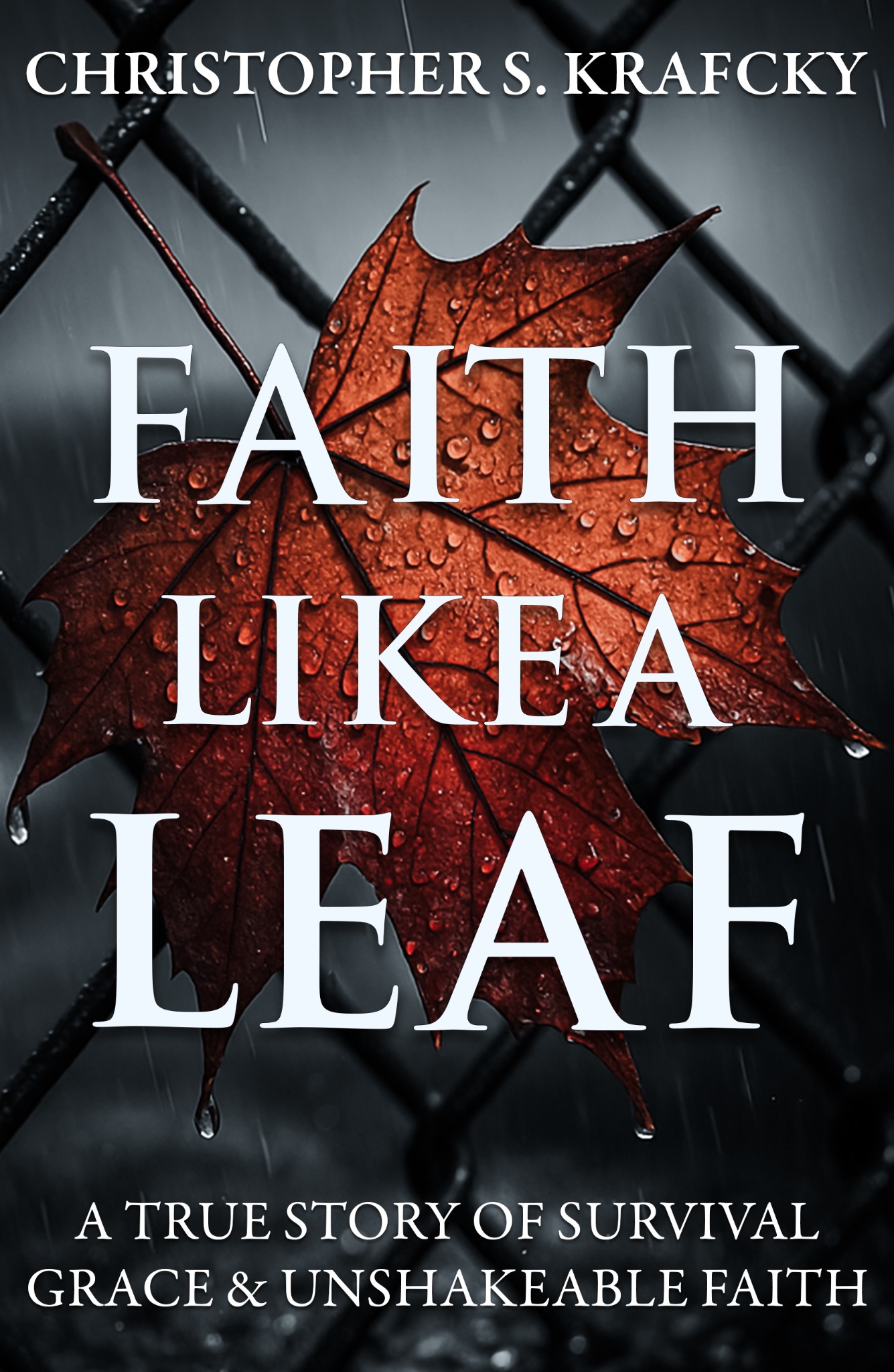
I've carried these stories for years like splinters beneath the skin. You learn to live with them, you learn to walk without limping, but you never really forget the pain. Still, I couldn't shake the image that kept returning to me: a single leaf stuck in a fence after the storm. The wind howled, the rain flooded, everything around it was blown away, but that leaf held. Not because it was strong, not because it was rooted, but because it refused to let go.
That's what this is about.
This isn't a success story. This isn't the kind of Christian book that skips to the victory verse or wraps everything up in a clean devotional takeaway. It's messy. It's broken. It's raw. But it's real.
A life full of trauma, survival, shame, grace, anger, hope, and redemption. Not in a straight line, not with tidy chapters or sanitized faith, but in the kind of story that only makes sense when you finally realize God was there in every crack I clung to.
I didn't write this to impress anyone. I wrote it because I know what it feels like to be forgotten, rejected, and labeled as too damaged to matter. I know what it feels like to wonder if God gave up on you a long time ago. I know what it means to keep going not because you're strong, but because giving up felt worse than holding on.
This isn't your typical Christian memoir either. I won't cover the bleeding with cliché Scripture bandages. I won't skip the hard parts, the shameful parts, or the moments that would make most churches uncomfortable. If you're looking for something tidy and uplifting, you might want to put this book back on the shelf.
Maybe you've felt forgotten. Maybe you've been abandoned, locked away, unwanted, overlooked, or written off. Maybe you've sat in the back of a church or at the edge of a hospital bed, wondering whether God could still use you. If so, then this book is for you.
This book is my scarred-up offering. It's not written from a pulpit or a platform, but from the sidewalk cracks, from the corners of basements, from locked closets and group homes, from hospital beds and secondhand pain, from the moments I should've been lost but wasn't.
Because even when it felt like no one was there, God was. Not always rescuing. Not always fixing it. But always present.
And if there's one thing I've come to believe, it's this: survival is holy. Holding on is worship. Still being here is proof that God hasn't walked away.
You don't need to be cleaned up to be called. You don't need a perfect past to have a purpose. What you need is the courage to be honest about the cracks. The ones where the light broke through. The ones where you gripped with everything you had left just to stay upright. The ones where you thought no one saw you. But God did.
I don't know what storm you've been through. I don't know where your faith has landed. Whether it's barely breathing, stuck in some rusted-out fence, or buried beneath all the wreckage life has thrown at you. But I know this: if you're still here, you're not done yet.
And neither is God.
Acknowledgements
First, to God.
You were there in the silence, in the locked rooms, the sleepless nights, and the years where I felt invisible. You didn't promise it would be easy, and it wasn't. But You never let go. This book isn't a monument to my strength—it's a record of Your presence. If there's light in these pages, it's because You met me in the dark. If there's grace, it's because You never stopped extending it. Every chapter, every scar, every breakthrough is stamped with Your mercy.
To Anna, my wife, my steady place. You are the grounding I never had growing up. You bring me back to earth when my mind starts spinning and my soul feels worn out. You're structure. You're stability. You're the kind of presence I didn't know I needed until God brought you into my life.
We may not walk out faith the same way, but you've supported me in the ways you know how—with grit, love, and a quiet strength that holds more weight than words ever could. You've stood beside this story, even when it wasn't easy to hear, and even when it cost you something. I'll never forget that.
To Tony. You've always believed in this book—not just because you believed in me, but because you saw what this story could do for someone else. I've carried the idea of writing for a long time. A lot of people have told me I should, you included. But when I finally brought it up, you didn't just nod your head—you jumped in, encouraged me, and kept pushing forward with conviction. You've kept saying people need to read this, and you've meant it every time. That's meant more than I've let on.
To those who left. I won't dress it up. You broke something in me. But your rejection also cleared a path for God's voice to grow louder. Your silence created space for grace to speak. I don't carry bitterness. Just clarity. You were part of the wilderness. And that wilderness became holy ground.
To the quiet ones—the ones who whispered truth, offered small prayers, sent a message, dropped a word of encouragement at just the right time. You may never know the impact you had. But I do. You were the handholds when everything else was crumbling. You helped this story live.
And to everyone who stood beside this leaf while it learned to hold on—thank you. This book may carry my name on the cover, but it was shaped by far more than me.
Introduction
I wasn't thinking about writing a book. I was just cleaning the yard.
My backyard backs up to the old Long Island Railroad line—tracks that haven't been used since the sixties. The trees have taken over by now, which is fine by me. It gives us something to look at besides rows of houses. But every fall, every storm, every heavy wind sends leaves tumbling into my yard like they're looking for a place to hide. They pile up in the corners, in the cracks between bricks, under patio chairs, and along the edges of the small fences that divide the garden from everything else.
Some are easy to clear. A quick sweep, a hard spray with the hose, and they're gone. But then there are the others. The ones that wedge themselves deep in the crevices. The ones that wrap around slats of wood like they're hanging on for dear life. I'd try to blow them out. Rinse them off. Kick them free. And still—some of them stayed.
That's when it hit me.
Those leaves were me.
No roots. No tree. No branch holding them in place. Just a stubborn refusal to let go. Just something deep inside that wouldn't release, no matter what came against it. I stood there holding the hose, watching them tremble in the blast of water, and I realized—I know that kind of faith. That kind that holds on, not because it's strong, but because it doesn't know what else to do. That kind that looks weak from the outside but is actually everything keeping you from being swept away.
That's where this book came from.
Faith Like A Leaf doesn't come out of a season of success. It comes from years of trauma, silence, abandonment, running, and survival. I wasn't raised in comfort. I didn't grow up feeling chosen. From the beginning, I was passed off, burned, misdiagnosed, mislabeled, and molded into someone else's idea of who I was supposed to be. When I didn't fit their shape, I was locked away. Forgotten. Then eventually left behind.
But God didn't forget.
I've spent most of my life trying to figure out why I'm still here. And maybe you have too. Maybe you've been hit with storms that should've blown you off the map. Maybe your story is quieter, but the weight still feels unbearable. Maybe you've had your faith swept up, scattered, crushed, or just worn down until you stopped trying. If so, then this book is for you.
Because some people are like those leaves.
They're not strong. They're not flashy.
But they're still here.
This isn't a perfect story. It's a faithful one. It's not about getting it all right. It's about what happens when God meets you in the cracks, not with a miracle, but with enough grace to keep holding on.
So here it is. My story.
Not cleaned up. Not polished. But real.
And maybe somewhere between the pain and the page, you'll find yourself too.
Born Into The Storm
God Sees First, Names Later
Some children are born into peace. I was born into a world already set against me. But even in the beginning, I believe God was there. Watching. Holding. Waiting. Like a gardener kneeling beside broken soil, knowing something would still grow.
Not every child enters life wrapped in warmth. Some of us are born into warzones before we ever learn to walk, talk, or cry out for help. That was my beginning. My biological mother was addicted to heroin and surviving by selling her body. I wasn't her first child. I wasn't even her only secret. I came into the world as a child of the streets, unplanned, unseen, and quickly unloved.
My father, from what little I was told, was likely her pimp. He was a ghost with a name who existed only on paper. Another man who left more damage than memories. By ten months old, I had already been tossed between strangers like loose change. Someone used my back as an ashtray. That's not a metaphor. That's not poetic license. Someone literally put out their cigarette on me.
At ten months old, I was hospitalized with pneumonia and a diagnosis stamped across my chart: "irreversibly brain damaged." A label no child should wear, let alone one who hadn't even learned to crawl. I couldn't sit up. I didn't respond to my mother's voice. I shook, screamed, and rolled my eyes backward. Doctors didn't expect much from me. Truth be told, neither did anyone else.
The woman who gave birth to me was already slipping through the cracks. Living in drug dens and shelters, sometimes leaving me with strangers so she could get high or hustle—sometimes just disappearing. One day she left me with a woman she barely knew, a babysitter named Jessica, and vanished. When she didn't come back, the police were called. That's when the system stepped in.
On July 25, 1973, the State of Illinois took custody of me for "neglect." I was just over a year old, but already the courts were signing papers that said my mother couldn't, or wouldn't, protect me. From that moment forward, I was a ward of the state. That sounds sterile on paper, but what it really meant was this: no stability, no security, no one to tuck me in at night.
I didn't know it then, but God was already working through the cracks.
"Can a mother forget the baby at her breast and have no compassion on the child she has borne? Though she may forget, I will not forget you."
— Isaiah 49:15
That promise wasn't something I had heard—but somehow, I lived it. Even when everyone else gave up, God didn't. I was placed in one foster home, then another, then another. In the early ones, I barely ate. I couldn't chew food like the other kids. I flinched at touch, cried uncontrollably, and showed signs of developmental delay. One family noticed I wasn't normal because I rolled my eyes back and shook randomly. Another thought I might be having seizures. Most didn't keep me long enough to find out.
When I landed in the Johnson home in 1973, I was just a shadow of a boy. Malnourished, cross-eyed, small for my age, and far behind developmentally. But there's one image that still clings to my memory like a faded photograph that won't burn—a red brick house with blue carpet. I don't know whose it was. I don't know how long I was there. But that house stands like a ghost in my childhood, quiet and unmovable, as if God left a landmark in my mind to prove I had passed through.
In a life where most places blurred together like rain on glass, this one detail—those bricks, that carpet—remained. Maybe because it was one of the only things that didn't. But something happened in that home. That house wasn't perfect—but it was planted soil. And maybe for the first time, I started to grow not just as a child—but as a soul.
I believe now it was God's hand, steadying me in silence. That moment of stability was like water to roots I didn't know I had. A whisper of what would become the unshakable faith to come. For eight or nine months, I wasn't moved. For eight or nine months, I wasn't left behind.
That sliver of consistency cracked open something in me. I began chewing food. I started using words. My body, once stiff and slow, started catching up. The boy labeled as retarded started to smile. The boy who had no name began to be called "Chris." Not a case number. Not "that one." Chris.
Then, without warning, I was moved again. The Johnsons had licensing issues, and all the children had to be pulled. I was sent to the Krafcky family on July 29, 1976. They were my fourth placement. I was four years old.
Something about the Krafcky's was different. They were strict, but they saw me. They didn't expect perfection, but they gave me structure. It was the first time I felt like I might belong somewhere. The caseworker said I "quickly became an integral member of their family." I guess that's social worker talk for "he finally exhaled."
When Brian and Heather were placed with us in 1977—siblings who came with behavior problems—I didn't act out. I didn't regress. If anything, I rose. I became "the well-behaved one." It wasn't that I was perfect. I just wasn't about to risk losing the first safe place I'd ever known.
That same year, the Krafcky's adopted an infant named Jessica. Another shift. Another chance for me to fade into the background. But I didn't. Somehow, I still mattered. They wanted to adopt me. Not foster. Not maybe. Not temporary. Legally theirs. Legally someone's.
The case was transferred to the adoption unit. On April 24, 1978, I was legally freed for adoption. On August 18, 1978, I became Christopher S. Krafcky. For the first time in my life, I had a last name that stuck. A name gave me grounding—but I still didn't know who I was.
"Your eyes saw my unformed body; all the days ordained for me were written in Your book before one of them came to be."
— Psalm 139:16
I wasn't an accident. I wasn't a mistake. I was seen long before anyone had called me by name. We lived in Wheeling back then—a quiet suburban town north of Chicago where the houses looked perfect, even if everything inside them wasn't. It was after we moved to Glenview that the cracks began to show. That's when the discipline changed. That's when the shadows got longer. That's when things shifted for real.
There were moments of warmth, sure, but also discipline that crossed lines. When we got in trouble, they'd lock us in closets or send us to the basement. One time, Heather was locked in so long she ate raw potatoes just to keep from going hungry. It became normal to fear silence, to jump at footsteps in the hallway, to wonder if today would be the day you ended up behind a door that wouldn't open.
I lived in a house with walls and rules. But there were no roots, only restraints. And even in that silence, I remember thinking: "Is this what it means to be loved? Or just… owned?" That's when my leaf began to tremble. But it still held on.
Our dog, Gretchen, was a black dachshund who seemed to understand what we were going through. Whenever our parents raised their hands to discipline us, Gretchen would try to bite them in our defense. They had to lock her up whenever punishments were coming. She died after getting hit by a car right in front of our house.
I remember watching it happen. It felt like losing the only one who was trying to protect us. Gretchen couldn't speak, but she fought for us. And I remember wondering—why would God take the one defender I had left?
Now, I see it differently. Maybe He allowed me to feel that loss, so I'd one day understand what it means to be rescued by Someone stronger. Someone who never leaves—even when the defender is gone.
I went to OLPH Catholic School from Kindergarten through 2nd grade. That's Our Lady of Perpetual Help. Ironically named, because I didn't feel much help from anyone. I struggled to fit in. The other kids could sense I didn't belong. I was different. Worn around the edges.
And then there was the thing I couldn't hide, even when I tried. A neurological condition called nystagmus. My eyes danced without music, trembling back and forth like they were afraid to settle. And when they moved, my head followed. Shaking, jerking, trying to compensate.
Try looking someone in the eye when your head won't stop swaying. Try focusing on words when the page won't sit still. Even as a kid, I knew I looked strange. Like I was glitching through real life. I didn't have a name for it then. I just knew people stared. And when they didn't, they avoided me altogether.
I started to believe my head shake was a fence, one that kept people out. To this day, it's why I keep most of my videos faceless. The shake never left… but neither did the shame.
Teachers didn't help much either. One nun dragged me into a coat closet in 1st grade and hit me. I learned quickly that even the people who were supposed to guide you could hurt you behind closed doors.
In 2nd grade, I had my first kiss—a girl named Jenny. Sweet moment. Innocent. One of the few memories from that time that didn't carry bruises.
But that innocence didn't last. One day, I brought some pills to school; plaque pills, they were called. I didn't know what they were. Thought they were candy or something. I gave them to a friend, and they turned his teeth red. I thought it was funny.
The school didn't. I got sent home, and that's when the beatings came. I was expelled after that. Not suspended. Expelled. At just seven years old.
Sometime around then, I got caught stealing from an A&P grocery store. I don't remember what I took—something small. Something a kid might take just to feel like he had something of his own.
The power had gone out, so my adoptive mom had to walk to the store because the garage door wouldn't open. She was livid. When we got home, there was yelling, maybe even a shove—I can't say for sure what hit me—but I remember the sting, the sudden snap of pain, and the bloody nose that followed.
I don't know if it was a fist, a palm, or something else. All I know is—I bled.
And somewhere in that pain, I remember something else just as real. A thought that whispered, "Don't disappear. Don't give up."
I didn't know it yet, but even then, I was already beginning to cling. I remember the look on her face and how small I felt. It wasn't the first time. Wouldn't be the last.
Reflection
Some leaves fall. Others hold on. I didn't choose my family. I didn't choose the trauma. But somehow, I was still there. Through ashtrays and hospital beds, locked closets and false names. God was doing something underground. The cracks didn't crush me. They covered me. Even then, my faith, fragile and unformed, was taking root.
Scripture to Hold
"Before I formed you in the womb I knew you, before you were born I set you apart…"
— Jeremiah 1:5
Encouragement
If you were born into chaos, don't believe the lie that you were a mistake. You are known. You are rooted. And even in the hardest soil, God can grow a leaf that won't let go.