There are questions that sound simple until life makes them personal.
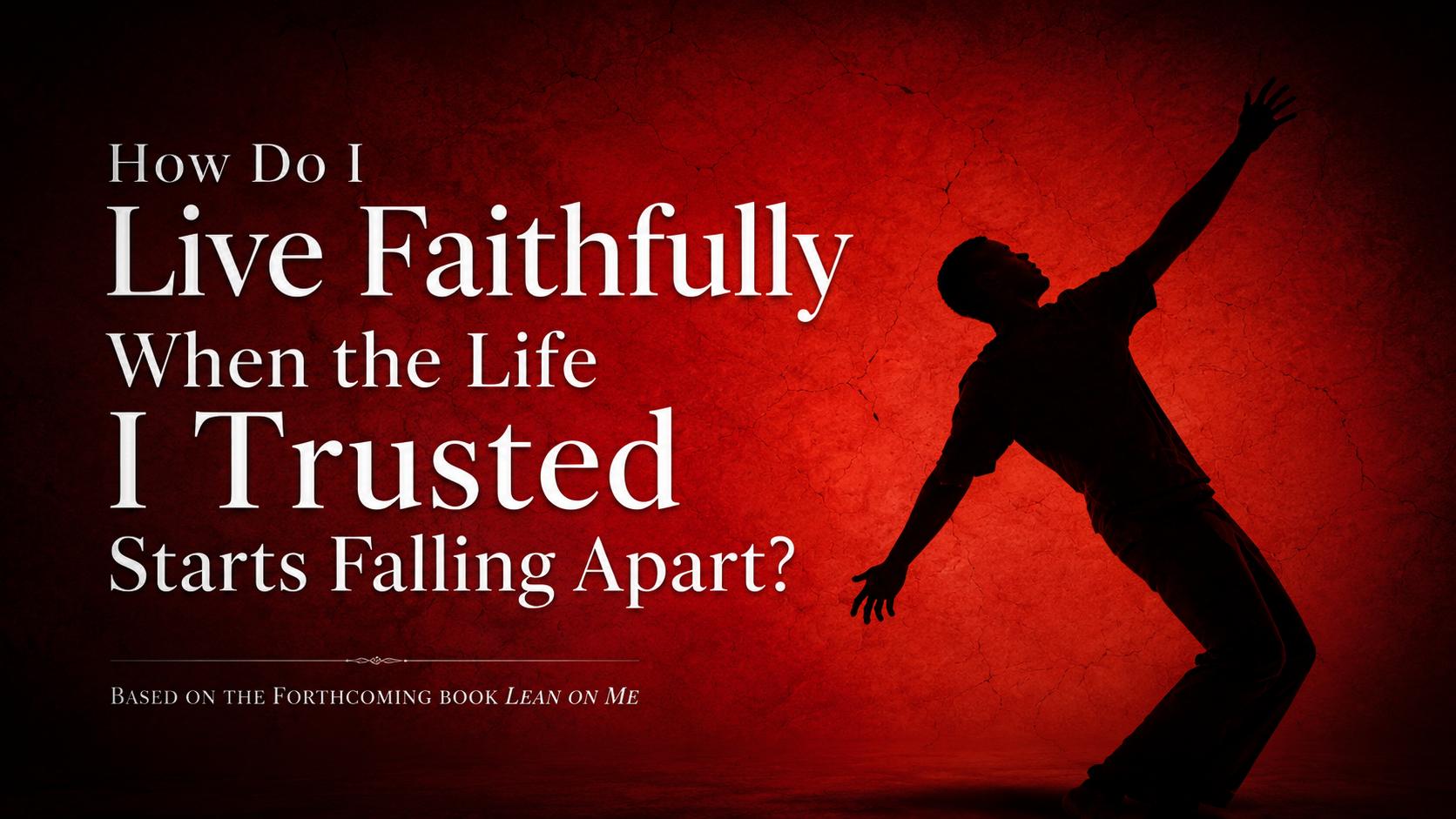
How do I live faithfully when the life I trusted starts falling apart?
That question is easy to discuss when everything feels stable. It’s easier to talk about trusting God when the bills are being paid, the career is moving forward, the future still looks familiar, and the life you imagined still feels within reach. Faith can sound steady when the ground under your feet has not started to move.
The question changes when the thing you leaned on begins to shake.
For me, that thing was my career.
I don’t think I realized how much of my identity was tied to work until I lost the job I had worked so hard to get. In 2022, I was let go from a position that represented more than income. It represented progress. It represented security. It represented years of trying to prove that I had finally built something solid.
When that disappeared, I didn’t just lose a paycheck. I lost the version of my life that made me feel like I was on track.
That’s the part people don’t always see from the outside. Job loss isn’t only about employment. It can touch your confidence, your marriage, your sense of usefulness, and even the way you understand yourself. When you’ve spent years believing that your ability to provide is part of what makes you valuable, unemployment doesn’t just create a financial problem. It creates an identity problem.
I had built a lot of my peace around the belief that if I worked hard enough, stayed responsible enough, and kept moving forward, life would eventually settle into something dependable. I don’t think I would have said it that plainly at the time, but looking back, that’s what was underneath much of it.
The problem is that a career can’t carry the full weight of a person’s identity. Neither can money, a title, a relationship, a plan, or the version of life we thought we were supposed to have by now. Those things may be good, and some of them are necessary, but they were never meant to become the ground beneath us.
That’s why seasons like this are so painful. They don’t just take something from us. They reveal something in us.
For a long time, I thought I was trusting God with my life while still quietly leaning on my ability to keep everything from falling apart. I wanted God involved, but I also wanted enough control to feel safe. I wanted faith, but I also wanted proof that my life was still moving in a direction I could explain.
When applications go unanswered, doors stay closed, and the opportunities in front of you don’t look like the life you thought you were building, that kind of trust gets tested.
This kind of testing often happens quietly. You wake up and check your email. You try to stay encouraged, but the silence gets to you. You pray, but anxiety still shows up. You tell yourself to keep going, yet part of you wonders how much longer you can carry the disappointment without becoming bitter.
That’s where faithfulness becomes much more honest.
I used to think faithfulness meant having a certain strength about me. It meant being steady, confident, and able to say the right thing about God even when life was hard. I’m learning that faithfulness is often less polished than that.
On some days, faithfulness looks like admitting that I’m tired without pretending I’ve given up. At other times, it means telling God the truth instead of trying to sound more spiritual than I feel. There are moments when the most faithful step is simply doing the next responsible thing while my emotions are still catching up.
That matters because a lot of people quietly shame themselves when life gets hard. They assume that feeling shaken means they must not be trusting God enough. I don’t believe that anymore.
Being shaken doesn’t always mean your faith is gone. It may mean the thing you were standing on wasn’t as solid as you thought.
That realization can hurt, but it can also become a mercy. If my worth is tied to my income, then my peace will rise and fall with my employment. If my value depends on a title, then every closed door will feel like a verdict. If my identity rests on being useful, needed, and respected, then any season of weakness will feel like personal failure.
That’s too much pressure for any human life to carry.
The reason this question matters so much to me is because I don’t want to spend the rest of my life only looking faithful when things are going well. I want a faith that can survive the middle of the story, when the outcome isn’t clear yet and the life I wanted doesn’t seem to be coming together the way I hoped.
I also don’t want to rush past the grief of that.
There’s a real grief that comes when your life no longer matches the picture you had in your head. You can be grateful and still disappointed. You can believe God is good and still feel confused. You can know that He provides and still struggle with the form that provision takes.
That last part has been difficult for me.
There are times when the door in front of you doesn’t look like restoration. It looks humbling. It may be honest work, meaningful work, or necessary work, but it still doesn’t look like what you thought all those years of effort were leading toward. When that happens, you have to wrestle with the difference between what God may be providing and what your pride was hoping for.
That’s not an easy thing to say out loud.
I’d rather be able to tell a cleaner story. I’d rather say that I lost something, learned the lesson quickly, and then everything came back better than before. Life hasn’t unfolded that neatly for me. I’m still learning what it means to trust God when I can’t control the timeline, when I don’t fully understand the path, and when the next step feels smaller than the future I had imagined.
Even so, I keep coming back to this thought: faithfulness in a falling-apart season may begin with telling the truth about what we were actually leaning on.
That kind of honesty doesn’t make us less spiritual. It makes room for God to meet us in the real place, not the edited version we present because we think that’s what faith is supposed to sound like.
I don’t think God is threatened by our honesty. He already knows when we’re afraid. He knows when we feel embarrassed, tired, angry, confused, or disappointed. He knows when we’re trying to keep it together in front of people while privately wondering what happened to the life we thought He was building.
Psalm 46 says that God is our refuge and strength, a present help in trouble. I’ve heard that verse many times, but it feels different when trouble isn’t theoretical. It means God is not only present after the resolution. He is present while the question is still open.
That doesn’t remove every fear, at least it hasn’t for me. It does, however, challenge the idea that God’s faithfulness can only be measured by how quickly my circumstances improve.
I’m learning that His presence in the middle matters too.
The middle is where a lot of us actually live. We’re between what happened and what comes next. We’re trying to make wise choices with incomplete information. We’re carrying responsibilities while still processing disappointment. We’re asking God for direction while also dealing with the very human pressure of bills, expectations, emotions, and relationships.
That’s why I don’t want to write about faith as if real life never gets complicated.
Faith has to meet us in the places where people actually struggle. It has to speak to the job loss, the silence, the fear of starting over, the ache of feeling like you should be further along by now, and the quiet questions that come when God allows something to be removed that you thought was holding your life together.
Maybe something you trusted has started to shake, and you’re trying to figure out what faithfulness looks like now. You still believe in God, but you’re tired. You still want to trust Him, but you’re disappointed. You still want to move forward, but the path in front of you feels different from the one you thought you were walking.
I don’t have a simple formula for that.
What I do have is a growing conviction that God can be trusted with the version of us that doesn’t have everything figured out. He can be trusted with our fear, our disappointment, our questions, and our unfinished stories. He can meet us in the place where our crutches fail and begin teaching us how to stand in a way we never could before.
That is the why behind this reflection.
I’m not writing from a perfect ending. I’m writing because there is value in telling the truth while the story is still unfolding. Someone else may need to know that feeling shaken doesn’t mean they’ve failed, and needing God in a deeper way is not a sign of weakness.
It may be the beginning of something more honest.
So, if the life you trusted is starting to fall apart, I hope you’ll be gentle with yourself. Pay attention to what the pain is revealing, but don’t let shame have the final word. Let the loss tell the truth, but don’t let it define your worth.
God is still present in the middle.
I’m learning that slowly, and I’m still learning it imperfectly. But maybe that’s where real faithfulness begins, not in having a life that never shakes, but in discovering that God is still there when it does.
Scripture Anchor:
“God is our refuge and strength, a very present help in trouble.”
— Psalm 46:1
Based on the forthcoming book Lean On Me.
Reader List
Want the next note when it drops?
Join the reader list for new posts, early excerpts, and release updates—delivered with purpose, not noise.